
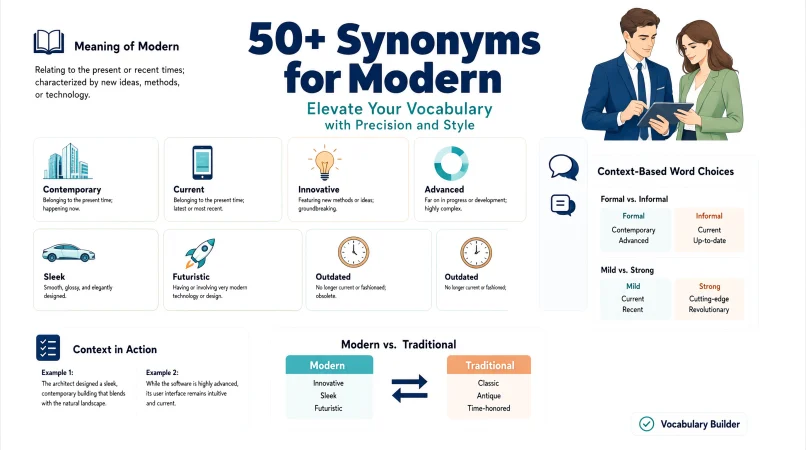
Modern means relating to the present time or reflecting recent ideas, styles, or developments. Common synonyms include contemporary, current, up to date, innovative, advanced, and cutting edge. Choose contemporary for style, current for present relevance, and innovative for something that introduces new ideas or methods.
Do you find yourself using the word modern repeatedly in essays, website content, product descriptions, business emails, resumes, or social media captions? Although it is a useful adjective, repeating it can make your writing sound predictable and less descriptive.
The best synonyms for modern depend on what you want to express. A contemporary building reflects current design trends, a cutting edge technology leads innovation, and an up to date report contains the latest information.
This guide explains more than 50 useful alternatives, with practical examples, tone differences, and recommendations for academic, professional, casual, and creative writing. You will learn how to choose words that communicate your intended meaning without sacrificing clarity or natural American English.
Meaning, Tone and Context
1. Simple Definition
Modern describes something associated with the present time, recent developments, or ways of thinking that differ from older traditions.
For example, a modern office may feature open workspaces and digital tools, while a modern teaching method may use interactive lessons and online resources.
The word can describe appearance, technology, architecture, lifestyles, ideas, and systems.
2. Part of Speech
Modern is primarily an adjective. It describes a noun by indicating its relationship to the present age, a particular historical period, or newer approaches.
Examples:
- Modern architecture emphasizes clean lines and functional spaces.
- The company introduced a modern payment system.
- Her writing reflects a modern perspective on family life.
3. Tone and Connotation
Modern is generally neutral, but it can suggest progress, sophistication, convenience, or innovation.
In some contexts, it may imply that older methods are less practical. However, modern does not automatically mean better, more effective, or more advanced.
4. Formality Level
Modern is suitable for formal and informal communication. It appears naturally in academic essays, marketing copy, professional reports, conversations, and product descriptions.
For more precise writing, select an alternative that explains what makes something modern. For instance, innovative emphasizes originality, while contemporary emphasizes connection to the present period.
5. Common Use Cases
The word frequently appears in these contexts:
- Technology and software.
- Architecture and interior design.
- Education and teaching methods.
- Business strategies and workplace practices.
- Fashion, art, and culture.
- Healthcare and scientific developments.
- Websites, branding, and digital marketing.
- Lifestyles and social attitudes.
6. Related Word Forms
| Word | Part of speech | Meaning | Example |
| Modern | Adjective | Related to the present age or newer approaches | The office has a modern design. |
| Modernity | Noun | The condition or characteristics of being modern | The novel explores modernity and social change. |
| Modernize | Verb | To update something using newer methods or features | The company plans to modernize its website. |
| Modernization | Noun | The process of making something more modern | Modernization improved the hospital’s equipment. |
| Modernized | Adjective or past participle | Updated to use newer methods or features | The modernized library offers digital resources. |
| Modernism | Noun | A movement that challenged traditional forms, especially in art and literature | Modernism changed the direction of twentieth century literature. |
Modern, contemporary, and innovative overlap, but they are not interchangeable in every sentence. Understanding their differences will help you choose the most accurate word.
When and How to Use “Modern”
Use modern when describing something associated with the present age, newer styles, or approaches that differ from traditional ones.
Choose a more specific synonym when you want to emphasize originality, technical progress, current relevance, or a particular design style.
Here are seven realistic examples.
- Professional: “Our company is adopting modern management practices to improve collaboration.”
- Academic: “The research examines modern approaches to language learning.”
- Personal: “We chose a modern home with plenty of natural light.”
- Email: “Please review the modern design concept before tomorrow’s meeting.”
- Social media: “A modern space with simple details and timeless character.”
- Resume: “Experienced in modern digital marketing strategies and analytics tools.”
- Creative writing: “The city blended modern architecture with historic streets.”
Notice that modern describes different things in these sentences. In the workplace, it may refer to updated practices. In design, it may describe a visual style. Also In academic writing, it may identify an approach associated with the present era.
Another Word for “Modern”
The best single replacement for modern is usually contemporary when you mean something connected to the present time. However, the most accurate alternative depends on the sentence.
| Situation | Best alternative | Example |
| Professional writing | Contemporary | We introduced contemporary management practices. |
| Academic writing | Current | The paper examines current educational trends. |
| Casual conversation | New | They bought a new coffee maker with smart features. |
| Emotional writing | Progressive | She has a progressive outlook on relationships. |
| Creative writing | Futuristic | The story takes place in a futuristic city. |
| Resume or workplace use | Up to date | Maintained up to date knowledge of industry standards. |
| Social media captions | Sleek | A sleek interior with a fresh, modern feel. |
| Stronger meaning | Cutting edge | The laboratory uses cutting edge imaging technology. |
| Softer meaning | Contemporary | The room has a contemporary look without feeling overly trendy. |
How to Choose the Best Replacement
Contemporary is a strong general alternative, especially for art, design, culture, and ideas.
Current works when information or circumstances are relevant now. Innovative is better when something introduces original ideas. Advanced highlights a high level of development, while sleek describes a smooth, streamlined appearance.
Avoid choosing a synonym simply because it sounds impressive. A word should express the specific quality you want to communicate.
When Not to Use “Modern”
Although modern is versatile, it can be too broad when a sentence needs more detail.
1. When You Mean the Latest Information
Instead of: “We need a modern report on customer preferences.”
Write: “We need an up to date report on customer preferences.”
The second sentence makes it clear that the information must be current.
2. When You Mean Original Ideas
Instead of: “The company introduced a modern solution.”
Write: “The company introduced an innovative solution.”
Use innovative when the solution introduces a new idea, method, or approach. A modern solution is not necessarily innovative.
3. When You Mean Technical Sophistication
Instead of: “The hospital installed modern equipment.”
Write: “The hospital installed advanced diagnostic equipment.”
Advanced emphasizes technical development rather than simply indicating that the equipment is new.
4. When You Mean a Specific Design Style
Instead of: “They decorated the apartment in a modern style.”
Write: “They decorated the apartment in a minimalist style.”
Use minimalist when the design emphasizes simplicity and limited decoration. Not every modern interior is minimalist.
5. When You Mean Future Oriented
Instead of: “The movie features modern technology.”
Write: “The movie features futuristic technology.”
Futuristic describes designs or concepts that suggest an imagined future, not necessarily technology currently in use.
6. When You Mean Social Progress
Instead of: “She has modern views on education.”
Write: “She has progressive views on education.”
Progressive can indicate support for reform or social change. It is more specific and may carry political or ideological associations depending on context.
Words Commonly Confused With “Modern”
Several related words describe different aspects of newness, time, design, or development.
| Word | Main difference | Best used for |
| Contemporary | Connected to the present time or period being discussed | Art, culture, architecture, and ideas |
| Current | Existing or relevant now | Information, events, and circumstances |
| Recent | Happening or appearing not long ago | Changes, discoveries, and events |
| Innovative | Introducing original ideas or methods | Products, services, and strategies |
| Advanced | Highly developed in capability or complexity | Technology, equipment, and techniques |
| Futuristic | Suggesting an imagined future | Fiction, design concepts, and speculative technology |
For example, a recent invention was developed not long ago. An innovative invention introduces something original. An advanced invention may offer sophisticated capabilities. These descriptions can overlap, but each emphasizes a different quality.
Best Synonym by Context for “Modern”
Use this table to select the most suitable alternative for different writing situations.
| Context | Best synonym | Why it works | Example |
| Formal writing | Contemporary | Sounds precise and professional | The report examines contemporary business practices. |
| Academic writing | Current | Highlights present relevance | The study considers current approaches to literacy. |
| Professional or business use | Innovative | Emphasizes original solutions | The company developed an innovative workflow. |
| Resume | Up to date | Communicates current knowledge | Maintained up to date knowledge of compliance standards. |
| Casual conversation | New | Simple and natural | We found a new restaurant downtown. |
| Creative writing | Futuristic | Creates a sense of the imagined future | A futuristic skyline dominated the horizon. |
| Emotional tone | Progressive | Suggests openness to change | Her progressive outlook encouraged honest conversations. |
| Strong intensity | Cutting edge | Emphasizes leading development | The center conducts cutting edge research. |
| Soft or moderate tone | Contemporary | Suggests present day relevance without exaggeration | The home features contemporary furnishings. |
| Social media captions | Sleek | Highlights clean visual design | Sleek details, natural light, and open spaces. |
| Architecture | Modernist | Refers to a particular design movement | The museum features modernist architecture. |
| Technology | Advanced | Emphasizes technical capability | The clinic uses advanced imaging systems. |
| Fashion | Trendy | Reflects current popular styles | She wore a trendy jacket to the event. |
| Website design | Responsive | Describes layouts that adapt to screen sizes | The business launched a responsive website. |
| Information and data | Up to date | Emphasizes accuracy in relation to the present | Keep your contact information up to date. |
| US and UK English | Contemporary | Widely understood in both varieties | The gallery displays contemporary art. |
One important distinction: modernist often refers to a specific movement in art, architecture, or literature. It is not a general replacement for every use of modern.
Which Synonym Should You Choose?
Use these five questions to identify the best alternative.
- What do you mean by modern? If you mean present day, choose contemporary. If you mean recently updated, choose up to date. If you mean original, choose innovative.
- How formal is your writing? Academic essays often benefit from contemporary or current. Everyday conversation may sound more natural with new.
- How strong should the word sound? Advanced and cutting edge can suggest substantial technical development. Use them only when the description is justified.
- What impression should the reader receive? Sleek suggests a streamlined appearance, while progressive suggests openness to reform.
- Does the replacement preserve the meaning? Read the full sentence after substituting the word. If the new term introduces an unsupported claim, choose a more neutral alternative.
The simplest rule is to identify the quality that makes something modern, then name that quality directly.
Real Life Examples of “Modern” in Sentences
The following examples demonstrate how related words can make writing more specific.
| Situation | Example sentence |
| School | Our teacher uses contemporary examples to explain historical concepts. |
| Workplace | The team adopted innovative methods to improve customer service. |
| Writing | The novel explores current debates about privacy and technology. |
| Conversation | Their new kitchen looks sleek and inviting. |
| Social media | Contemporary design, warm textures, and simple details. |
| Resume | Applied current digital marketing practices to improve campaign performance. |
| Please ensure that the figures in the attached report are up to date. | |
| Storytelling | Beyond the old stone walls stood a futuristic city filled with glowing towers. |
| Product description | The laptop combines a sleek design with advanced security features. |
| Business presentation | Our strategy reflects contemporary customer expectations and emerging market needs. |
These examples also demonstrate an important writing principle: specificity is more useful than replacing a word with a more complicated one.
25 Synonyms for “Modern”
The word modern can describe something related to the present time, influenced by current trends, or developed using the latest technology. Depending on the context, synonyms for modern may emphasize innovation, contemporary style, advanced features, or forward-thinking attitudes.
The following 25 alternatives include simple meanings, common uses, and example sentences to help you choose the most appropriate word.
Common Synonyms for Modern
These words are useful when discussing the present time, recent developments, or information that reflects current conditions.
| Synonym | Simple Meaning | Best Used For | Example Sentence |
|---|---|---|---|
| 1. Contemporary | Related to the present time | Art, culture, design | The gallery features contemporary paintings. |
| 2. Current | Relevant or existing now | Information, trends | We reviewed current industry standards. |
| 3. Present-day | Belonging to the time we live in | History, society | Present-day communication relies heavily on digital tools. |
| 4. Up-to-date | Updated with the latest information or developments | Records, knowledge, systems | The database contains up-to-date customer details. |
| 5. New | Recently created, introduced, or acquired | Products, ideas, methods | The school introduced a new learning platform. |
| 6. Recent | Happening or appearing not long ago | Discoveries, events | Recent research has changed the discussion. |
Synonyms for Modern Technology and Innovation
Use these terms when describing advanced equipment, new inventions, digital services, or developments that improve existing methods.
| Synonym | Simple Meaning | Best Used For | Example Sentence |
|---|---|---|---|
| 7. Innovative | Introducing original ideas or methods | Business, products | The startup developed an innovative payment system. |
| 8. Advanced | Highly developed in function or capability | Technology, science | The laboratory uses advanced testing equipment. |
| 9. Cutting-edge | At the forefront of development | Research, technology | The institute invests in cutting-edge robotics. |
| 10. State-of-the-art | Incorporating the most advanced available features | Facilities, equipment | The hospital opened a state-of-the-art treatment center. |
| 11. High-tech | Involving sophisticated technology | Products, workplaces | The company built a high-tech production facility. |
| 12. Digital | Using electronic or computer-based technology | Services, communication | The library offers digital resources. |
| 13. Novel | New or original in a particular context | Research, ideas | The researchers proposed a novel approach to treatment. |
| 14. Modernized | Updated using newer methods or features | Buildings, systems | The modernized library now offers online services. |
Synonyms for Modern Style and Design
These words describe contemporary appearances, popular styles, and design choices associated with modern aesthetics.
| Synonym | Simple Meaning | Best Used For | Example Sentence |
|---|---|---|---|
| 15. Trendy | Reflecting current popular tastes | Fashion, lifestyle | The cafe has a trendy interior. |
| 16. Fashionable | Popular or stylish at a particular time | Clothing, design | She selected fashionable accessories for the event. |
| 17. Contemporary-styled | Designed with a present-day aesthetic | Interiors, branding | They chose contemporary-styled furniture for the office. |
| 18. Sleek | Smooth, streamlined, and visually polished | Products, interiors | The phone has a sleek appearance. |
| 19. Minimalist | Characterized by simplicity and limited decoration | Design, art | A minimalist layout makes the website easier to navigate. |
| 20. Futuristic | Suggesting an imagined future | Fiction, architecture | The film features futuristic vehicles. |
| 21. Reimagined | Redesigned or reconsidered in a new way | Branding, creative projects | The company introduced a reimagined version of its classic product. |
Synonyms for Modern Attitudes and Thinking
These expressions describe people, policies, or approaches that support progress, consider future needs, or embrace change.
| Synonym | Simple Meaning | Best Used For | Example Sentence |
|---|---|---|---|
| 22. Progressive | Favoring progress, improvement, or reform | Policies, attitudes | The organization supports progressive educational practices. |
| 23. Reform-minded | Inclined to support changes or improvements | Leadership, policy | The reform-minded director proposed new procedures. |
| 24. Forward-thinking | Considering future needs and possibilities | Strategy, leadership | Her forward-thinking approach helped the team prepare for growth. |
| 25. Contemporary-minded | Having attitudes or preferences associated with the present era | People, culture | The contemporary-minded designer draws inspiration from changing lifestyles. |
How to Choose the Right Synonym for “Modern”
The best synonym depends on the noun you are describing and the message you want to communicate.
- For current information: Use current, recent, or up-to-date.
- For advanced technology: Choose cutting-edge, advanced, or state-of-the-art.
- For contemporary design: Use sleek, minimalist, or contemporary.
- For new ideas: Choose innovative or novel.
- For progressive attitudes: Use forward-thinking or progressive.
- For a future-inspired appearance: Choose futuristic.
Remember that these expressions are not interchangeable in every situation. Digital refers to technology, minimalist describes simplicity, and futuristic suggests an imagined future. Matching the synonym to the context makes your writing more precise, natural, and effective.
Synonym Groups and Usage Differences
Professional vs. Personal Synonyms
Professional writing benefits from words that explain a concrete improvement or capability. Innovative, advanced, current, and up to date are useful when discussing business systems, industry knowledge, technology, and workplace practices.
Personal writing may benefit from more descriptive language. Sleek, trendy, contemporary, and futuristic help communicate appearance, taste, or atmosphere.
Examples:
Professional: “The organization introduced an innovative training program.”
Personal: “We decorated the apartment with sleek furniture and contemporary artwork.”
The first emphasizes originality. The second describes visual style.
Formal vs. Conversational Synonyms
| Formal expression | Conversational alternative |
| Contemporary | Modern or current |
| Innovative | New or original |
| Advanced | Highly developed |
| Up to date | Updated or current |
| Progressive | Open to change |
| State of the art | Equipped with the latest technology |
Formal language is especially useful in research papers, reports, proposals, and business presentations. Conversational language works better when communicating quickly or explaining an idea to a general audience.
Remember that state of the art makes a strong claim about the level of development. Do not use it merely because something is new.
Academic Synonyms
Academic writing requires accuracy about time periods, evidence, and the nature of an idea.
Use contemporary when referring to present day culture, scholarship, or artistic practice. Use current for information or conditions that apply now. Choose recent when emphasizing that a development occurred not long ago.
Innovative and novel are appropriate when an idea or method introduces something original. However, originality should be supported by evidence rather than assumed.
Example: “The researchers developed a novel method for analyzing language patterns.”
This sentence is more precise than “The researchers developed a modern method” if the method’s originality is the important point.
Professional and Business Synonyms
Different business situations call for different alternatives.
| Business purpose | Recommended word | Example |
| Introducing a new solution | Innovative | We introduced an innovative customer support process. |
| Describing technical capability | Advanced | The company uses advanced analytics software. |
| Updating information | Current | Please review the current pricing structure. |
| Improving outdated systems | Modernized | The modernized platform reduces manual work. |
| Discussing future strategy | Forward thinking | A forward thinking strategy can help prepare for market changes. |
| Describing product appearance | Sleek | The product has a sleek, user friendly interface. |
| Describing new equipment | State of the art | The facility features state of the art testing equipment. |
For resumes, demonstrate what you accomplished rather than relying on adjectives alone.
Instead of writing “Experienced in modern business methods,” try “Implemented updated reporting procedures that reduced manual data entry.” The second statement communicates a specific contribution, provided the claim is accurate.
Creative or Literary Synonyms
Creative writing often benefits from descriptive alternatives that establish atmosphere or reveal a particular quality.
Futuristic suggests an imagined future. Sleek creates an impression of streamlined elegance. Novel emphasizes originality, while reimagined suggests that something familiar has been transformed.
Example: “The architect reimagined the abandoned factory as a sleek cultural center with futuristic lighting.”
Each word adds a different detail. Together, they help readers visualize the setting.
Slang or Modern Synonyms
The word modern can describe trends, but modern slang is not automatically a synonym for it.
Expressions such as trendy, cool, and stylish may work in casual conversation when describing popular designs, clothing, or lifestyles. However, they do not mean exactly the same thing.
For example, something can be modern without being trendy, and something can be cool without being new.
Avoid slang in academic writing or formal business communication unless the tone and subject specifically call for it.
Strongest vs. Weaker Synonyms
The following scale shows how strongly some alternatives suggest innovation or development. It is a practical guide, not an absolute ranking of word meanings.
Mild or general
New, contemporary, current
Indicates recentness or present day relevance.
Updated or improved
Up to date, modernized, progressive
Suggests revision, development, or change.
Strongly innovative
Innovative, advanced, forward thinking
Highlights originality, capability, or future planning.
Leading edge
Cutting edge, state of the art
Suggests a leading level of technological development.
Use the strongest expressions only when the facts justify them. A recently updated website is not necessarily cutting edge.
Emotional vs. Neutral Synonyms
Most alternatives for modern are neutral, but some convey approval or a particular attitude.
| Neutral expression | Additional implication |
| Contemporary | Connected to the present period |
| Current | Relevant at this time |
| Up to date | Updated and not outdated |
| Innovative | Original and potentially valuable |
| Progressive | Favoring progress or reform |
| Trendy | Popular at the moment |
| Futuristic | Suggestive of an imagined future |
| Cutting edge | At the forefront of development |
Use neutral language when describing facts. Choose expressive alternatives when you want to communicate a specific impression, but avoid implying that newer is always better.
Antonyms of “Modern”
The opposite of modern depends on the context in which the word is used. When it refers to the present era, ancient or old-fashioned may be appropriate. When it describes technology, equipment, or methods, outdated, antiquated, or obsolete may be more accurate.
The following 15 contrasting terms cover different meanings of modern. They are contextual opposites rather than exact antonyms in every sentence.
Antonyms Related to Age and History
These words describe things that belong to an earlier period or have existed for a long time.
| Antonym | Meaning | Example Sentence |
|---|---|---|
| 1. Ancient | Belonging to the distant past | The museum displays ancient pottery. |
| 2. Old-fashioned | Following styles or attitudes associated with an earlier period | He prefers old-fashioned furniture. |
| 3. Old | Existing for a long time | They restored an old farmhouse. |
| 4. Archaic | Extremely old-fashioned, especially in language or systems | The document contains archaic expressions. |
| 5. Antiquated | Old and no longer suitable for current needs | The office still uses antiquated filing procedures. |
Antonyms Related to Outdated Technology and Methods
These expressions are useful when discussing devices, systems, information, or practices that no longer meet current standards.
| Antonym | Meaning | Example Sentence |
|---|---|---|
| 6. Outdated | No longer current or appropriate | The website contains outdated information. |
| 7. Obsolete | No longer used because something more suitable has replaced it | The company retired its obsolete equipment. |
| 8. Dated | Looking as if it belongs to an earlier period | The room has dated wallpaper. |
| 9. Behind the times | Not keeping up with current developments | The company risked falling behind the times. |
| 10. Rudimentary | At an early stage of development or lacking later refinements | The exhibit explains rudimentary tools used by early communities. |
Antonyms Related to Tradition and Established Practices
These words describe customs, styles, or approaches that follow established ideas rather than newer developments.
| Antonym | Meaning | Example Sentence |
|---|---|---|
| 11. Traditional | Based on established customs or practices | The family follows traditional cooking methods. |
| 12. Conventional | Following established or widely accepted practices | The school uses conventional teaching methods. |
| 13. Conservative | Favoring established traditions or gradual change, depending on context | The organization adopted a conservative approach to redesign. |
Terms Related to Older Styles and Lack of Change
These expressions can describe something that resembles an earlier period or has remained the same over time.
| Antonym | Meaning | Example Sentence |
|---|---|---|
| 14. Retro | Deliberately styled to resemble an earlier period | The cafe has a retro interior. |
| 15. Unchanged | Remaining as it was without modification | The original process has remained unchanged for decades. |
How to Choose the Right Antonym for “Modern”
The best antonym depends on what you want to describe.
- For historical objects: Use ancient or old.
- For outdated technology: Choose obsolete or outdated.
- For old-fashioned styles: Use dated or old-fashioned.
- For established customs: Choose traditional or conventional.
- For something that fails to keep up with current trends: Use behind the times.
Remember that retro is not necessarily negative because it often describes an intentional return to an older style. Similarly, traditional can express cultural value rather than a lack of modernity. Choosing the right word helps make your writing more accurate and natural.
Comparison: Modern vs. Similar Words
Modern vs. Contemporary
Main difference: Modern can refer to the present age or to newer approaches and styles. Contemporary generally means belonging to the same period as the present or another specified period.
Which is stronger? Neither is inherently stronger.
Which is more formal? Both are suitable for formal writing.
Examples:
- “The company introduced a modern office layout.”
- “The gallery displays contemporary American art.”
Use contemporary when the connection to a particular period matters.
Modern vs. Current
Main difference: Modern often describes a style, approach, or historical period. Current emphasizes what exists or applies now.
Which is stronger? Neither is stronger, but current is more specific about present relevance.
Which is more formal? Both are appropriate in professional communication.
Examples:
- “The hotel features modern interiors.”
- “Please check the current hotel rates.”
Use current for information, prices, circumstances, and active trends.
Modern vs. Recent
Main difference: Modern describes a relationship to the present age or newer approaches. Recent means something happened or appeared not long ago.
Which is stronger? Neither is stronger.
Which is more formal? Both work in formal writing.
Examples:
- “Modern medicine uses a wide range of diagnostic methods.”
- “Recent research has examined new diagnostic methods.”
Use recent when timing is important.
Modern vs. Innovative
Main difference: Modern may simply mean contemporary or updated. Innovative specifically suggests introducing an original idea, method, or solution.
Which is stronger? Innovative makes a stronger claim about originality.
Which is more formal? Both are professional, but innovative communicates a more specific quality.
Examples:
- “The business uses modern software.”
- “The business developed an innovative software solution.”
A product can be modern without being innovative.
Modern vs. Advanced
Main difference: Modern relates to the present era or newer approaches. Advanced emphasizes a high degree of development, capability, or complexity.
Which is stronger? Advanced often makes a stronger claim about capability.
Which is more formal? Both are appropriate in technical and professional writing.
Examples:
- “The clinic has a modern interior.”
- “The clinic uses advanced diagnostic equipment.”
Use advanced when technical sophistication matters more than appearance or age.
Modern vs. Futuristic
Main difference: Modern describes present day or newer styles and methods. Futuristic suggests what the future might look like.
Which is stronger? Futuristic often creates a more imaginative impression.
Which is more formal? Both can be used professionally, depending on the context.
Examples:
- “The architect designed a modern residential building.”
- “The architect proposed a futuristic building with an experimental shape.”
Use futuristic for imagined designs, science fiction, or concepts that look ahead rather than describe the present.
Common Phrases and Expressions with “Modern”
1. Modern Way of Thinking
Meaning: An approach to ideas that reflects contemporary attitudes or newer perspectives.
Example sentence: “Her modern way of thinking helped the team reconsider its assumptions.”
2. Modern Way of Life
Meaning: The habits, expectations, and activities associated with present day society.
Example sentence: “Digital communication has changed the modern way of life.”
3. Modern Technology
Meaning: Technology associated with recent developments or current methods.
Example sentence: “Modern technology allows students to access learning resources from home.”
4. Modern Society
Meaning: Society as it exists in the present era or a specified modern period.
Example sentence: “Privacy has become an important concern in modern society.”
5. Modern Architecture
Meaning: Architecture associated with modern design principles or, in a narrower sense, the Modernist movement.
Example sentence: “The building combines modern architecture with sustainable materials.”
6. Modern Approach
Meaning: A method that reflects newer practices, ideas, or developments.
Example sentence: “The school adopted a modern approach to teaching writing.”
7. Modern Workplace
Meaning: A workplace shaped by current tools, practices, expectations, or organizational structures.
Example sentence: “A modern workplace often relies on digital collaboration tools.”
8. Modern Design
Meaning: Design associated with modern styles or contemporary approaches, depending on context.
Example sentence: “The brand uses modern design to create a clean, consistent identity.”
These phrases are useful in everyday English, but a more specific expression may improve technical or academic writing.
Common Mistakes to Avoid
1. Using “Modern” When You Mean “New”
Something can be new without representing a modern style or approach.
Instead of “They bought a modern car yesterday,” write “They bought a new car yesterday” if the only relevant fact is that they recently purchased it.
2. Confusing “Modern” With “Innovative”
Modern does not automatically mean original. An established product can have a modern appearance without introducing anything new.
Use innovative when a product or method genuinely introduces an original idea or approach.
3. Using Casual Synonyms in Formal Writing
Words such as trendy and cool may suit social media captions, but they can weaken the precision of an academic paper.
For formal writing, choose contemporary, current, or advanced according to the intended meaning.
4. Using an Overly Dramatic Synonym
Cutting edge and state of the art suggest a high level of development. Using these terms for an ordinary update may exaggerate the facts.
Choose updated or modernized when something has simply been improved or refreshed.
5. Repeating “Modern” Too Often
Repeated use can make product descriptions, articles, and business reports feel monotonous.
Vary your vocabulary with accurate alternatives such as contemporary, sleek, innovative, and current. Do not substitute words mechanically when their meanings differ.
6. Choosing the Wrong Emotional Tone
Progressive can suggest support for reform, while trendy emphasizes popularity. Neither is a universal replacement for modern.
Consider the impression you want to create before selecting an alternative.
7. Using Trendy Language in Technical Writing
Words such as futuristic can be useful in creative descriptions, but they may be misleading in a technical report about existing technology.
Use advanced for technical capability, current for present relevance, and innovative for genuine originality.
FAQs
1. What is the best synonym for modern?
The best general synonym for modern is contemporary. Use current for present relevance, innovative for originality, and advanced for sophisticated technology or capabilities.
2. What is a formal synonym for modern?
Contemporary is a strong formal alternative, particularly in academic and professional writing. Current is more appropriate when describing present conditions, information, or industry standards.
3. What is an informal synonym for modern?
New is a simple informal alternative when something has recently appeared or been introduced. Trendy and sleek work when describing popular styles or streamlined appearances.
4. What is another word for modern in professional writing?
Use contemporary for present day practices, innovative for original solutions, and up to date for current information. Choose the word that accurately reflects your intended meaning.
5. What is the difference between modern and contemporary?
Modern can describe present day approaches, newer styles, or a historical period. Contemporary usually emphasizes belonging to the present time or the same period being discussed.
6. What is the opposite of modern?
Common opposites include old fashioned, outdated, antiquated, and obsolete. Use old fashioned for earlier styles, outdated for information or practices, and obsolete for things no longer useful or in use.
Conclusion
The word modern describes something associated with the present age, newer approaches, or recent developments. Its best synonyms depend on whether you mean current, stylish, innovative, technologically advanced, or future oriented.
Use contemporary for present day styles and ideas, current for information that applies now, innovative for original solutions, and advanced for sophisticated capabilities. For design and creative writing, sleek, minimalist, and futuristic offer more specific descriptions.
The most effective vocabulary choice is the one that communicates your meaning accurately. Before replacing modern, ask yourself what makes the subject modern. Is it new, original, technologically advanced, or simply fashionable? Answering that question will help you write with greater clarity and confidence.