
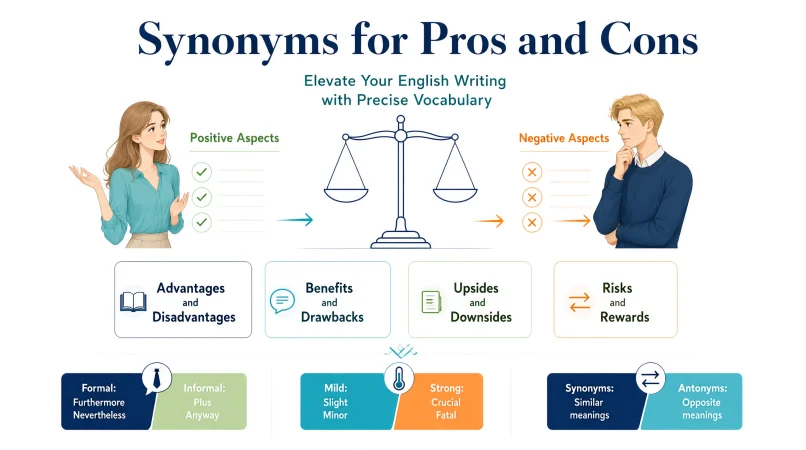
“Pros and cons” means the positive and negative aspects of a decision, situation, product, or idea. The best alternatives include advantages and disadvantages for formal writing, benefits and drawbacks for balanced analysis, and upsides and downsides for casual conversation.
Do you find yourself writing “pros and cons” repeatedly in essays, work emails, blog posts, presentations, or social media captions? Although this familiar expression is clear and useful, choosing more precise alternatives can make your writing sound more professional, persuasive, and natural.
The best synonyms for pros and cons depend on what you want to communicate. An academic essay may need advantages and disadvantages, a business report may call for benefits and drawbacks, and a decision making discussion may be clearer with risks and rewards.
This guide explains more than 50 useful alternatives, their meanings, differences, tones, and real world applications. You will also learn which expressions work best in formal writing, everyday conversation, academic assignments, professional communication, and creative content.
Meaning, Tone and Context
Simple Definition
The expression pros and cons refers to the favorable and unfavorable sides of something. It helps people evaluate choices, compare options, and make informed decisions.
For example, when considering a new job, the pros might include better pay and career growth, while the cons might include a longer commute and less free time.
Part of Speech
Pros and cons is a plural noun phrase. The word pros refers to positive points, while cons refers to negative points.
The expression is commonly used with verbs such as weigh, consider, compare, discuss, and evaluate.
Example: “Before buying a car, we should carefully weigh the pros and cons.”
Tone and Formality
The expression is neutral and conversational. It works in everyday discussions, presentations, blog posts, and many professional settings.
However, alternatives can communicate a more specific purpose. Advantages and disadvantages sounds appropriate for academic analysis, while benefits and risks is useful when evaluating a business proposal or investment decision.
Common Use Cases
You can use the expression when discussing:
- Personal decisions, such as moving to another city.
- Education, such as comparing online and in person classes.
- Business, such as evaluating a new marketing strategy.
- Technology, such as examining the effects of artificial intelligence.
- Consumer choices, such as comparing products or subscription plans.
- Writing and presentations, such as organizing a balanced argument.
Related Word Forms
| Word | Meaning | Example |
| Pro | An advantage or positive point | One major pro is the flexible schedule. |
| Con | A disadvantage or negative point | A significant con is the high cost. |
| Advantage | A favorable feature | Experience gives her an advantage. |
| Disadvantage | An unfavorable feature | Limited storage is a disadvantage. |
| Advantageous | Beneficial or favorable | The arrangement is advantageous for students. |
| Disadvantageous | Unfavorable or less beneficial | The timing is disadvantageous for commuters. |
When and How to Use “Pros and Cons”
Use pros and cons when you want to present both sides of a decision without sounding overly technical or emotional.
It is particularly useful when the reader needs a straightforward comparison rather than a detailed risk assessment or persuasive argument.
Here are seven realistic examples.
- Professional: “The team reviewed the pros and cons of adopting a four day workweek.”
- Academic: “The essay examines the pros and cons of using artificial intelligence in education.”
- Personal: “I am weighing the pros and cons of moving closer to my family.”
- Email: “Could you share the pros and cons of each proposal before Friday?”
- Social media: “The pros and cons of working from home are not always obvious.”
- Business: “Management considered the pros and cons before approving the expansion.”
- Casual conversation: “There are pros and cons to living in a big city.”
In each example, the expression communicates a balanced evaluation. When a particular benefit, limitation, or danger matters more than the overall comparison, a more precise alternative may be better.
Another Word for “Pros and Cons”
The best single replacement depends on whether you want to emphasize benefits, limitations, risks, or a balanced comparison.
Best overall alternative: Advantages and disadvantages. It preserves the original meaning and works well in formal, academic, and professional writing.
Here are the best choices for different situations.
| Situation | Best alternative | Example |
| Professional writing | Benefits and drawbacks | We reviewed the benefits and drawbacks of the proposal. |
| Academic writing | Advantages and disadvantages | The paper examines the advantages and disadvantages of remote learning. |
| Casual conversation | Upsides and downsides | There are upsides and downsides to city life. |
| Emotional writing | Blessings and challenges | Moving abroad brought blessings and challenges. |
| Creative writing | Gains and sacrifices | Her success came with gains and sacrifices. |
| Resume or workplace use | Strengths and limitations | The review identifies the project’s strengths and limitations. |
| Social media captions | Pluses and minuses | The pluses and minuses of adult life are real. |
| Stronger meaning | Risks and rewards | Entrepreneurship involves significant risks and rewards. |
| Softer meaning | Good points and less favorable aspects | We discussed the good points and less favorable aspects of the change. |
Choosing the Right Alternative
Use advantages and disadvantages when you need a clear, balanced expression. Choose benefits and drawbacks when evaluating practical value, and risks and rewards when the possibility of loss or gain is important.
For workplace assessments, strengths and limitations can sound more analytical. In everyday speech, upsides and downsides feels relaxed and natural.
When Not to Use “Pros and Cons”
Although the expression is versatile, it does not suit every situation.
1. When You Need Academic Precision
In a research paper, pros and cons may sound less formal than the surrounding language.
Instead of: “This study explores the pros and cons of online education.”
Write: “This study evaluates the advantages and disadvantages of online education.”
2. When You Are Discussing Safety
The expression may be too general when a decision involves potential harm.
Instead of: “The pros and cons of this medication need consideration.”
Write: “The potential benefits and risks of this medication need careful evaluation.”
3. When You Are Evaluating Performance
Pros and cons does not always distinguish what someone does well from areas that need improvement.
Instead of: “The manager discussed the pros and cons of the employee.”
Write: “The manager discussed the employee’s strengths and areas for improvement.”
4. When You Need to Emphasize Limitations
Sometimes the negative aspects deserve specific attention.
Instead of: “The pros and cons of the software include its high cost.”
Write: “The software’s main drawback is its high cost.”
5. When You Want a More Natural Caption
The phrase can sound predictable in short social media posts.
Instead of: “The pros and cons of traveling alone.”
Try: “The freedom and challenges of solo travel.”
The goal is not to eliminate pros and cons. It is to choose language that communicates your precise meaning.
Words Commonly Confused With “Pros and Cons”
Several expressions appear interchangeable but emphasize different aspects of a comparison.
| Expression | Main difference | Best situation |
| Advantages and disadvantages | General positive and negative points | Essays and formal explanations |
| Benefits and drawbacks | Practical gains and limitations | Reviews and business writing |
| Strengths and weaknesses | Areas of capability and deficiency | Performance reviews and assessments |
| Risks and rewards | Possible losses and gains | Investments and uncertain decisions |
| Opportunities and challenges | Potential for progress and obstacles | Career development and strategy |
| Gains and losses | Outcomes involving increase or decrease | Finance, business, and performance |
For example, strengths and weaknesses is appropriate when evaluating a candidate’s skills, but risks and rewards is more appropriate when discussing a potentially profitable investment.
Best Synonym by Context for “Pros and Cons”
The following table helps you select a suitable alternative without changing the intended meaning.
| Context | Best synonym | Why it works | Example |
| Formal writing | Advantages and disadvantages | Clear and established | The report examines the advantages and disadvantages of the policy. |
| Academic writing | Merits and limitations | Encourages critical evaluation | The paper considers the merits and limitations of the theory. |
| Professional communication | Benefits and drawbacks | Practical and balanced | We discussed the benefits and drawbacks of the new system. |
| Resume or performance review | Strengths and areas for improvement | Constructive and specific | The review identifies strengths and areas for improvement. |
| Casual conversation | Upsides and downsides | Natural and conversational | There are upsides and downsides to freelancing. |
| Creative writing | Gains and sacrifices | Suggests tradeoffs | His ambition brought gains and sacrifices. |
| Emotional writing | Blessings and challenges | Adds a personal perspective | Parenthood brings blessings and challenges. |
| Strong intensity | Risks and rewards | Emphasizes significant consequences | Starting a business involves risks and rewards. |
| Softer tone | Good points and limitations | Approachable and measured | Let’s discuss the good points and limitations of the plan. |
| Social media captions | Pluses and minuses | Short and accessible | The pluses and minuses of city living. |
| Product reviews | Pros and cons, strengths and drawbacks | Helps compare product features | The review explains the phone’s strengths and drawbacks. |
| Policy analysis | Benefits and potential costs | Highlights public impact | The analysis considers benefits and potential costs. |
| Job interviews | Strengths and development areas | Professional and constructive | I understand my strengths and development areas. |
| Financial decisions | Potential gains and losses | Focuses on financial outcomes | Investors should evaluate potential gains and losses. |
| US and UK English | Advantages and disadvantages | Widely understood in both varieties | Both terms are standard in American and British English. |
Which Synonym Should You Choose?
Choose your replacement by considering five factors.
- Meaning: Are you comparing general positive and negative points, or examining a specific issue such as cost, safety, or performance?
- Formality: Use advantages and disadvantages in formal essays, benefits and drawbacks in business communication, and upsides and downsides in conversation.
- Emotional intensity: Choose neutral terms for objective analysis and more expressive language when the subject is personal or creative.
- Professional value: In workplace writing, strengths and limitations or benefits and risks often provides more useful information than a broad comparison.
- Sentence context: Read the complete sentence after replacing the phrase. A synonym is suitable only if the sentence still communicates the intended meaning.
A useful rule is to replace general language with specific language whenever you can identify the exact benefit or limitation.
Real Life Examples of “Pros and Cons” in Sentences
The following examples demonstrate how alternative expressions work in different situations.
| Situation | Example sentence |
| School | The teacher asked us to evaluate the advantages and disadvantages of school uniforms. |
| Workplace | Our department compared the benefits and drawbacks of a flexible schedule. |
| Writing | A balanced essay discusses both the merits and limitations of the argument. |
| Conversation | I like living downtown, but there are definitely upsides and downsides. |
| Social media | The freedom and challenges of traveling solo have taught me a lot. |
| Resume | I understand my strengths and areas for improvement, and I actively work on both. |
| Please review the potential benefits and risks before approving the proposal. | |
| Storytelling | Her new life offered exciting opportunities but demanded difficult sacrifices. |
| Product review | The laptop’s main strengths are its battery life and portability, while its biggest drawback is the price. |
| Business presentation | We evaluated the potential gains and losses before entering the market. |
These examples show why context matters. A product review benefits from specific strengths and drawbacks, while a personal story may communicate more effectively through opportunities and sacrifices.
25 Synonyms for “Pros and Cons”
The phrase pros and cons refers to the positive and negative aspects of a decision, situation, product, or idea. Several alternatives can communicate the same general meaning while offering different levels of formality and precision.
Below are 25 useful synonyms for pros and cons, along with their simple meanings, best uses, and example sentences.
Common Synonyms for Everyday Use
These alternatives work well in everyday conversations, general writing, and informal discussions.
| Synonym | Simple Meaning | Best Used For | Example Sentence |
|---|---|---|---|
| 1. Advantages and disadvantages | Positive and negative points | Essays and formal writing | The essay examines the advantages and disadvantages of electric vehicles. |
| 2. Benefits and drawbacks | Useful outcomes and limitations | Business and product reviews | We compared the benefits and drawbacks of each plan. |
| 3. Upsides and downsides | Good and bad aspects | Casual conversation | The upsides and downsides of freelancing deserve consideration. |
| 4. Pluses and minuses | Positive and negative points | Informal discussions | Let’s list the pluses and minuses before deciding. |
| 5. Positives and negatives | Favorable and unfavorable aspects | General discussions | We discussed the positives and negatives of the change. |
| 6. Good points and bad points | Simple positive and negative features | Everyday conversation | Let’s discuss the good points and bad points of the idea. |
Synonyms for Formal and Academic Writing
Use these expressions in essays, research papers, reports, and professional evaluations when you want a more precise or formal tone.
| Synonym | Simple Meaning | Best Used For | Example Sentence |
|---|---|---|---|
| 7. Strengths and weaknesses | Areas of ability and deficiency | Evaluations and assessments | The report identifies the team’s strengths and weaknesses. |
| 8. Merits and drawbacks | Worthwhile qualities and limitations | Formal analysis | The proposal has several merits and drawbacks. |
| 9. Merits and limitations | Valuable qualities and boundaries | Academic writing | The study explains the merits and limitations of the method. |
| 10. Advantages and limitations | Favorable qualities and restrictions | Technical explanations | The software’s advantages and limitations are clearly documented. |
| 11. Favorable and unfavorable aspects | Positive and negative features | Formal analysis | The review covers favorable and unfavorable aspects of the policy. |
| 12. Benefits and limitations | Positive effects and boundaries | Research and technology | The article explains the benefits and limitations of automation. |
| 13. Strengths and areas for improvement | Capabilities and development needs | Workplace feedback | The manager discussed strengths and areas for improvement. |
Synonyms for Business and Decision-Making
These alternatives are particularly useful when comparing options, assessing investments, planning projects, or evaluating business strategies.
| Synonym | Simple Meaning | Best Used For | Example Sentence |
|---|---|---|---|
| 14. Costs and benefits | Resources required and value received | Policy and business decisions | The city assessed the costs and benefits of the project. |
| 15. Risks and rewards | Possible harm and potential benefit | Investments and entrepreneurship | Starting a company involves risks and rewards. |
| 16. Gains and losses | Positive and negative outcomes | Finance and business | The strategy could produce significant gains and losses. |
| 17. Gains and trade-offs | Benefits and compromises | Strategy and planning | The decision involves gains and trade-offs. |
| 18. Assets and liabilities | Valuable resources and obligations | Finance and business analysis | The assessment considered the project’s assets and liabilities. |
| 19. Advantages and trade-offs | Benefits and compromises | Decision-making | The plan offers advantages and trade-offs for small businesses. |
| 20. Benefits and risks | Potential value and possible harm | Safety and business | The team evaluated the benefits and risks of the investment. |
Synonyms for Opportunities and Personal Choices
These expressions emphasize future possibilities, potential challenges, and the sacrifices involved in making a decision.
| Synonym | Simple Meaning | Best Used For | Example Sentence |
|---|---|---|---|
| 21. Opportunities and challenges | Possibilities and obstacles | Careers and strategy | The new role presents opportunities and challenges. |
| 22. Opportunities and obstacles | Potential openings and barriers | Career planning | The report identifies opportunities and obstacles to growth. |
| 23. Rewards and sacrifices | Gains and things given up | Personal and creative writing | Career advancement can bring rewards and sacrifices. |
| 24. Gains and sacrifices | What is gained and what is given up | Personal decisions | Moving abroad brought gains and sacrifices. |
| 25. Strengths and drawbacks | Strong qualities and disadvantages | Reviews and assessments | The review highlights the product’s strengths and drawbacks. |
How to Choose the Right Synonym for “Pros and Cons”
Not every alternative is interchangeable in every sentence. The best choice depends on your audience, purpose, and writing style.
- For everyday conversation: Use upsides and downsides or pluses and minuses.
- For academic essays: Choose advantages and disadvantages or merits and limitations.
- For business decisions: Use costs and benefits or benefits and risks.
- For product reviews: Choose strengths and weaknesses or benefits and drawbacks.
- For career planning: Use opportunities and challenges.
- For personal decisions: Choose rewards and sacrifices.
Remember that assets and liabilities has a specific financial meaning, while opportunities and challenges generally describes future possibilities rather than a straightforward list of positive and negative points. Selecting the most appropriate expression makes your writing clearer, more natural, and more precise.
Synonym Groups and Usage Differences
Professional vs. Personal Synonyms
Professional writing benefits from precise and constructive language. Expressions such as benefits and drawbacks, strengths and limitations, and costs and benefits help readers evaluate an idea objectively.
Personal writing can use more conversational or expressive alternatives. Upsides and downsides works for everyday decisions, while rewards and sacrifices can convey the emotional consequences of a life choice.
Example:
Professional: “The team evaluated the benefits and risks of the proposed expansion.”
Personal: “Moving to another country brought excitement, uncertainty, and a few unexpected sacrifices.”
Formal vs. Conversational Synonyms
Formal expressions are generally suitable for essays, reports, research papers, and presentations. Conversational alternatives work well in messages, informal discussions, and lifestyle content.
| Formal expression | Conversational expression |
| Advantages and disadvantages | Upsides and downsides |
| Benefits and drawbacks | Pluses and minuses |
| Merits and limitations | Good points and bad points |
| Costs and benefits | What you gain and what you give up |
| Strengths and weaknesses | Good points and weak spots |
Use the formal version when clarity and professional credibility matter. Choose the conversational version when you want to sound approachable and natural.
Academic Synonyms
Academic writing requires careful distinctions between evidence, interpretation, benefits, and limitations.
Consider these expressions:
- Advantages and disadvantages: Best for a general comparison of two sides.
- Merits and limitations: Useful for evaluating a theory, method, or argument.
- Benefits and limitations: Appropriate when discussing what a method offers and where it falls short.
- Costs and benefits: Useful for examining resources, expenses, and outcomes.
- Strengths and weaknesses: Appropriate for evaluating research design, evidence, or an argument.
Example: “The research examines the strengths and weaknesses of the proposed method, including its reliability and limited sample size.”
This is more informative than simply stating that the method has pros and cons.
Professional and Business Synonyms
Business writing should explain how a decision affects costs, productivity, employees, customers, or strategic goals.
| Business purpose | Recommended expression |
| Evaluating a new product | Benefits and drawbacks |
| Comparing investments | Risks and rewards |
| Reviewing project performance | Strengths and limitations |
| Assessing financial impact | Costs and benefits |
| Giving employee feedback | Strengths and areas for improvement |
| Evaluating a strategic decision | Opportunities and challenges |
Example: “Before expanding into a new market, the company assessed potential costs, expected benefits, and operational risks.”
This wording makes the evaluation more specific and actionable.
Creative or Literary Synonyms
Creative writing often benefits from words that communicate tension, emotion, or change rather than merely listing favorable and unfavorable points.
Consider rewards and sacrifices, gains and losses, blessings and challenges, and opportunities and obstacles.
Example: “The promotion brought recognition and financial security, but it also demanded sacrifices that changed her family life.”
This sentence conveys the human consequences of a decision more vividly than “The promotion had pros and cons.”
Slang or Modern Synonyms
There is no need to force slang into every discussion. Common informal alternatives such as pluses and minuses, upsides and downsides, and good points and bad points already sound natural in everyday American English.
Expressions such as the good, the bad, and the ugly are more dramatic. They work for an entertaining review or opinion piece, but may sound exaggerated in a business report.
Strongest vs. Weaker Synonyms
These expressions differ in emphasis, not simply in the amount of positivity or negativity they communicate.
Mild and conversational
Good points and limitations
Useful for low stakes decisions and friendly discussions.
Balanced and neutral
Advantages and disadvantages
Appropriate for essays, reports, and everyday evaluations.
Analytical and consequential
Benefits and risks
Highlights potential value alongside possible harm.
High stakes and uncertain
Risks and rewards
Emphasizes significant potential gains and consequences.
Choose an expression according to the stakes of the decision, not merely to make your writing sound stronger.
Emotional vs. Neutral Synonyms
Neutral expressions help readers focus on facts. Emotional expressions communicate personal experience or the human cost of a decision.
| Neutral expression | More expressive alternative |
| Advantages and disadvantages | Blessings and challenges |
| Gains and losses | Rewards and sacrifices |
| Benefits and limitations | Hopes and hardships |
| Opportunities and obstacles | Dreams and difficulties |
| Positive and negative outcomes | Triumphs and setbacks |
For objective reporting, prefer neutral language. For memoirs, storytelling, or personal reflections, expressive alternatives may communicate the intended feeling more effectively.
AAntonyms of “Pros and Cons”
The phrase pros and cons describes the positive and negative aspects of a decision, situation, or choice. It does not have one exact opposite in every context. However, several expressions can convey a one-sided evaluation, focus exclusively on benefits or drawbacks, or show a lack of balanced consideration.
The following 15 expressions are contextual opposites of pros and cons. Their meanings depend on how they are used.
Expressions That Focus on One Side
| Antonym or Contrasting Expression | Meaning | Example Sentence |
|---|---|---|
| 1. Advantages only | Positive points without disadvantages | The presentation listed advantages only. |
| 2. Disadvantages only | Negative points without benefits | The review discussed disadvantages only. |
| 3. One-sided view | An opinion that considers mainly one perspective | The article presents a one-sided view of the policy. |
| 4. One-sided argument | An argument that neglects opposing points | The essay relies on a one-sided argument. |
| 5. Partial assessment | An incomplete or limited evaluation | A partial assessment may overlook important risks. |
Expressions That Show Uncritical Support
These expressions emphasize approval or agreement without sufficient questioning or consideration of potential drawbacks.
| Antonym or Contrasting Expression | Meaning | Example Sentence |
|---|---|---|
| 6. Unqualified praise | Approval without meaningful criticism | The product received unqualified praise from the reviewer. |
| 7. Unreserved approval | Complete approval without reservations | The committee gave its unreserved approval. |
| 8. Unconditional support | Support without stated conditions | The proposal received unconditional support from its sponsor. |
| 9. Uncritical acceptance | Acceptance without careful evaluation | Uncritical acceptance can lead to poor decisions. |
| 10. Blind endorsement | Support without sufficient examination | The manager avoided a blind endorsement of the plan. |
| 11. Unquestioning agreement | Agreement without raising concerns | Unquestioning agreement can prevent useful discussion. |
Expressions That Suggest Biased or Incomplete Analysis
These terms describe judgments that fail to consider relevant evidence or opposing perspectives fairly.
| Antonym or Contrasting Expression | Meaning | Example Sentence |
|---|---|---|
| 12. Unilateral judgment | A judgment made from one side or perspective | The decision reflected a unilateral judgment. |
| 13. Selective evaluation | Assessment that considers only chosen information | Selective evaluation can distort the findings. |
| 14. Unbalanced analysis | An assessment that gives unequal consideration to relevant evidence | The report offers an unbalanced analysis of the alternatives. |
| 15. Unqualified rejection | Rejection without acknowledging possible benefits | The board issued an unqualified rejection of the proposal. |
What Is the Best Opposite of “Pros and Cons”?
The best contrasting expression depends on your intended meaning:
- Advantages only: When discussing positive aspects without mentioning drawbacks.
- Disadvantages only: When focusing exclusively on negative aspects.
- One-sided view: When presenting only one perspective.
- Unbalanced analysis: When giving unequal attention to relevant evidence.
- Uncritical acceptance: When agreeing with something without evaluating it carefully.
These expressions are contextual opposites rather than exact dictionary antonyms. For a balanced discussion, pros and cons remains the most natural phrase. For a one-sided discussion, choose the expression that most accurately describes the situation.
Comparison: “Pros and Cons” vs. Similar Words
Pros and Cons vs. Advantages and Disadvantages
Main difference: Both expressions describe positive and negative aspects. Advantages and disadvantages is more formal and explicit.
Which is stronger? Neither is inherently stronger.
Which is more formal? Advantages and disadvantages.
Examples:
- “Let’s discuss the pros and cons of the proposal.”
- “The report analyzes the advantages and disadvantages of the proposal.”
Pros and Cons vs. Benefits and Drawbacks
Main difference: Benefits and drawbacks emphasizes practical value and limitations, while pros and cons is a broader, more general comparison.
Which is stronger? Neither is inherently stronger.
Which is more formal? Both are appropriate in professional writing, although benefits and drawbacks can sound more analytical.
Examples:
- “We listed the pros and cons of the subscription.”
- “We evaluated the benefits and drawbacks of the subscription.”
Pros and Cons vs. Strengths and Weaknesses
Main difference: Strengths and weaknesses focuses on capabilities, quality, or performance. Pros and cons can apply to almost any decision.
Which is stronger? Neither is stronger, but strengths and weaknesses is more specific for assessments.
Which is more formal? Both work in formal contexts.
Examples:
- “We discussed the pros and cons of hiring the candidate.”
- “We evaluated the candidate’s strengths and weaknesses.”
Pros and Cons vs. Risks and Rewards
Main difference: Risks and rewards emphasizes uncertainty, possible losses, and potential gains.
Which is stronger? Risks and rewards often communicates higher stakes.
Which is more formal? Both are suitable for professional use.
Examples:
- “Consider the pros and cons of launching the product.”
- “Evaluate the risks and rewards of launching the product.”
Pros and Cons vs. Upsides and Downsides
Main difference: The expressions have similar meanings, but upsides and downsides is more conversational.
Which is stronger? Neither is inherently stronger.
Which is more formal? Pros and cons is generally more suitable for a formal presentation, although both can work in many workplace conversations.
Examples:
- “The pros and cons of working remotely deserve attention.”
- “There are upsides and downsides to working remotely.”
Pros and Cons vs. Costs and Benefits
Main difference: Costs and benefits focuses on resources spent compared with value gained. Costs can include time, effort, and opportunity costs, not just money.
Which is stronger? Neither is stronger, but costs and benefits is more focused.
Which is more formal? Costs and benefits is common in policy and business analysis.
Examples:
- “We reviewed the pros and cons of the program.”
- “We compared the program’s costs and benefits before approving it.”
Common Phrases and Expressions with “Pros and Cons”
1. Weigh the Pros and Cons
Meaning: Carefully consider the positive and negative aspects before deciding.
Example sentence: “Take some time to weigh the pros and cons before accepting the offer.”
2. List the Pros and Cons
Meaning: Write down the advantages and disadvantages of a choice.
Example sentence: “I listed the pros and cons of each apartment before signing a lease.”
3. Discuss the Pros and Cons
Meaning: Talk about both favorable and unfavorable points.
Example sentence: “The committee will discuss the pros and cons of the revised policy.”
4. Compare the Pros and Cons
Meaning: Examine the positive and negative aspects of different choices.
Example sentence: “We compared the pros and cons of two project management tools.”
5. Consider the Pros and Cons
Meaning: Think about the consequences of a decision.
Example sentence: “You should consider the pros and cons before changing careers.”
6. Look at Both Sides
Meaning: Examine different perspectives rather than focusing on only one.
Example sentence: “Before forming an opinion, look at both sides of the debate.”
7. The Pros Outweigh the Cons
Meaning: The advantages are greater or more important than the disadvantages.
Example sentence: “For our family, the benefits of moving closer to work outweigh the drawbacks.”
8. The Cons Outweigh the Pros
Meaning: The disadvantages are more significant than the advantages.
Example sentence: “After reviewing the costs, we decided that the disadvantages outweighed the benefits.”
Common Mistakes to Avoid
1. Using a General Expression When a Specific One Is Better
“Pros and cons” is useful, but it may hide the exact issue being discussed.
Instead of “The pros and cons of the investment,” write “The potential gains and financial risks of the investment” when those are the main concerns.
2. Confusing Benefits With Advantages
A benefit is a positive outcome or value received. An advantage is a favorable feature or position compared with an alternative.
For example, flexible hours are an advantage of a job, while improved work life balance may be a benefit.
3. Using Casual Language in Formal Writing
Expressions such as upsides and downsides work well in conversation, but advantages and disadvantages may be more suitable for a formal academic essay.
Always consider the expectations of your audience.
4. Choosing an Overly Dramatic Alternative
Expressions such as triumphs and tragedies can exaggerate an ordinary comparison.
For a routine product review, benefits and drawbacks is more appropriate.
5. Repeating the Same Expression Too Often
Repeating “pros and cons” in every paragraph makes an article feel monotonous.
Use relevant alternatives such as limitations, potential benefits, risks, or tradeoffs when they accurately describe the point being discussed.
6. Ignoring Emotional Tone
Strengths and weaknesses can sound evaluative when discussing an employee. Strengths and areas for improvement is often more constructive in workplace feedback.
Choose wording that communicates the facts without creating an unintended emotional effect.
7. Using Slang in Academic or Professional Writing
Informal expressions may make a research paper or formal report sound less precise.
Replace casual language with established terms when the audience expects a professional or academic tone.
FAQs
1. What is the best synonym for pros and cons?
The best general synonym for pros and cons is advantages and disadvantages. Use benefits and drawbacks for practical evaluations and risks and rewards for decisions involving uncertainty.
2. What is a formal synonym for pros and cons?
Advantages and disadvantages is a widely suitable formal alternative. Merits and limitations also works well when evaluating research, theories, arguments, or proposals.
3. What is an informal synonym for pros and cons?
Upsides and downsides is a natural informal alternative in American English. Pluses and minuses is another familiar expression for everyday conversations and casual writing.
4. What is another word for pros and cons in professional writing?
Benefits and drawbacks is useful for business decisions, while strengths and limitations suits performance assessments. Use costs and benefits when comparing resources and expected value.
5. What is the difference between pros and cons and advantages and disadvantages?
Both expressions describe positive and negative aspects. Pros and cons is more conversational, while advantages and disadvantages is more explicit and often preferred in formal writing.
6. What is the opposite of pros and cons?
There is no exact universal antonym because pros and cons already includes opposing sides. Depending on context, use advantages only, disadvantages only, or a one sided view.
Conclusion
The phrase pros and cons describes the positive and negative aspects of a decision, idea, or situation. Although it works in many contexts, choosing a more precise alternative can improve clarity, tone, and professionalism.
Use advantages and disadvantages for formal and academic writing, benefits and drawbacks for practical evaluations, strengths and weaknesses for assessments, and upsides and downsides for everyday conversation. When a decision involves uncertainty, risks and rewards may be more informative.
The most useful vocabulary tip is simple: choose a synonym that explains the specific benefit, limitation, or consequence you want readers to understand. Precision matters more than using an impressive sounding word.