
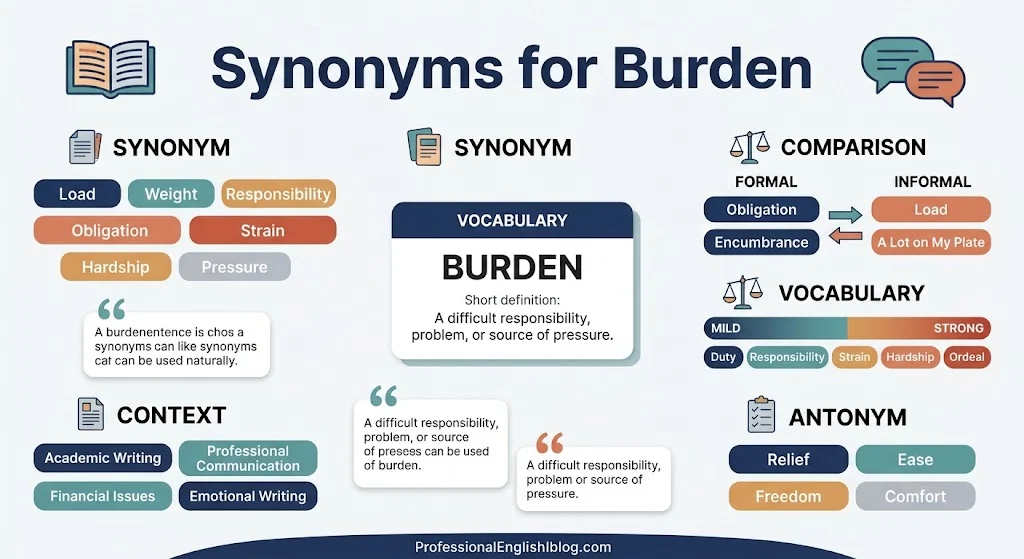
A burden is something difficult to carry, manage, or deal with, such as a responsibility, financial obligation, or emotional strain. Common alternatives include load, weight, responsibility, obligation, hardship, and pressure, depending on context.
Do you often use the word burden when writing about responsibilities, stress, financial difficulties, or emotional struggles? It is a useful word, but repeating it in essays, emails, reports, and everyday conversations can make your writing sound limited.
The challenge is that a burden can mean different things. It may be a heavy responsibility, an emotional strain, a financial obligation, or something that makes life more difficult. Words such as load, weight, obligation, strain, and hardship each express a slightly different meaning.
This guide explores synonyms for burden with clear definitions, natural examples, and practical recommendations. You will learn which alternatives work best in academic writing, professional communication, personal conversations, and creative expression.
Meaning, Tone and Context
Simple Definition
A burden is something that creates difficulty, pressure, worry, or responsibility for a person or group. It can be physical, emotional, financial, or related to work and daily life.
For example, caring for a sick family member can be a responsibility, while debt can become a financial burden.
The word can also describe something that makes a situation harder for another person.
Part of Speech
Burden can function as both a noun and a verb.
- Noun: Something difficult to carry, manage, or deal with.
- Verb: To place a responsibility, problem, or difficulty on someone.
Examples:
- The additional expense became a burden.
- She carried the burden of supporting her family.
- The new policy may burden small businesses.
Tone and Formality
Burden usually has a negative or serious tone because it suggests difficulty, pressure, or unwanted responsibility.
It is neutral enough for academic papers, professional reports, news articles, and everyday conversations. However, in emotional writing, it can communicate guilt, exhaustion, or personal hardship.
Common Use Cases
- Personal life: Family responsibilities and difficult situations.
- Emotional writing: Stress, grief, guilt, and mental pressure.
- Finance: Debt, expenses, taxes, and financial obligations.
- Workplace: Heavy workloads and additional responsibilities.
- Academic writing: Social, economic, and administrative difficulties.
- Public policy: The effects of rules, costs, and obligations on communities.
Important Word Forms
| Word Form | Part of Speech | Meaning | Example |
| Burden | Noun | A difficult responsibility or problem | The debt became a burden. |
| Burden | Verb | To place a difficulty or responsibility on someone | Do not burden your team with unnecessary work. |
| Burdened | Adjective or past participle | Carrying a heavy responsibility or difficulty | She felt burdened by family obligations. |
| Burdensome | Adjective | Difficult, demanding, or troublesome | The paperwork became burdensome. |
| Burdens | Plural noun or verb form | Multiple difficulties or the act of placing pressure | Financial burdens affect many households. |
| Burdened with | Phrase | Having to deal with something difficult | He was burdened with unexpected expenses. |
When and How to Use “Burden”
Use burden when a responsibility, problem, expense, or emotional difficulty feels difficult to manage. It is especially useful when you want to emphasize the pressure something creates.
Here are practical examples from different situations.
1. Professional: The additional paperwork created a burden for the administrative team.
2. Personal: She did not want to become a burden to her family.
3. Academic: Rising education costs place a financial burden on students.
4. Emotional: He carried the burden of guilt for many years.
5. Creative: The old promise became a burden he could no longer ignore.
6. Social media: You do not have to carry every burden alone.
7. Email: We should avoid placing an unnecessary burden on our colleagues.
Another Word for “Burden”
There is no single replacement that works in every context. The best synonym depends on whether you mean responsibility, pressure, expense, emotional difficulty, or hardship.
| Situation | Recommended Alternative | Why It Works |
| Professional writing | Responsibility | Describes a duty or obligation clearly. |
| Academic writing | Strain | Explains pressure on a person, system, or resource. |
| Casual conversation | Load | Sounds natural when discussing too much to handle. |
| Emotional writing | Weight | Suggests emotional pressure or sadness. |
| Creative writing | Yoke | Creates an image of being controlled by a heavy responsibility. |
| Resume or workplace use | Workload | Identifies the amount of work assigned. |
| Social media captions | Weight | Expresses emotional difficulty in a short, relatable way. |
| Stronger meaning | Hardship | Emphasizes serious difficulty or suffering. |
| Softer meaning | Responsibility | Presents a duty in a more neutral way. |
Best recommendation: Use responsibility for a duty, load for something difficult to manage, strain for pressure, and hardship for a difficult life condition.
When Not to Use “Burden”
Although burden is useful, it can sound too negative or vague when a sentence simply describes an ordinary duty or task.
A more specific synonym can make your meaning clearer and avoid suggesting that every responsibility is unwanted.
| General Sentence | More Precise Sentence | Why It Is Better |
| The project is a burden. | The project requires considerable effort. | Explains the difficulty more clearly. |
| She has a burden at work. | She has a heavy workload. | Identifies the amount of work. |
| The payment is a burden. | The monthly payment is a financial strain. | Specifies the financial pressure. |
| He carries a burden for his family. | He carries significant family responsibilities. | Uses a more neutral expression. |
| The new rules burden everyone. | The new rules create additional obligations for everyone. | Identifies the type of difficulty. |
Avoid using burden to describe a positive responsibility unless you intentionally want to emphasize its difficulty.
Words Commonly Confused With “Burden”
Several words are closely related to burden but do not have exactly the same meaning.
| Word | Meaning | Difference From Burden |
| Responsibility | A duty or task someone is expected to handle | Responsibility can be positive or neutral, while burden usually emphasizes difficulty. |
| Obligation | Something a person must do because of a rule, promise, or duty | Obligation emphasizes necessity rather than emotional pressure. |
| Load | A physical or figurative amount someone must carry or manage | Load can refer to quantity, while burden emphasizes difficulty. |
| Hardship | A difficult condition or period of suffering | Hardship describes a challenging situation rather than one specific responsibility. |
| Pressure | Stress caused by demands or expectations | Pressure describes the force or stress someone experiences. |
| Strain | Physical, emotional, financial, or practical pressure | Strain emphasizes the harmful effect of demands or difficulties. |
These distinctions are especially important in professional and academic writing. A responsibility is not automatically a burden, and an obligation does not always create hardship.
Best Synonym by Context for Burden
The best synonym depends on what is creating the difficulty. A work responsibility, financial problem, emotional struggle, and physical load each need different wording.
| Context | Best Synonym | Why It Works | Example |
| Formal writing | Obligation | Describes a duty or commitment | The obligation requires careful planning. |
| Academic writing | Strain | Explains pressure on individuals or systems | Rising costs place a strain on public resources. |
| Professional or business use | Responsibility | Sounds clear and neutral | The manager accepted responsibility for the project. |
| Resume | Workload | Describes the amount of assigned work | Managed a demanding workload while meeting deadlines. |
| Casual conversation | Load | Sounds natural and direct | I have a lot on my plate and a heavy load this week. |
| Creative writing | Weight | Creates an emotional or symbolic image | The weight of his secret followed him everywhere. |
| Emotional tone | Emotional weight | Communicates psychological pressure | She struggled with the emotional weight of the decision. |
| Strong intensity | Hardship | Emphasizes serious difficulty | The family endured years of hardship. |
| Soft or moderate tone | Duty | Presents an expected task without strong negativity | She viewed caring for her parents as a duty. |
| Social media captions | Weight | Short and expressive | Put down the weight you were never meant to carry. |
| Financial writing | Financial strain | Identifies money related pressure | Higher rent created financial strain for the household. |
| Legal or official writing | Obligation | Describes a formal duty | The agreement creates a legal obligation. |
| Health and caregiving | Caregiving responsibility | Identifies the demands of providing care | The family shared the caregiving responsibility. |
| Public policy | Cost | Describes a financial or practical demand | The new requirement increased the cost for small businesses. |
| US and UK usage | Burden | Standard in both varieties of English | The burden of rising expenses affects many families. |
Which Synonym Should You Choose?
Before replacing burden, identify what kind of difficulty your sentence describes.
1. Identify the source of difficulty. If it is a duty, choose responsibility or obligation. If it is an amount of work, choose workload or load.
2. Consider the type of pressure. Use strain for pressure on finances, relationships, health, or resources. Use emotional weight when describing feelings.
3. Choose the right level of seriousness. Hardship suggests serious difficulty. Duty is more neutral and does not necessarily imply suffering.
4. Think about your audience. Academic readers may prefer strain or obligation. Workplace readers may understand workload or responsibility more easily.
5. Check the emotional tone. Saying “I am a burden” can sound self critical. Saying “I need support with my responsibilities” expresses the situation more constructively.
6. Preserve the original meaning. Do not replace burden with hardship if you are describing a specific duty. A hardship is a difficult condition, not necessarily an assigned responsibility.
Real Life Examples of Burden in Sentences
These examples show how to use burden and more precise alternatives in different situations.
| Situation | Example Sentence |
| School | The cost of textbooks can become a financial burden for students. |
| Workplace | The new reporting requirements increased the administrative workload. |
| Academic writing | Economic inequality places additional strain on low income households. |
| Conversation | I do not want to put all the responsibility on you. |
| Social media | You deserve support, not the weight of every problem. |
| Resume | Managed a high workload while maintaining accuracy and meeting deadlines. |
| We should distribute the additional responsibilities fairly across the team. | |
| Storytelling | The weight of his decision stayed with him long after the journey ended. |
25 Synonyms for “Burden”
The word burden describes a difficult responsibility, problem, expense, or emotional pressure that someone must manage. Depending on the context, useful alternatives include load, responsibility, obligation, strain, hardship, and obstacle.
The following 25 synonyms and related expressions are organized by meaning, with simple definitions, recommended uses, and example sentences to help you choose the right word.
Common Synonyms for Burden Meaning Responsibility or Duty
These words describe tasks, obligations, or responsibilities that someone is expected to handle.
| Synonym | Simple Meaning | Best Used For | Example Sentence |
|---|---|---|---|
| 1. Responsibility | A duty someone must handle | Professional and personal situations | Managing the household became a major responsibility. |
| 2. Obligation | Something a person is required to do | Legal, financial, and formal writing | The contract created a financial obligation. |
| 3. Duty | A task or responsibility someone is expected to fulfill | Formal and personal situations | Caring for the children was a shared duty. |
| 4. Load | Something carried or managed | Work, duties, and physical weight | The extra workload added to her daily load. |
| 5. Overload | An excessive amount of work or responsibility | Workplace and personal situations | The additional assignments created an overload for the team. |
| 6. Workload | The amount of work assigned to someone | Business and professional writing | Her workload doubled during the busy season. |
| 7. Demand | A requirement that needs time, effort, or resources | Work and organizational settings | The demands of the role increased each month. |
Synonyms for Burden Meaning Pressure or Difficulty
Use these alternatives when burden refers to stress, hardship, or something that makes life or work more challenging.
| Synonym | Simple Meaning | Best Used For | Example Sentence |
|---|---|---|---|
| 8. Weight | A physical or emotional heaviness | Emotional and figurative writing | He felt the weight of his responsibilities. |
| 9. Strain | Pressure that makes something difficult | Money, relationships, and resources | Medical expenses placed a strain on the family. |
| 10. Hardship | A difficult or painful condition | Personal stories and social issues | The family overcame years of hardship. |
| 11. Pressure | Stress caused by demands or expectations | Work and emotional situations | The pressure of meeting deadlines became difficult. |
| 12. Difficulty | A problem that requires effort to overcome | Everyday and academic writing | Finding affordable housing was a serious difficulty. |
| 13. Trouble | A problem or situation that causes concern | Casual conversation | The extra expense caused trouble for the family. |
Synonyms for Burden Meaning Obstacle or Hindrance
These words describe something that prevents progress, creates restrictions, or makes a task more difficult.
| Synonym | Simple Meaning | Best Used For | Example Sentence |
|---|---|---|---|
| 14. Encumbrance | Something that restricts or makes progress difficult | Formal and legal writing | The debt became an encumbrance on the business. |
| 15. Liability | A responsibility, debt, or source of disadvantage | Finance and business | The unpaid loan remained a financial liability. |
| 16. Hindrance | Something that slows or prevents progress | Academic and professional writing | Poor communication became a hindrance to progress. |
| 17. Impediment | An obstacle that makes progress difficult | Formal and academic writing | Limited funding was a major impediment to development. |
| 18. Obstacle | Something that stands in the way of progress | General and professional writing | Lack of experience was an obstacle at first. |
Synonyms for Burden Meaning Suffering or Emotional Distress
These alternatives express stronger forms of physical or emotional difficulty and are especially useful in personal, literary, and descriptive writing.
| Synonym | Simple Meaning | Best Used For | Example Sentence |
|---|---|---|---|
| 19. Affliction | A condition that causes suffering | Literary and serious personal writing | The illness became a constant affliction. |
| 20. Torment | Severe mental or physical suffering | Emotional and literary writing | The memory became a source of torment. |
| 21. Ordeal | An extremely difficult or unpleasant experience | Personal stories and journalism | The long recovery was a painful ordeal. |
| 22. Toll | The harmful effect of a difficult experience | Emotional, physical, and financial contexts | Years of stress took a toll on her health. |
Synonyms for Burden Meaning Cost or Heavy Demand
These terms describe financial consequences, sacrifices, or demands that require significant effort or resources.
| Synonym | Simple Meaning | Best Used For | Example Sentence |
|---|---|---|---|
| 23. Cost | Something paid or sacrificed to achieve an outcome | Financial and figurative writing | The decision came at a high personal cost. |
| 24. Tax | A strain or demand placed on someone or something | Formal and figurative writing | The long hours taxed his energy. |
| 25. Yoke | A heavy responsibility or controlling obligation | Literary and figurative writing | He felt trapped under the yoke of debt. |
How to Choose the Right Synonym for “Burden”
Choose a synonym according to the meaning of your sentence. Use responsibility, obligation, or duty when describing something someone must handle. Choose load, workload, or overload when discussing work and duties. Use strain, pressure, or hardship to express difficulty, and choose hindrance or impediment when something prevents progress.
For stronger emotional descriptions, torment and ordeal may be suitable. In financial writing, liability and cost can communicate specific types of financial responsibility or sacrifice.
Important usage note: Not every entry is a direct substitute in every sentence. Liability is often a financial or legal term, workload specifically refers to work, and toll usually describes the harmful effect of a difficult experience. Tax can mean a strain when used figuratively, while yoke is a more literary expression.
Synonym Groups and Usage Differences
Professional vs. Personal Synonyms
Professional writing benefits from neutral expressions that explain the actual responsibility or demand. Words such as workload, obligation, responsibility, and strain are useful in reports, workplace discussions, and business communication.
Personal writing can be more emotional. Expressions such as weight, torment, hardship, and ordeal help communicate the personal effect of a difficult situation.
Compare:
- Professional: The additional duties increased the team’s workload.
- Personal: The weight of caring for everyone became overwhelming.
Formal vs. Conversational Synonyms
Formal alternatives are useful in reports, essays, presentations, and official communication. Conversational words are easier to understand in everyday discussions and messages.
| Formal Expression | Conversational Alternative |
| Obligation | Duty |
| Encumbrance | Problem |
| Impediment | Obstacle |
| Financial strain | Money trouble |
| Workload | Amount of work |
| Ordeal | Difficult experience |
| Onus | Responsibility |
Use formal language when precision is important. Choose everyday expressions when a natural and approachable tone is more appropriate.
Academic Synonyms
Academic writing should distinguish between a responsibility, a source of pressure, and a condition of hardship.
Useful expressions include:
- Strain: Pressure placed on a person, system, or resource.
- Obligation: A duty arising from a rule, agreement, or responsibility.
- Encumbrance: Something that restricts progress or creates a disadvantage.
- Impediment: A factor that prevents or slows progress.
- Hardship: A difficult condition involving suffering or deprivation.
- Onus: The responsibility or duty placed on a particular person or group.
For example, instead of writing “The policy created a burden for families,” you could write “The policy placed additional financial strain on low income families.”
Professional and Business Synonyms
In business writing, the best alternative depends on whether the issue involves workload, cost, legal responsibility, or operational difficulty.
| Situation | Recommended Expression |
| Too many assigned tasks | Heavy workload |
| Financial difficulty | Financial strain |
| Contractual duty | Obligation |
| Extra management responsibility | Administrative responsibility |
| Something slowing a project | Hindrance |
| A legal or financial disadvantage | Liability |
| Responsibility for a decision | Onus |
For resumes, avoid writing “I handled burdens.” Use achievement focused language such as “Managed competing responsibilities,” “Coordinated a demanding workload,” or “Handled complex operational requirements.”
Creative or Literary Synonyms
Creative writing can use more expressive alternatives to communicate the emotional weight of a difficult experience.
- Yoke: Suggests being controlled by a heavy responsibility.
- Torment: Communicates intense suffering.
- Ordeal: Describes an extremely difficult experience.
- Weight: Creates an image of emotional heaviness.
- Affliction: Suggests ongoing suffering or distress.
- Toll: Describes the harmful effect of prolonged difficulty.
Example:
- Neutral: The responsibility was difficult to manage.
- More expressive: The weight of the responsibility followed him everywhere.
- Stronger: The experience became an emotional ordeal.
Slang or Modern Synonyms
There is no single modern slang word that accurately replaces burden in every situation. However, several informal expressions communicate the idea naturally.
| Expression | Meaning | Best Context |
| A lot on my plate | Having many things to manage | Everyday conversation |
| Too much to handle | More responsibility or difficulty than someone can manage | Casual speech |
| Heavy load | A large amount of work or responsibility | Work and personal conversations |
| A weight off my shoulders | Relief after a worry or responsibility is removed | Informal and emotional writing |
These expressions work well in conversations, texts, and social media captions. Avoid them in formal academic or legal writing unless they appear in a direct quotation.
Strongest vs. Weaker Synonyms
The following scale shows differences in emotional intensity. It is a practical guide rather than a universal ranking, because each word describes a slightly different kind of difficulty.
| Intensity | Word or Expression | General Effect |
| Mild | Duty | A responsibility someone is expected to fulfill. |
| Moderate | Responsibility | A task or obligation to manage. |
| Noticeable | Load | Something demanding time or effort. |
| Strong | Strain | Pressure that makes a situation difficult. |
| Very strong | Hardship | Serious difficulty or suffering. |
| Intense | Ordeal | An extremely unpleasant experience. |
| Highly emotional | Torment | Severe and ongoing suffering. |
Use duty for an ordinary responsibility and torment only when the situation genuinely involves severe suffering.
Emotional vs. Neutral Synonyms
Some alternatives describe a practical responsibility, while others emphasize how difficult it feels.
| Neutral Expression | Emotional Expression | Difference |
| Responsibility | Weight | The second suggests emotional pressure. |
| Obligation | Yoke | The second suggests a restrictive or oppressive duty. |
| Workload | Ordeal | The second emphasizes an extremely difficult experience. |
| Financial obligation | Financial hardship | The second highlights suffering caused by money problems. |
| Difficulty | Torment | The second communicates much more intense suffering. |
Use neutral expressions in factual reports. Choose emotional alternatives when personal experience or literary tone is important.
Antonyms of “Burden”
The closest opposites of burden include relief, ease, and freedom, depending on how the word is used. While a burden describes a difficult responsibility, problem, or source of pressure, its opposite can express comfort, reduced stress, independence, or freedom from obligations.
There is no single antonym that fits every meaning. The following 15 words and expressions describe different contrasts, along with their meanings and example sentences.
Antonyms of Burden Meaning Relief or Reduced Pressure
These words describe the removal of stress, difficulty, or emotional and practical pressure.
| Antonym | Meaning | Example Sentence |
|---|---|---|
| 1. Relief | The removal or reduction of worry or difficulty | Sharing the work brought relief to the team. |
| 2. Ease | A state of comfort or freedom from difficulty | The new system made the process easier. |
| 3. Comfort | A condition of physical or emotional ease | Their support brought comfort during a difficult time. |
| 4. Lightness | A feeling of reduced heaviness or pressure | Sharing her concerns gave her a sense of lightness. |
| 5. Simplicity | The quality of being easy to understand or manage | The revised process brought simplicity to the task. |
Antonyms of Burden Meaning Freedom or Independence
These alternatives are useful when burden refers to an unwanted responsibility, restriction, or obligation.
| Antonym | Meaning | Example Sentence |
|---|---|---|
| 6. Freedom | The state of not being restricted or controlled | She finally enjoyed freedom from constant obligations. |
| 7. Liberation | Freedom from a restriction or oppressive condition | The agreement brought liberation from unfair obligations. |
| 8. Independence | The ability to manage without relying on others | Financial independence reduced her worries. |
| 9. Leisure | Free time without work or duties | He finally had time for leisure after completing the project. |
Antonyms of Burden Meaning Help or Support
These words describe assistance, resources, or favorable conditions that make responsibilities easier to manage.
| Antonym | Meaning | Example Sentence |
|---|---|---|
| 10. Support | Help that makes a difficult responsibility easier | Family support reduced the pressure on him. |
| 11. Assistance | Help provided to someone who needs it | The organization offered assistance with household expenses. |
| 12. Convenience | Something that makes a task easier | Online payment offers greater convenience. |
Antonyms of Burden Meaning Advantage or Opportunity
These terms describe favorable circumstances that contrast with the difficulties or disadvantages associated with a burden.
| Antonym | Meaning | Example Sentence |
|---|---|---|
| 13. Benefit | Something that provides an advantage or improvement | The change became a benefit rather than a problem. |
| 14. Advantage | A condition that makes something easier or more favorable | Flexible hours gave employees an advantage. |
| 15. Opportunity | A favorable chance to do something | The new program created an opportunity for growth. |
How to Choose the Right Antonym for “Burden”
The best opposite depends on what burden means in your sentence. Use relief when referring to the removal of emotional or practical pressure. Choose freedom or liberation when describing release from unwanted responsibilities or restrictions. Use support or assistance when someone receives help with a difficult task.
If you are describing a favorable situation, benefit, advantage, or opportunity may be more appropriate.
Important usage note: These words are contextual contrasts rather than exact antonyms in every sentence. Relief is often the closest opposite when burden means emotional or practical pressure. Freedom is more suitable when burden refers to an unwanted responsibility or restriction. Always consider the intended meaning before choosing an alternative.
Comparison: Burden vs. Similar Words
Burden vs. Responsibility
Main difference: A burden is a difficulty or pressure someone must carry. A responsibility is a duty someone is expected to manage.
Which one is stronger: Burden usually has a more negative meaning.
Which is more formal: Both are suitable for formal writing. Responsibility is more neutral.
Examples:
- Burden: The extra expenses became a burden on the family.
- Responsibility: Managing the household was her responsibility.
Burden vs. Obligation
Main difference: An obligation is something a person is required to do. A burden is something difficult or stressful to manage.
Which one is stronger: Burden usually communicates more difficulty.
Which is more formal: Obligation often sounds more formal, especially in legal and financial contexts.
Examples:
- Burden: The debt became a serious burden.
- Obligation: The agreement created a financial obligation.
Burden vs. Load
Main difference: A load is something carried or managed, physically or figuratively. A burden emphasizes the difficulty associated with carrying or managing it.
Which one is stronger: Burden often sounds more negative.
Which is more formal: Both work in formal writing, although load is often more direct.
Examples:
- Burden: The responsibility became a burden.
- Load: The additional work increased her daily load.
Burden vs. Hardship
Main difference: A burden is a particular responsibility, problem, or source of pressure. Hardship describes a difficult condition or period of suffering.
Which one is stronger: Hardship often suggests more serious or prolonged difficulty.
Which is more formal: Both are suitable for formal and academic writing.
Examples:
- Burden: The loan placed a financial burden on the family.
- Hardship: The family experienced financial hardship after losing its income.
Burden vs. Strain
Main difference: Burden refers to something difficult to manage. Strain describes pressure that affects a person, relationship, system, or resource.
Which one is stronger: Neither is always stronger. Strain emphasizes the effect of pressure.
Which is more formal: Both are appropriate in professional and academic writing.
Examples:
- Burden: The new expenses became a burden.
- Strain: The new expenses placed a strain on the household budget.
Burden vs. Pressure
Main difference: A burden is a responsibility or problem that is difficult to carry. Pressure is the stress or force created by demands and expectations.
Which one is stronger: Burden suggests something that must be carried, while pressure emphasizes the stress being experienced.
Which is more formal: Both are widely used in formal communication.
Examples:
- Burden: The extra responsibility became a burden.
- Pressure: The tight deadline placed pressure on the team.
Common Phrases and Expressions with “Burden”
These expressions are useful in personal conversations, academic writing, professional communication, and everyday English.
1. Bear the Burden
Meaning: To accept or carry a difficult responsibility or problem.
Example sentence: The local community had to bear the burden of the rising costs.
2. Carry the Burden
Meaning: To deal with a difficult responsibility or emotional problem.
Example sentence: She carried the burden of supporting her family for many years.
3. Lift a Burden
Meaning: To reduce or remove someone’s responsibility, worry, or difficulty.
Example sentence: The additional funding helped lift a financial burden from the school.
4. Shoulder the Burden
Meaning: To accept responsibility for something difficult.
Example sentence: The team leader agreed to shoulder the burden of managing the project.
5. A Heavy Burden
Meaning: A serious responsibility, problem, or emotional difficulty.
Example sentence: Caring for several family members became a heavy burden.
6. Burden of Proof
Meaning: The responsibility to provide enough evidence to support a claim, especially in legal or formal reasoning.
Example sentence: The burden of proof rests with the party making the claim.
7. Financial Burden
Meaning: A money related responsibility or expense that causes difficulty.
Example sentence: Rising medical bills created a financial burden for the household.
8. Be a Burden to Someone
Meaning: To feel that your needs or problems create difficulty for another person.
Example sentence: He worried that asking for help would make him a burden to his friends.
Common Mistakes to Avoid
Choosing a synonym without considering its meaning can make your writing inaccurate. Avoid these common mistakes.
1. Using Burden When a More Precise Word Is Better
Burden is broad. If you mean the amount of work someone has, workload may be clearer.
Instead of: The burden at work increased.
Better: The workload increased.
2. Confusing Burden With Responsibility
A responsibility is a duty, while a burden suggests that the duty is difficult or unwanted.
Instead of: Every responsibility is a burden.
Better: Some responsibilities become burdens when they create excessive pressure.
3. Using a Casual Expression in Formal Writing
Expressions such as a lot on my plate and too much to handle are conversational.
Instead of: The team has too much on its plate.
Better: The team is managing an excessive workload.
4. Using an Overly Dramatic Synonym
Words such as torment and ordeal suggest serious suffering. They are not appropriate for every ordinary inconvenience.
Instead of: Preparing the presentation was a torment.
Better: Preparing the presentation was demanding.
5. Repeating Burden Too Often
Repeated use can make your writing sound limited.
Instead of: The burden affected the family. The burden also affected their finances.
Better: The financial strain affected the family and made everyday expenses harder to manage.
6. Choosing the Wrong Emotional Tone
Obligation sounds more neutral than burden. Torment is much more emotional than strain.
Choose a word that reflects the seriousness of the situation rather than exaggerating it.
7. Using Slang in Academic or Professional Writing
Expressions such as a lot on my plate are useful in conversation, but formal reports usually need more precise language.
Use responsibilities, workload, financial strain, or obligations when appropriate.
FAQs
1. What Is the Best Synonym for Burden?
Load is a useful general alternative. Responsibility, obligation, strain, and hardship are better when you need to describe a specific type of difficulty.
2. What Is a Formal Synonym for Burden?
Obligation, encumbrance, and strain are formal alternatives. Choose obligation for a duty and strain for pressure or difficulty.
3. What Is an Informal Synonym for Burden?
Load, trouble, and a lot on my plate are informal alternatives. They work well in everyday conversations and personal messages.
4. What Is Another Word for Burden in Professional Writing?
Use responsibility, workload, obligation, or administrative strain. These expressions describe workplace duties and demands more clearly than a general reference to burden.
5. What Is the Difference Between Burden and Responsibility?
Responsibility means a duty someone must manage. Burden suggests that a duty, problem, or obligation creates difficulty or unwanted pressure.
6. What Is the Opposite of Burden?
Relief is a common opposite when burden means pressure or worry. Freedom and ease also work when describing the removal of unwanted responsibilities.
Conclusion
A burden refers to a difficult responsibility, problem, expense, or emotional pressure. Common synonyms include load, weight, responsibility, obligation, strain, and hardship.
Choose precise terms like workload and financial strain for professional writing, while weight, ordeal, and torment suit emotional or creative contexts.
Depending on the meaning, relief, freedom, and ease are useful opposites of burden. Always consider the context to choose the most accurate word.