
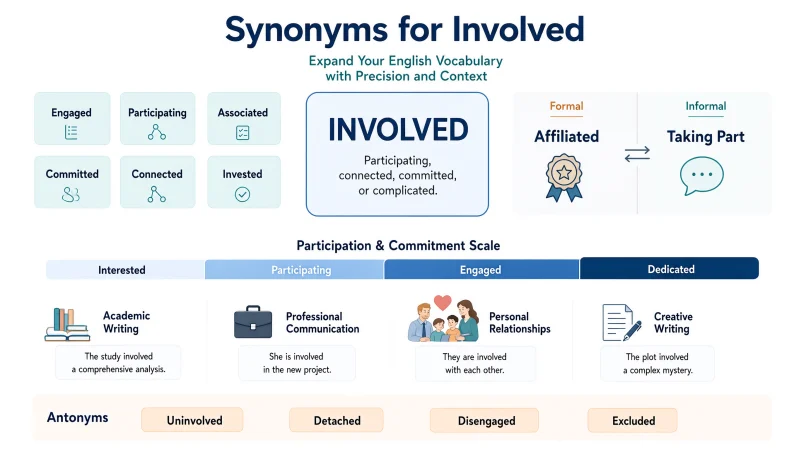
Involved means participating in something, having a connection to a situation, or being complicated. Common synonyms include engaged, participating, associated, committed, connected, and complicated. Choose engaged for active participation, associated for a connection, and complex when describing difficulty.
Have you ever used the word involved repeatedly in an essay, work email, resume, or everyday conversation? It is a flexible word, but its meaning changes depending on the sentence. It can describe participation, responsibility, complexity, or a close personal connection.
For example, an employee may work on a project, a person may actively support a cause, or a legal matter may involve complex issues.These meanings require different alternatives.
This guide explains synonyms for involved with clear definitions, natural examples, and context based recommendations. You will learn which words work best in academic writing, professional communication, casual conversation, and creative writing.
Meaning, Tone and Context
1. Simple Definition
Involved has several meanings.It describes someone who participates in an activity, maintains a relationship with a person or situation, or has a connection to a particular event.
It can also describe something difficult to understand because it contains many details or complicated parts.
Examples:
- She is involved in community activities.
- Several departments are involved in the project.
- The instructions are too involved for beginners.
2. Part of Speech
Involved is mainly used as an adjective and as the past participle of the verb involve.
| Word Form | Part of Speech | Meaning | Example |
| Involve | Verb | To include or require someone’s participation | The project will involve several teams. |
| Involved | Adjective or past participle | Participating, connected, or complicated | She is involved in the campaign. |
| Involvement | Noun | Participation or connection | His involvement helped the organization. |
| Involving | Verb form | Including someone or something | The task involves careful planning. |
3. Tone and Formality
Involved is generally neutral and suitable for both formal and informal English.
Its tone depends on the context. Participating in a charity can show commitment, while involvement in a dispute can suggest an unwanted connection.
When it describes a process or explanation, it can mean complicated or detailed.
4. Common Use Cases
- Professional: Employees involved in a project.
- Academic: Students involved in research.
- Personal: People involved in a relationship.
- Community: Volunteers involved in local activities.
- Legal: Individuals involved in an investigation.
- Technical: An involved process or explanation.
- Creative: A deeply involved character or storyline.
5. Important Related Forms
- Involvement: The act or state of participating or being connected.
- Involvement level: The degree of participation.
- Involved party: A person or organization connected to a situation.
- Involuntary: Done without choosing or agreeing to do it. This is related in spelling but is not a synonym.
When and How to Use “Involved”
Use involved when you want to describe participation, connection, responsibility, or complexity. It is especially useful when the exact nature of someone’s participation is not the main focus.
Here are realistic examples from different situations.
1. Professional: Several departments were involved in preparing the annual report.
2. Personal: My sister is involved in a local volunteer organization.
3. Academic: More than 100 students were involved in the research project.
4. Emotional: He became deeply involved in the lives of the people he helped.
5. Creative: The novel follows an involved storyline with several unexpected developments.
6. Social media: Proud to be involved in a project that makes a difference.
7. Email: Please include everyone involved in the decision making process.
Another Word for “Involved”
The best single replacement depends on the intended meaning. Engaged is a strong general alternative when someone actively participates. Use associated for a connection, committed for dedication, and complex when describing something difficult.
| Situation | Recommended Alternative | Why It Works |
| Professional writing | Engaged | Shows active participation. |
| Academic writing | Participating | Clearly describes taking part in research or an activity. |
| Casual conversation | Taking part | Sounds natural and straightforward. |
| Emotional writing | Invested | Shows personal interest or emotional commitment. |
| Creative writing | Entangled | Suggests a complicated personal or situational connection. |
| Resume or workplace use | Contributed | Highlights a person’s actual work and participation. |
| Social media captions | Active | Communicates participation in a simple way. |
| Stronger meaning | Committed | Suggests dedication and responsibility. |
| Softer meaning | Associated | Describes a connection without suggesting deep participation. |
Quick Recommendations
- Professional writing: Use engaged or contributed when describing active work.
- Academic writing: Use participating or associated when explaining research roles and connections.
- Casual conversation: Use taking part or connected.
- Emotional writing: Use invested or committed.
- Creative writing: Use entangled when describing complicated relationships or situations.
- Resume writing: Use action verbs such as coordinated, contributed, managed, or collaborated to show what you actually did.
When Not to Use “Involved”
Although involved is useful, it may lack clarity when readers need to know exactly what someone did or how two things connect.
Choose a more specific word when participation, responsibility, or complexity matters.
| General Sentence | More Precise Sentence | Why It Is Better |
| I was involved in the project. | I coordinated the project. | Explains the actual responsibility. |
| She was involved in the research. | She participated in the research. | Clearly describes her role. |
| He is involved with the organization. | He is affiliated with the organization. | Focuses on the formal connection. |
| The instructions are involved. | The instructions are complicated. | Makes the meaning easier to understand. |
| They were involved in the discussion. | They actively contributed to the discussion. | Shows meaningful participation. |
Avoid using involved when it could create confusion about someone’s role. In professional writing, specific action verbs usually communicate more than general descriptions.
Words Commonly Confused With “Involved”
These words are related to different meanings of involved, but they are not interchangeable in every sentence.
| Word | Meaning | Difference From Involved |
| Engaged | Actively participating or interested | Emphasizes attention and active participation. |
| Associated | Connected with a person, group, or subject | Describes a connection without necessarily suggesting participation. |
| Committed | Dedicated to a person, goal, or activity | Emphasizes responsibility and dedication. |
| Interested | Wanting to know or learn more | Does not necessarily mean taking part. |
| Complicated | Difficult to understand or deal with | Describes difficulty, not participation. |
| Entangled | Caught up in a complicated situation or relationship | Often suggests difficulty, conflict, or unwanted involvement. |
For example, someone can support a charity without participating in its activities. However, a person who volunteers regularly actively contributes to its work.
Best Synonym by Context for Involved
The most suitable alternative depends on whether you mean participation, connection, commitment, or complexity.
| Context | Best Synonym | Why It Works | Example |
| Formal writing | Associated | Describes a clear connection | The organization is associated with the initiative. |
| Academic writing | Participating | Identifies people taking part in research | Participating students completed the survey. |
| Professional or business use | Engaged | Communicates active participation | The team remained engaged throughout the project. |
| Resume | Contributed | Highlights a specific work contribution | Contributed to the development of a new training program. |
| Casual conversation | Taking part | Sounds natural and direct | I am taking part in the community event. |
| Creative writing | Entangled | Suggests a complicated connection | The characters became entangled in a family dispute. |
| Emotional tone | Invested | Shows personal or emotional commitment | She was deeply invested in the cause. |
| Strong commitment | Dedicated | Communicates strong loyalty and effort | He is dedicated to helping young people. |
| Soft or moderate connection | Connected | Describes a general relationship | She is connected to several local groups. |
| Social media captions | Active | Briefly communicates participation | Happy to stay active in the community. |
| Technical description | Complex | Describes something with many difficult parts | The process is more complex than it appears. |
| Legal context | Implicated | Suggests a connection to possible wrongdoing | Several individuals were implicated in the investigation. |
Important: Implicated is not a neutral substitute for involved. It often suggests suspected responsibility for wrongdoing, so use it only when that meaning is accurate.
US and UK Usage
The main synonyms for involved are common in both American and British English. There is no major difference in their basic meanings.
Words such as engaged, participating, associated, committed, and complicated are standard in both varieties.
Which Synonym Should You Choose?
Use these steps to select the most accurate alternative.
1. Identify the meaning. Are you describing participation, a connection, commitment, or complexity? This is the most important decision.
2. Describe the person’s role. Use participating for taking part, contributing for adding work or ideas, and leading for directing an activity.
3. Consider the level of commitment. Choose interested for curiosity, engaged for active attention, and dedicated for sustained commitment.
4. Check the relationship. Use associated or connected for a general link. Choose affiliated for a more formal organizational relationship.
5. Describe complexity accurately. Use complicated, complex, or intricate when involved means difficult to understand.
6. Match the tone. Professional writing usually benefits from specific terms. Creative writing may allow expressive words such as entangled or immersed.
7. Check the sentence structure. Some alternatives need different prepositions. For example, someone may participate in a project, have a connection to an organization, or dedicate time and effort to a cause.
Real Life Examples of Involved in Sentences
These examples show how a more precise synonym can improve communication in different situations.
| Situation | Example Sentence |
| School | Students participating in the science fair presented their projects. |
| Workplace | The marketing team contributed to the company’s new campaign. |
| Academic writing | Researchers engaged in the study completed several interviews. |
| Conversation | My brother is taking part in a local soccer league. |
| Social media | Excited to stay active in a community project. |
| Resume | Collaborated with a team of designers to improve the customer experience. |
| Please contact all individuals associated with this project. | |
| Storytelling | The main character became entangled in a complicated family dispute. |
25 Synonyms for “Involved”
The word involved has several meanings depending on the context. It can describe someone participating in an activity, having a connection with a person or organization, showing commitment, or being part of a complicated situation.
The following 25 synonyms and related expressions cover different meanings, with simple definitions, suitable contexts, and example sentences.
Synonyms for Involved Meaning Participating or Taking Part
These alternatives describe someone who actively participates in an activity, discussion, project, or event.
| Synonym | Simple Meaning | Best Used For | Example Sentence |
|---|---|---|---|
| 1. Engaged | Actively participating or paying attention | Work, education, and activities | The employees remained engaged during the training session. |
| 2. Participating | Taking part in an activity | Academic and community contexts | Participating students received certificates. |
| 3. Active | Taking part regularly or energetically | Community and social contexts | He is active in neighborhood activities. |
| 4. Collaborating | Working together with others | Workplace and academic contexts | Several researchers are collaborating on the study. |
| 5. Contributing | Providing effort, ideas, or resources | Professional and community contexts | She is contributing to the development of the program. |
| 6. Included | Made part of a group or activity | General and professional writing | All team members were included in the discussion. |
Synonyms for Involved Meaning Connected or Associated
Use these words when describing a relationship, affiliation, or connection with a person, organization, group, or particular matter.
| Synonym | Simple Meaning | Best Used For | Example Sentence |
|---|---|---|---|
| 7. Associated | Connected with a person or organization | Formal and professional writing | She is associated with a national research group. |
| 8. Connected | Having a relationship or link | Everyday and professional communication | He is connected to several local businesses. |
| 9. Affiliated | Officially connected with an organization | Business and academic writing | The clinic is affiliated with a major university. |
| 10. Concerned | Connected with or affected by a matter | Formal and personal contexts | Everyone concerned attended the meeting. |
| 11. Integrated | Made part of a larger system or group | Technical and organizational contexts | The new department was integrated into the company. |
Synonyms for Involved Meaning Committed or Deeply Engaged
These alternatives emphasize dedication, personal interest, or strong emotional and intellectual participation.
| Synonym | Simple Meaning | Best Used For | Example Sentence |
|---|---|---|---|
| 12. Committed | Dedicated to a person, activity, or goal | Personal and professional contexts | She is committed to improving public education. |
| 13. Dedicated | Giving time and effort to something | Work and personal descriptions | The volunteers are dedicated to helping families. |
| 14. Invested | Personally interested or emotionally committed | Personal and workplace writing | He is invested in the success of the project. |
| 15. Immersed | Deeply occupied with an activity or subject | Learning and creative writing | She became immersed in the research. |
| 16. Occupied | Busy with an activity or task | Everyday communication | The staff were occupied with customer requests. |
| 17. Instrumental | Playing an important role in achieving something | Formal and professional writing | Her advice was instrumental in the project’s success. |
Synonyms for Involved Meaning Caught Up in a Situation
These words describe people connected to difficult, complicated, or sometimes negative situations.
| Synonym | Simple Meaning | Best Used For | Example Sentence |
|---|---|---|---|
| 18. Entangled | Caught up in a complicated situation | Relationships and storytelling | He became entangled in a legal dispute. |
| 19. Implicated | Connected with possible wrongdoing | Legal and investigative writing | Two officials were implicated in the case. |
| 20. Enmeshed | Deeply caught up in a complicated situation | Emotional and descriptive writing | The family became enmeshed in a long conflict. |
Synonyms for Involved Meaning Complex or Detailed
When involved describes something difficult to understand, manage, or explain, these alternatives may be more precise.
| Synonym | Simple Meaning | Best Used For | Example Sentence |
|---|---|---|---|
| 21. Complex | Made up of many connected or difficult parts | Technical and academic writing | The case involves a complex set of regulations. |
| 22. Complicated | Difficult to understand or manage | Everyday and professional writing | The instructions are too complicated for new users. |
| 23. Intricate | Containing many detailed or interconnected parts | Creative and technical descriptions | The novel has an intricate storyline. |
| 24. Elaborate | Detailed and carefully developed | Descriptions and explanations | The proposal contains an elaborate explanation of the process. |
| 25. Multifaceted | Having several different aspects | Academic and professional writing | The issue requires a multifaceted approach. |
How to Choose the Right Synonym for “Involved”
Choose a synonym according to the meaning of your sentence. Use engaged or participating when someone takes part in an activity. Choose associated, connected, or affiliated when describing a relationship with an organization or person. Use committed or dedicated to emphasize effort and responsibility.
When describing a difficult situation, entangled or enmeshed may be more appropriate. If you mean something has many complicated parts, choose complex, intricate, or multifaceted instead.
Important usage note: These alternatives are not interchangeable in every context. Engaged and participating describe taking part, while complex and intricate describe difficulty or detail. Implicated often suggests a connection to possible wrongdoing, so use it carefully. Always consider the sentence before choosing a replacement.
Synonym Groups and Usage Differences
Professional vs. Personal Synonyms
Professional writing should explain what someone contributed, managed, or participated in. Words such as collaborating, contributing, engaged, and affiliated can make a person’s role clearer.
Personal writing may focus more on relationships, feelings, and commitment. Words such as invested, dedicated, and entangled can communicate those ideas more effectively.
Compare:
- Professional: She was involved in the development of the training program.
- More specific: She contributed to the development of the training program.
- Personal: He was deeply invested in the relationship.
Formal vs. Conversational Synonyms
Formal alternatives work well in reports, essays, presentations, and official communication. Conversational expressions are more natural in everyday speech and informal messages.
| Formal Expression | Conversational Alternative |
| Participating | Taking part |
| Associated | Connected |
| Affiliated | Linked to |
| Committed | Dedicated to |
| Occupied | Busy |
| Complicated | Hard to understand |
| Collaborating | Working together |
Use formal alternatives when precision matters. Choose conversational words when a relaxed and straightforward tone is more appropriate.
Academic Synonyms
Academic writing should explain the nature of participation or connection rather than rely on a broad word such as involved.
Useful alternatives include:
- Participating: Describes individuals taking part in a study or activity.
- Engaged: Suggests active participation or attention.
- Associated: Identifies a relationship between people, variables, or subjects.
- Affiliated: Describes a formal institutional connection.
- Integrated: Explains how something has become part of a larger system.
- Multifaceted: Describes an issue with several different aspects.
- Complex: Describes a subject with many interconnected elements.
For example, instead of writing “Students involved in the study completed a questionnaire,” write “Students participating in the study completed a questionnaire.”
The revised sentence identifies their role more directly.
Professional and Business Synonyms
In workplace communication, involved can be unclear because it does not explain what a person actually did.
Choose an alternative that communicates the responsibility.
| Situation | Recommended Expression |
| Team projects | Collaborating |
| Project contributions | Contributing |
| Employee participation | Engaged |
| Organizational connection | Affiliated |
| Business commitment | Dedicated |
| Task responsibility | Managing |
| Department participation | Coordinating |
For resumes, replace general statements with measurable contributions wherever possible.
Instead of “Involved in customer service operations,” write “Handled customer inquiries, resolved service issues, and maintained client records.”
Creative or Literary Synonyms
Creative writing can use expressive words to describe complicated relationships, deep attention, and personal connections.
- Entangled: Suggests being caught in a difficult situation.
- Enmeshed: Communicates a deep and complicated connection.
- Immersed: Shows complete attention or participation.
- Invested: Adds emotional or personal commitment.
- Intricate: Describes a detailed and complicated structure.
- Multifaceted: Suggests several layers or dimensions.
For example:
- Neutral: She was involved in a family conflict.
- More expressive: She became entangled in a family conflict.
- More emotional: She was deeply invested in resolving the conflict.
Slang or Modern Synonyms
There is no single slang word that replaces involved in every context. However, informal expressions can make everyday conversation sound more natural.
| Expression | Meaning | Best Context |
| In the mix | Included in an activity or situation | Casual conversation |
| Part of it | Included or participating | Everyday speech |
| Hands on | Directly involved in practical work | Workplace conversation |
| All in | Fully committed to an activity | Informal speech |
| Tied up in | Busy with or caught in something | Casual conversation |
Examples:
- I want to be in the mix during the planning process.
- She takes a hands on approach to training new employees.
- We are all in for the community project.
These expressions are useful in conversations and informal writing. In academic papers and formal reports, use precise alternatives instead.
Strongest vs. Weaker Synonyms
The words below show different levels of participation or commitment. They are not a universal ranking because their meanings vary by context.
| General Level | Word | Meaning |
| Light connection | Associated | Connected to something |
| Basic participation | Participating | Taking part |
| Active participation | Engaged | Actively involved |
| Personal commitment | Invested | Personally committed |
| Strong dedication | Dedicated | Giving sustained effort |
| Deep connection | Enmeshed | Closely caught up in a situation |
Use associated for a simple connection and dedicated when someone demonstrates sustained commitment.
Emotional vs. Neutral Synonyms
Some synonyms describe participation without adding emotion. Others suggest personal attachment, commitment, or difficulty.
| Neutral Expression | Emotional Expression | Difference |
| Associated | Invested | The second suggests personal commitment. |
| Participating | Dedicated | The second suggests sustained effort. |
| Connected | Entangled | The second can suggest a complicated relationship. |
| Engaged | Immersed | The second suggests deeper attention or absorption. |
| Involved in a situation | Enmeshed in a situation | The second suggests being deeply caught up in it. |
Choose neutral expressions for factual reports. Use emotional alternatives when personal feelings are important to the meaning.
Antonyms of “Involved”
The opposite of involved depends on its meaning. When it describes participation, suitable opposites include uninvolved, detached, and absent. When it describes complexity, simple and straightforward may be better opposites.
The following table contains 15 contextual antonyms and contrasting expressions.
| Antonym | Meaning | Example Sentence |
| 1. Uninvolved | Not participating or connected | He remained uninvolved in the project. |
| 2. Disengaged | Not actively participating or interested | Several employees appeared disengaged during the meeting. |
| 3. Detached | Emotionally or personally separate | She remained detached from the dispute. |
| 4. Unconnected | Having no relationship or link | The two incidents were unconnected. |
| 5. Unassociated | Not linked with a person or organization | The individual was unassociated with the company. |
| 6. Independent | Not controlled by or dependent on another | The research team operated independently. |
| 7. Absent | Not present at an activity or event | He was absent from the committee meeting. |
| 8. Excluded | Deliberately not included | Several applicants were excluded from the final discussion. |
| 9. Withdrawn | Having stepped away from participation | She became withdrawn from the group activities. |
| 10. Indifferent | Showing little interest or concern | He remained indifferent to the proposal. |
| 11. Uncommitted | Not dedicated to a goal or activity | The organization seemed uncommitted to the initiative. |
| 12. Simple | Easy to understand or deal with | The new instructions are simple. |
| 13. Straightforward | Clear and uncomplicated | The application process is straightforward. |
| 14. Basic | Having few complicated features | The software offers a basic setup. |
| 15. Uncomplicated | Not difficult or complex | We chose an uncomplicated solution. |
Important distinction: Uninvolved is the closest general opposite when involved means taking part in something or having a connection to it. Simple, straightforward, and uncomplicated are opposites only when involved means complicated or difficult to understand.
Comparison: Involved vs. Similar Words
Involved vs. Engaged
Main difference: Involved can describe participation in an activity or a connection to someone or something. Engaged usually emphasizes active participation, attention, or commitment.
Which is stronger: Engaged often suggests more active participation.
Which is more formal: Both are suitable for professional writing.
Examples:
- Involved: She is involved in the research project.
- Engaged: She is actively engaged in the research project.
Involved vs. Associated
Main difference: Involved can suggest active participation, while associated usually describes a connection or relationship.
Which is stronger: Involved generally suggests more direct participation.
Which is more formal: Associated is often more formal when describing an organizational or professional relationship.
Examples:
- Involved: He is involved in the campaign.
- Associated: He is associated with the campaign.
Involved vs. Committed
Main difference: Involved means taking part in something or having a connection to it. Committed means dedicated to a responsibility, person, or goal.
Which is stronger: Committed suggests stronger dedication.
Which is more formal: Both are suitable for professional and personal writing.
Examples:
- Involved: She is involved in community service.
- Committed: She is committed to improving her community.
Involved vs. Interested
Main difference: Interested means wanting to know more about something. Involved generally suggests participation or connection.
Which is stronger: Involved suggests a more direct connection or role.
Which is more formal: Both are neutral and appropriate for formal writing.
Examples:
- Interested: He is interested in environmental research.
- Involved: He is involved in an environmental research project.
Involved vs. Complicated
Main difference: Involved can describe something with many difficult details. Complicated directly emphasizes difficulty or complexity.
Which is stronger: Complicated is usually clearer when describing difficulty.
Both expressions suit professional and academic writing.
Examples:
- Involved: The instructions are quite involved.
- Complicated: The instructions are complicated and difficult to follow.
Involved vs. Entangled
Main difference: Involved can describe neutral participation or connection. Entangled describes someone caught in a complicated situation or relationship.
Which is stronger: Entangled usually has a stronger and more negative implication.
Which is more formal: Involved is more neutral and broadly suitable. Entangled is useful in descriptive and literary writing.
Examples:
- Involved: She participated in the legal proceedings.
- Entangled: She became entangled in a lengthy legal dispute.
Common Phrases and Expressions with “Involved”
These phrases appear in professional communication, everyday conversation, and formal writing.
1. Involved in Something
Meaning: Participating in an activity or connected to a situation.
Example sentence: Several employees are helping with the product launch.
2. Deeply Involved
Meaning: Having a strong level of participation, interest, or personal connection.
Example sentence: She actively contributes to community development.
3. Get Involved
Meaning: Start participating in an activity, organization, or cause.
Example sentence: Students should participate in volunteer programs.
4. Actively Involved
Meaning: Participating regularly and making a meaningful contribution.
Example sentence: He actively contributes to the company’s training initiatives.
5. Directly Involved
Meaning: Having an immediate role or connection to an event or activity.
Example sentence: Only the employees directly involved in the project attended the meeting.
6. Personally Involved
Meaning: Having a personal relationship, interest, or connection with a situation.
Example sentence: The manager personally helped resolve the complaint.
7. Involved in the Process
Meaning: Taking part in the steps or activities required to complete something.
Example sentence: All department heads contributed to the decision-making process.
8. Become Involved With
Meaning: Develop a connection or begin participating in a person, group, or activity.
Example sentence: She became involved with a nonprofit organization after graduating.
Common Mistakes to Avoid
Choosing the wrong synonym can change the meaning of your sentence. Avoid these common mistakes.
1. Using Involved When a More Specific Word Is Better
Involved does not explain exactly what someone did.
Instead of: I contributed to the marketing campaign.
Better: I coordinated the marketing campaign and managed its social media content.
2. Confusing Involved With Interested
Interest does not necessarily mean participation in an activity.
Instead of: She takes part in photography because she wants to learn more about it.
Better: She wants to learn more about photography.
3. Using a Casual Expression in Formal Writing
Expressions such as in the mix and all in may sound too informal in academic or professional communication.
Instead of: Several employees were in the mix during the investigation.
Better: Several employees participated in the investigation.
4. Using an Overly Dramatic Synonym
Words such as entangled and enmeshed can suggest complicated or difficult circumstances.
Instead of: He became deeply involved in the school project.
Better: He participated in the school project.
5. Repeating Involved Too Often
Repeated use can make writing sound vague.
Instead of: She participated in research, contributed to planning, and delivered presentations.
Better: She conducted research, coordinated planning, and delivered presentations.
6. Choosing a Synonym With the Wrong Meaning
Associated describes a connection, while committed suggests dedication. Do not use them as if they mean exactly the same thing.
Instead of: He values the organization, although you only mean he has a formal connection to it.
Better: He has an affiliation with the organization.
7. Using Slang in Academic or Professional Writing
Expressions such as in the mix and tied up in may be natural in conversation but can weaken formal writing.
Choose participating, associated, engaged, or connected when you want to express those specific meanings more clearly.
FAQs
1. What Is the Best Synonym for Involved?
Engaged is a strong general alternative when describing active participation. Associated works for connections, while committed communicates dedication and responsibility.
2. What Is a Formal Synonym for Involved?
Associated, affiliated, participating, and engaged are useful formal alternatives. Choose according to whether you mean connection, membership, or active participation.
3. What Is an Informal Synonym for Involved?
Taking part, connected, and part of it are natural informal alternatives. The phrase in the mix also works in casual conversation.
4. What Is Another Word for Involved in Professional Writing?
Use contributed, collaborated, coordinated, or participated to describe actual workplace responsibilities. These alternatives communicate specific actions more clearly than involved.
5. What Is the Difference Between Involved and Engaged?
Involved can describe participation or connection. Engaged usually suggests active participation, attention, or commitment to a particular activity.
6. What Is the Opposite of Involved?
Uninvolved is the closest general opposite when describing participation. Detached, disengaged, absent, and excluded are other alternatives depending on context.
Conclusion
Involved can describe participation, connection, commitment, or complexity. Its best synonyms include engaged, participating, associated, committed, invested, and complicated.
For professional and academic writing, use precise words such as contributed, participating, and affiliated. In everyday conversation, taking part and connected sound natural. For emotional or creative writing, invested, entangled, and immersed can communicate deeper relationships.
The most important point is that these words do not all mean the same thing. Choose according to the role, relationship, or level of complexity you want to describe.
A practical vocabulary tip: Whenever you write involved, ask yourself what the person actually did. Replacing a general description with a specific action can make your writing clearer and more professional.