
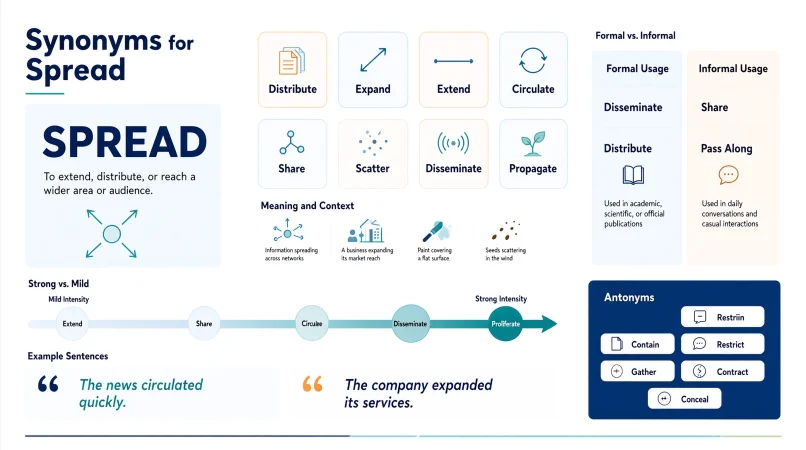
Spread means to extend, distribute, scatter, or make something reach a wider area or group. Useful synonyms include distribute, expand, extend, circulate, disseminate, scatter, broadcast, share, and propagate. The best choice depends on whether you mean physical movement, information sharing, growth, or wider coverage.
The word spread appears in many kinds of writing. You might spread information in an email, spread a message on social media, spread butter on toast, or describe how a rumor travels. Using the same word repeatedly can make your writing less precise.
Choosing another word for spread depends on what you mean. This guide explores alternatives for different situations, from formal reports and academic writing to everyday conversation and creative descriptions. You will learn which synonyms fit naturally, how their meanings differ, and when a replacement may change the meaning of your sentence.
Meaning, Tone and Context
Simple Definition
Spread means to make something extend over a larger area, reach more people, move in different directions, or become more widely available.
It can describe physical actions, such as spreading a blanket, as well as abstract ideas, such as spreading awareness or information.
Part of Speech
Spread can function as both a verb and a noun.
| Part of Speech | Meaning | Example |
| Verb | To extend, distribute, or make something reach farther | They spread the news quickly. |
| Noun | The extent, range, or distribution of something | The report shows the spread of the disease. |
| Adjective | Used in compound descriptions to indicate something distributed or extended | The map shows the spread pattern. |
Tone and Formality
Spread is generally neutral. Its tone changes according to the subject and context.
- Positive: Spread kindness, hope, awareness, or encouragement.
- Negative: Spread rumors, misinformation, disease, or fear.
- Neutral: Spread seeds, paint, butter, or information.
The word works in casual, professional, and academic writing. However, a more specific synonym can make formal communication clearer.
Common Use Cases
You can use spread when describing:
- Information reaching a wider audience.
- News, rumors, or opinions circulating among people.
- Growth across a region or population.
- Physical materials covering a surface.
- Ideas, beliefs, or cultural practices reaching new communities.
- Illness or infection moving between people.
- Resources or responsibilities being distributed.
Important Word Forms
| Word Form | Meaning | Example |
| Spread | Base form and present tense | We spread awareness. |
| Spread | Past tense | The message spread quickly. |
| Spread | Past participle | The news has spread everywhere. |
| Spreading | Present participle | The fire is spreading. |
| Spreader | A person or thing that spreads something | The tool is a butter spreader. |
The verb spread is irregular. Its base form, past tense, and past participle are all spelled the same way.
When and How to Use “Spread”
Use spread when something extends, moves outward, reaches more people, or covers a larger surface. The word is flexible, but the surrounding context determines its exact meaning.
Here are practical examples from everyday and professional situations.
1. Professional: The company plans to spread information about its new services through email campaigns.
2. Academic: Researchers studied how misinformation spread across online communities.
3. Personal: She spread a warm blanket over her tired child.
4. Social media: The video spread rapidly after several popular accounts shared it.
5. Health: Public health officials worked to prevent the infection from spreading.
6. Creative: Golden sunlight spread across the quiet valley.
7. Business: The organization wants to expand its services into new markets.
Notice that some examples use spread naturally, while others become more precise with words such as expand, circulate, or disseminate.
Another Word for “Spread”
The best single replacement for spread is usually distribute when something is being given or delivered to several people or places. However, distribute does not work for every meaning of spread.
Choose your synonym according to the action you want to describe.
| Situation | Best Alternative | Why It Works |
| Professional writing | Distribute | Describes giving information or resources to different recipients. |
| Academic writing | Disseminate | Refers to communicating research, knowledge, or findings widely. |
| Casual conversation | Share | Sounds natural when giving information or experiences to others. |
| Emotional writing | Radiate | Describes expressing or showing a feeling outwardly. |
| Creative writing | Unfurl | Creates an image of something opening or extending. |
| Resume or workplace use | Expand | Shows growth in responsibilities, services, or reach. |
| Social media captions | Share | Fits content, messages, photos, and ideas reaching an audience. |
| Stronger meaning | Propagate | Suggests active or continued multiplication and transmission. |
| Softer meaning | Extend | Describes gradual or moderate expansion. |
When Not to Use “Spread”
Although spread is useful, it can sound too general when the reader needs to understand exactly what happened.
For example, saying that a company spread its services does not clearly explain whether it opened new branches, reached new customers, or offered additional products.
Consider these improvements:
| General Sentence | More Precise Sentence | Why It Is Better |
| The company spread its operations. | The company expanded its operations. | Expanded clearly communicates business growth. |
| The team spread the documents. | The team distributed the documents. | Distributed explains how the documents reached people. |
| The news spread through the office. | The news circulated throughout the office. | Circulated describes information moving among people. |
| The organization spread knowledge. | The organization disseminated knowledge. | Disseminated sounds more appropriate in formal communication. |
| The paint spread across the wall. | The paint coated the wall. | Coated describes the resulting surface coverage. |
Use spread when the meaning is clear. Replace it when a more specific verb communicates the action more accurately.
Words Commonly Confused With “Spread”
Several words have meanings close to spread, but they describe different actions. Understanding these differences helps you choose a more accurate expression.
| Word | Meaning | When It Is Better |
| Expand | To become larger or increase in scope | Business growth, services, operations, or opportunities |
| Distribute | To give or deliver something to different people or places | Documents, resources, products, or supplies |
| Extend | To make something longer, wider, or more extensive | Deadlines, coverage, invitations, or physical reach |
| Scatter | To throw or distribute things in different directions | Seeds, papers, objects, or people |
| Circulate | To move among people or places | News, messages, documents, and rumors |
| Disseminate | To distribute information or knowledge widely | Research, official information, and educational material |
Spread vs. expand: Spread can describe movement across an area or audience. Expand focuses on becoming larger in size, number, or scope.
Spread vs. distribute: Spread has several meanings, including covering a surface or reaching a wider audience. Distribute specifically emphasizes giving or delivering something to multiple recipients.
- Spread vs. extend: Extend usually emphasizes increasing length, reach, or duration. Spread often suggests movement across a wider area.
- Spread vs. scatter: Scatter suggests objects or people moving in separate directions, sometimes randomly. Spread can describe a more gradual or organized extension.
- Spread vs. circulate: Circulate is especially useful for information that passes from one person or place to another.
- Spread vs. disseminate: Disseminate is more formal and commonly appears in academic, scientific, and professional communication.
Best Synonym by Context for “Spread”
The most suitable synonym depends on what is spreading and how it moves.
| Context | Best Synonym | Why It Works | Example |
| Formal writing | Disseminate | Communicates wide distribution in a formal tone | The agency disseminated the updated guidelines. |
| Academic writing | Circulate | Describes information moving among researchers | The findings circulated among academic departments. |
| Professional or business use | Distribute | Clearly describes delivery to different recipients | Please distribute the report to all team members. |
| Resume | Expand | Highlights growth and increased responsibility | Expanded customer outreach across three regions. |
| Casual conversation | Share | Sounds natural and friendly | She shared the news with her friends. |
| Creative writing | Unfurl | Creates an image of something opening outward | The golden fields unfurled beneath the morning sun. |
| Emotional tone | Radiate | Describes feelings or qualities expressed outwardly | Her confidence radiated throughout the room. |
| Strong intensity | Propagate | Suggests continued transmission or multiplication | The false claim continued to propagate online. |
| Soft or moderate tone | Extend | Suggests gradual increase in reach | The shade extended across the garden. |
| Social media captions | Share | Fits posts, images, videos, and messages | Share a little kindness today. |
| Physical coverage | Coat | Describes covering a surface | Coat the bread with a thin layer of butter. |
| Movement in many directions | Scatter | Describes separate movement or distribution | The wind scattered leaves across the road. |
| News and rumors | Circulate | Describes information passing between people | A rumor began to circulate at school. |
| Business growth | Broaden | Emphasizes increasing range or scope | The company broadened its service offerings. |
| US and UK usage | Spread | A familiar and natural choice in both varieties | The message spread throughout the community. |
Which Synonym Should You Choose?
Before replacing spread, identify the action in your sentence. A synonym should preserve the intended meaning rather than simply sound more sophisticated.
Use this practical guide:
- For information: Choose share, circulate, or disseminate. Use disseminate when the tone is formal.
- For business growth: Choose expand, broaden, or extend, depending on what is becoming larger.
- For physical coverage: Choose coat, cover, or smear when describing a material placed over a surface.
- For objects moving outward: Choose scatter or disperse.
- For public awareness: Choose promote, communicate, or publicize.
- For feelings and qualities: Choose radiate when an emotion or quality is visibly expressed.
- For biological or repeated transmission: Choose propagate when something continues to multiply or pass onward.
A useful rule is to ask whether something is being covered, delivered, extended, shared, or multiplied. That one distinction often reveals the best word.
Real Life Examples of “Spread” in Sentences
Here are examples showing how related words can make everyday and professional writing more specific.
| Situation | Example Sentence |
| School | The teacher distributed worksheets before the lesson began. |
| Workplace | The manager circulated the updated schedule among employees. |
| Writing | The author disseminated useful information through a series of articles. |
| Conversation | I shared the exciting news with my family. |
| Social media | The campaign encouraged people to share positive messages online. |
| Resume | Expanded the company’s customer outreach to new markets. |
| Please distribute this announcement to the relevant departments. | |
| Storytelling | Moonlight stretched across the empty road as the night grew quiet. |
These examples show why choosing a precise synonym matters. Distribute describes delivery, circulate describes movement among people, and stretch creates a visual image.
25 Synonyms for “Spread”
The word spread has several meanings. It can describe distributing something among people, making information widely known, expanding over an area, moving in different directions, or covering a surface. Depending on the context, different synonyms may communicate your intended meaning more accurately.
The following 25 synonyms and related expressions include simple definitions, recommended uses, and example sentences.
Synonyms for Spread Meaning Distribute or Share Information
These alternatives are useful when describing the distribution of information, resources, messages, news, or ideas among people.
| Synonym | Simple Meaning | Best Used For | Example Sentence |
|---|---|---|---|
| 1. Distribute | To give something to several people or places | Documents, supplies, and resources | The school distributed books to new students. |
| 2. Disseminate | To share information widely | Research and formal communication | The researchers disseminated their findings. |
| 3. Circulate | To move among people or places | News, messages, and documents | The announcement circulated throughout the office. |
| 4. Broadcast | To send information to a large audience | Television, radio, and public messages | The station broadcast the announcement nationwide. |
| 5. Share | To give or communicate something to others | Conversations, posts, and experiences | She shared her ideas during the meeting. |
| 6. Transmit | To pass something from one place or person to another | Signals, diseases, and information | Radio equipment transmitted the signal clearly. |
| 7. Publicize | To make information known to the public | Events, announcements, and campaigns | The team publicized the upcoming fundraiser. |
| 8. Promote | To encourage awareness or acceptance | Causes, products, and campaigns | The group promoted awareness of local environmental issues. |
| 9. Promulgate | To make information, rules, or ideas officially known | Laws, policies, and formal announcements | The agency promulgated new safety regulations. |
Synonyms for Spread Meaning Expand or Increase Reach
Use these words when something becomes larger, reaches farther, or increases its range, influence, or coverage.
| Synonym | Simple Meaning | Best Used For | Example Sentence |
|---|---|---|---|
| 10. Expand | To become larger or more extensive | Businesses, services, and operations | The company plans to expand into new markets. |
| 11. Extend | To increase length, reach, or coverage | Physical areas, deadlines, and services | The park extended its walking trails. |
| 12. Broaden | To increase range or scope | Knowledge, experience, and services | Travel helped broaden her perspective. |
| 13. Widen | To make or become wider | Roads, gaps, and coverage | The city widened the road near the school. |
| 14. Radiate | To send out light, heat, or an expressed quality | Energy, warmth, and emotion | Her enthusiasm radiated throughout the room. |
| 15. Propagate | To multiply or transmit something | Plants, ideas, and information | The organization works to propagate accurate information. |
Synonyms for Spread Meaning Scatter or Move in Different Directions
These alternatives describe things moving outward, separating, or gradually spreading through an area.
| Synonym | Simple Meaning | Best Used For | Example Sentence |
|---|---|---|---|
| 16. Scatter | To send things in different directions | Objects, seeds, and leaves | The children scattered flower seeds across the garden. |
| 17. Disperse | To move or distribute in different directions | Crowds, particles, and groups | The crowd dispersed after the event. |
| 18. Diffuse | To spread gradually through an area or substance | Light, heat, gases, and tension | Soft light diffused through the curtains. |
| 19. Unfurl | To open or spread out from a folded or rolled position | Flags, leaves, and fabric | The flag unfurled in the morning breeze. |
| 20. Extend outward | To reach farther from a central point | Physical growth and movement | The branches extended outward over the fence. |
Synonyms for Spread Meaning Cover or Coat a Surface
These words describe placing a substance or material over an object, area, or surface.
| Synonym | Simple Meaning | Best Used For | Example Sentence |
|---|---|---|---|
| 21. Cover | To place something over an area or surface | Materials, objects, and spaces | Fresh snow covered the entire field. |
| 22. Coat | To apply a layer over a surface | Paint, food, and protective materials | Coat the vegetables with olive oil. |
| 23. Smear | To spread a soft substance over a surface | Creams, paint, and food | He smeared butter across the warm toast. |
| 24. Blanket | To cover an area or surface completely | Snow, clouds, and physical coverage | A thick layer of snow blanketed the field. |
| 25. Permeate | To spread throughout something, often gradually | Smells, substances, and influences | The aroma of fresh coffee permeated the kitchen. |
How to Choose the Right Synonym for “Spread”
Choose a synonym based on what is being spread and how it moves. Use distribute for sharing resources, disseminate for spreading information, and broadcast for communicating with a large audience. Choose expand or broaden when something increases in size or scope, and scatter or disperse when objects move in different directions.
For physical coverage, cover, coat, and smear are useful alternatives. Use permeate when something gradually spreads throughout an area or substance.
Important usage note: These 25 words are not interchangeable in every sentence. Coat describes applying a layer to a surface, while publicize means making information known to the public. Similarly, unfurl describes opening something folded or rolled, whereas disseminate refers to distributing information widely. Always consider the intended meaning before choosing a replacement.
Synonym Groups and Usage Differences
Different synonyms of spread suit different audiences, subjects, and writing styles. The following groups make it easier to select a word that fits your purpose.
Professional vs. Personal Synonyms
Professional communication often benefits from precise verbs such as distribute, disseminate, circulate, and expand.
Personal communication usually sounds more natural with share, pass along, cover, or extend.
For example:
- Professional: The department circulated the revised policy.
- Personal: I shared the good news with my sister.
Formal vs. Conversational Synonyms
| Formal Synonym | Conversational Alternative | Example |
| Disseminate | Share | The organization shared its findings. |
| Distribute | Hand out | The teacher handed out the worksheets. |
| Circulate | Pass around | Please pass around the invitation. |
| Propagate | Spread | The idea spread among local communities. |
| Publicize | Tell people about | They told people about the upcoming event. |
Formal words work well in reports, essays, research papers, and official emails. Conversational alternatives are often better for texts, everyday discussions, and friendly messages.
Academic Synonyms
Academic writing benefits from words that explain how information, ideas, or findings reach a wider audience.
- Disseminate: Suitable for research findings, knowledge, and educational information.
- Circulate: Useful when documents or ideas move among researchers.
- Propagate: Appropriate when describing the transmission or reproduction of ideas, organisms, or information.
- Diffuse: Useful for describing the gradual movement of substances, energy, or influence.
- Permeate: Describes something that gradually reaches or affects every part of a system or environment.
Example: The researchers disseminated their findings through academic publications.
Professional and Business Synonyms
In workplace communication, choose verbs that explain the action clearly.
- Distribute: Send documents, reports, or resources to different people.
- Circulate: Share information among employees or departments.
- Expand: Increase the size or reach of a business.
- Broaden: Increase the range of products, services, or opportunities.
- Publicize: Make a product, service, or event known to the public.
Example: The company expanded its operations and broadened its customer base.
For a resume, use specific action verbs that show what you accomplished. Instead of writing “Spread information about new products,” write “Promoted new products through targeted customer campaigns.”
Creative or Literary Synonyms
Creative writing often benefits from verbs that create a clear mental picture.
- Unfurl: Suggests something opening gradually.
- Radiate: Creates an image of light, warmth, or emotion moving outward.
- Permeate: Describes something passing through every part of a place or atmosphere.
- Overspread: Suggests covering a large surface or area.
- Diffuse: Describes something spreading gently or gradually.
Example: A soft golden glow permeated the room.
Slang or Modern Synonyms
Spread does not have one universal slang replacement. In casual online communication, people often use familiar expressions such as:
- Go viral: Become extremely popular or widely shared online.
- Blow up: Become suddenly popular or receive significant attention.
- Get around: Become known among a group of people.
Example: Her video went viral overnight.
These expressions are suitable for informal conversations and social media. In academic writing or professional reports, use more precise alternatives such as circulate, gain attention, or be widely shared.
Strongest vs. Weaker Synonyms
The intensity of a synonym depends on what is spreading. This scale is a practical guide rather than a strict ranking.
| Intensity | Word | Meaning |
| Mild | Extend | Reach a little farther or become longer |
| Mild | Share | Pass something to another person |
| Moderate | Distribute | Deliver something to several recipients |
| Moderate | Circulate | Move through a group or network |
| Strong | Disseminate | Distribute information widely |
| Strong | Propagate | Transmit or multiply something over time |
| Very strong | Proliferate | Increase rapidly in number or quantity |
| Very strong | Permeate | Reach throughout an entire place or system |
For example, share sounds simple and neutral, while proliferate suggests rapid growth or multiplication.
Emotional vs. Neutral Synonyms
Some words describe an action without expressing a strong feeling. Others add emotional or descriptive meaning.
| Neutral Synonyms | Emotional or Expressive Synonyms |
| Distribute | Radiate |
| Circulate | Permeate |
| Extend | Unfurl |
| Expand | Overspread |
| Share | Flood |
Use neutral words in reports and instructions. Choose expressive alternatives when you want readers to imagine a scene or feel the emotional effect.
Antonyms of “Spread”
The word spread does not have one exact opposite because its meaning changes with context. The opposite of spreading information may be suppressing or concealing it, while the opposite of expanding may be shrinking or contracting. Similarly, the opposite of covering a surface may be uncovering it.
The following 15 words and expressions are contextual antonyms or contrasting terms rather than exact dictionary opposites.
Antonyms of Spread Meaning Limit or Contain
These words describe keeping something within boundaries, preventing it from moving freely, or limiting its reach.
| Antonym | Meaning | Example Sentence |
|---|---|---|
| 1. Contain | Keep something within limits | The barriers helped contain the fire. |
| 2. Restrict | Limit the movement or reach of something | The policy restricted access to the information. |
| 3. Confine | Keep something within a particular area | Workers confined the spill to one section. |
Antonyms of Spread Meaning Gather or Bring Together
Use these alternatives when something is collected, concentrated, or combined instead of being distributed across different places.
| Antonym | Meaning | Example Sentence |
|---|---|---|
| 4. Concentrate | Bring things together in one place | The company concentrated its resources in one region. |
| 5. Gather | Bring separate things or people together | Volunteers gathered the scattered supplies. |
| 6. Collect | Bring items together into one place | The staff collected the documents after the meeting. |
| 7. Consolidate | Combine separate parts into a whole | The business consolidated its regional offices. |
Antonyms of Spread Meaning Become Smaller or Contract
These words describe a reduction in size, area, volume, or physical extent rather than expansion.
| Antonym | Meaning | Example Sentence |
|---|---|---|
| 8. Compress | Reduce something into a smaller space | The machine compressed the material into a compact block. |
| 9. Contract | Become smaller or narrower | The metal contracted as it cooled. |
| 10. Shrink | Become smaller in size or extent | The fabric shrank after washing. |
Antonyms of Spread Meaning Stop or Hide Information
These terms are useful when spread refers to sharing news, information, messages, or ideas with others.
| Antonym | Meaning | Example Sentence |
|---|---|---|
| 11. Withdraw | Remove or take something back | The organization withdrew its public announcement. |
| 12. Suppress | Prevent information or activity from becoming known or continuing | The authorities tried to suppress the report. |
| 13. Conceal | Keep something hidden | He concealed the documents in a drawer. |
| 14. Cover up | Hide something from view or public knowledge | The company tried to cover up the mistake. |
Antonyms of Spread Meaning Remove a Covering or Reveal
This term provides a contrast when spread means covering a surface or hiding something beneath a layer.
| Antonym | Meaning | Example Sentence |
|---|---|---|
| 15. Uncover | Remove a covering or reveal something hidden | The investigation uncovered new evidence. |
How to Choose the Right Opposite of “Spread”
The correct opposite depends on what spread means in your sentence. Use contain, restrict, or confine when discussing limits. Choose gather, collect, or consolidate when bringing separate things together. Use shrink or contract when describing a reduction in size.
When discussing information, suppress or conceal may express the intended contrast. If spread means covering a surface, uncover is often the more appropriate opposite.
Important usage note: These words are contextual contrasts, not interchangeable antonyms. For example, suppress refers to preventing something from becoming known or continuing, while uncover means revealing something hidden. Always consider the specific meaning of spread before choosing its opposite.
SEO tip: Grouping antonyms by meaning helps readers understand different word relationships and makes vocabulary articles easier to scan. Use descriptive subheadings to keep longer sections organized.
Comparison: Spread vs. Similar Words
The following comparisons explain how spread differs from six related words. These distinctions are especially useful when editing essays, reports, emails, and articles.
Spread vs. Expand
Main difference: Spread describes movement across an area or audience. Expand means to become larger in size, number, or scope.
Stronger word: Expand often communicates measurable growth more clearly.
More formal: Both work in formal writing, but expand is more precise for business growth.
- Spread: The company spread its services across the region.
- Expand: The company expanded its services across the region.
Spread vs. Distribute
Main difference: Spread has several meanings, while distribute specifically means delivering or giving something to different recipients.
Stronger word: Neither is universally stronger. Distribute is more specific for delivery.
More formal: Both are suitable for professional communication.
- Spread: The school spread the learning materials among students.
- Distribute: The school distributed learning materials to students.
Spread vs. Extend
Main difference: Spread often suggests movement over a wider area. Extend emphasizes greater length, duration, or reach.
Stronger word: Spread can suggest wider coverage, while extend emphasizes added reach.
More formal: Both are appropriate for formal writing.
- Spread: The branches spread across the garden.
- Extend: The branches extended over the garden wall.
Spread vs. Scatter
Main difference: Spread can describe organized or gradual movement. Scatter suggests movement in separate directions.
Stronger word: Scatter often creates a stronger image of objects moving apart.
More formal: Both are neutral, but scatter is more descriptive.
- Spread: The wind spread the leaves across the lawn.
- Scatter: The wind scattered leaves in every direction.
Spread vs. Circulate
Main difference: Spread can describe physical coverage, growth, or communication. Circulate usually describes something moving among people or places.
Stronger word: Spread is broader. Circulate is more specific for information moving through a group.
More formal: Both work in professional writing.
- Spread: The news spread throughout the office.
- Circulate: The news circulated throughout the office.
Spread vs. Disseminate
Main difference: Spread is a general word. Disseminate specifically refers to distributing information, knowledge, or ideas widely.
Stronger word: Disseminate sounds more formal and precise for sharing information on a large scale.
More formal: Disseminate is the more formal choice.
- Spread: The organization spread information about the program.
- Disseminate: The organization disseminated information about the program.
Common Phrases and Expressions With “Spread”
These expressions show how spread appears in everyday English, professional communication, and descriptive writing.
1. Spread the Word
Meaning: Tell other people about something so they can share the information.
Example sentence: Please spread the word about our community event.
2. Spread Awareness
Meaning: Help more people understand an issue, cause, or subject.
Example sentence: The campaign aims to spread awareness about online safety.
3. Spread the News
Meaning: Tell people about recent information or an event.
Example sentence: She could not wait to spread the news about her promotion.
4. Spread Like Wildfire
Meaning: Become known or popular very quickly.
Example sentence: The story spread like wildfire across social media.
5. Spread Out
Meaning: Move apart or arrange things over a larger area.
Example sentence: The students spread out across the library to find quiet places to study.
6. Spread Across
Meaning: Extend over or reach different parts of an area.
Example sentence: Dark clouds spread across the evening sky.
7. Spread Throughout
Meaning: Reach or cover all parts of a particular place or group.
Example sentence: The announcement spread throughout the organization.
8. Spread the Message
Meaning: Communicate an idea or belief to a wider audience.
Example sentence: The volunteers used social media to spread the message of kindness.
Common Mistakes to Avoid
Choosing a synonym without checking its meaning can make a sentence confusing. Avoid these common vocabulary mistakes.
1. Using spread when a more precise verb is available.
General: The company spread its business.
Better: The company expanded its business.
Expand clearly communicates business growth.
2. Confusing spread with distribute.
Spread can mean covering an area or reaching a wider audience. Distribute specifically describes delivering something to multiple recipients.
3. Using casual language in formal writing.
Casual: The news got around quickly.
Formal: The news circulated quickly.
Circulated is more appropriate for reports and professional communication.
4. Choosing an overly dramatic synonym.
Unnatural: The teacher propagated the worksheets to students.
Better: The teacher distributed the worksheets to students.
Propagate usually describes multiplication or transmission, not ordinary document delivery.
5. Repeating spread too often.
Repetitive: The message spread online, spread among students, and spread throughout the school.
Better: The message circulated online, reached students, and became widely known throughout the school.
6. Choosing the wrong emotional tone.
Radiate works when describing warmth, confidence, or happiness. It is not a natural replacement for distributing documents or sharing research.
7. Using slang in academic or professional writing.
Casual: The video blew up online.
Formal: The video gained widespread attention online.
Use slang only when the audience and communication style make it appropriate.
FAQs
1. What is the best synonym for spread?
Distribute is useful when giving something to several people. Expand works for growth, while circulate and disseminate suit information.
2. What is a formal synonym for spread?
Disseminate is a formal synonym when discussing information, research, or knowledge. Distribute and circulate are also suitable in professional contexts.
3. What is an informal synonym for spread?
Share is a natural informal alternative when talking about information, experiences, photos, or ideas. Pass along also works in conversation.
4. What is another word for spread in professional writing?
Use distribute for resources, circulate for documents, disseminate for information, and expand for business growth or wider operations.
5. What is the difference between spread and expand?
Spread describes movement across an area or audience. Expand focuses on becoming larger in size, number, or scope.
6. What is the opposite of spread?
There is no single opposite for every meaning. Contain, restrict, gather, contract, and conceal can express contrasting actions depending on context.
Conclusion
Spread refers to covering an area, sharing information, increasing, or distributing something. Common synonyms include distribute, expand, circulate, disseminate, scatter, extend, and share.
Choose distribute for resources, disseminate for knowledge, expand for growth, and circulate for information. Always consider the context to select the most accurate synonym and maintain clear, natural writing.