
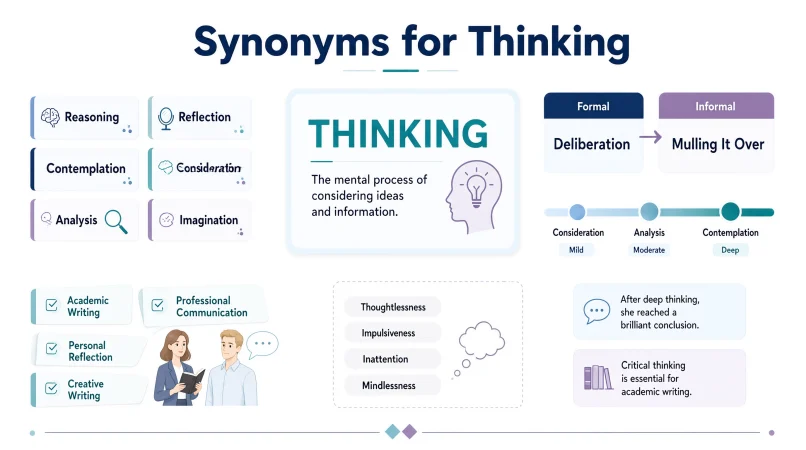
Thinking is the mental process of considering information, forming ideas, solving problems, or making decisions. Common alternatives include thought, reasoning, reflection, contemplation, consideration, and deliberation, depending on the context and depth of the mental activity.
Using the word thinking repeatedly can make an essay, email, presentation, or everyday conversation sound less precise. You might be describing careful reasoning, a personal opinion, creative imagination, or simply considering an idea. Each situation calls for a different expression.
The best synonyms for thinking depend on what the mind is doing. Words such as reasoning, reflection, contemplation, consideration, and thought can communicate different mental activities and levels of depth.
This guide explains their meanings, tones, and practical uses. You will learn how to choose natural alternatives for academic writing, professional communication, personal expression, and creative work without changing your intended meaning.
Meaning, Tone and Context
Simple Definition
Thinking is the process of using your mind to understand information, develop ideas, consider possibilities, remember experiences, or reach conclusions.
It can happen deliberately, such as when solving a difficult problem, or naturally, such as when reflecting on an experience.
Part of Speech
Thinking has several grammatical uses:
1. Noun or gerund: The activity or process of using the mind.
Example: Critical thinking helps students evaluate information.
2. Present participle: The ongoing action of the verb think.
Example: She is thinking about a new business idea.
3. Adjective: Describing someone or something that uses thought or judgment.
Example: A thinking person questions assumptions.
Tone and Formality
Thinking is a neutral word. It works in casual conversations, academic writing, workplace communication, and personal discussions.
Its alternatives can carry more specific meanings. Reasoning sounds analytical, reflection suggests reviewing an experience, and contemplation often describes deep or sustained consideration.
Common Use Cases
- Education: Critical thinking, logical thinking, and independent thinking.
- Workplace: Strategic thinking, creative thinking, and decision making.
- Personal life: Reflection, consideration, and personal thoughts.
- Problem solving: Analysis, reasoning, and evaluation.
- Creative work: Imagination, brainstorming, and inspiration.
- Emotional situations: Introspection and thoughtful consideration.
Important Word Forms
| Word Form | Part of Speech | Meaning | Example |
| Think | Verb | To use the mind or form an opinion | I think this approach will work. |
| Thinking | Noun or participle | The process or action of using the mind | Her thinking has changed. |
| Thought | Noun or past tense verb | An idea, or the act of thinking | That thought changed my decision. |
| Thoughtful | Adjective | Showing careful consideration or kindness | She gave a thoughtful response. |
| Thoughtfully | Adverb | In a careful or considerate manner | He answered thoughtfully. |
| Thinker | Noun | A person who thinks deeply or creatively | She is an independent thinker. |
| Rethink | Verb | To consider something again | We need to rethink the plan. |
| Overthinking | Noun or gerund | Thinking about something excessively | Overthinking can make simple decisions difficult. |
When and How to Use “Thinking”
Use thinking when describing the mental process of considering information, developing ideas, evaluating options, or making decisions.
Here are examples from different situations.
1. Professional: Strategic thinking helps managers plan for long term business goals.
2. Academic: Critical thinking allows students to evaluate evidence before reaching conclusions.
3. Personal: I have been thinking about my future career.
4. Emotional: Her quiet thinking helped her understand her feelings.
5. Creative: Creative thinking can turn an ordinary idea into something original.
6. Social media: A little positive thinking can change your perspective.
7. Email: I am thinking about your suggestion and will share my feedback soon.
Another Word for “Thinking”
There is no single replacement that fits every use of thinking. The best choice depends on whether you mean forming an opinion, analyzing information, reviewing an experience, or imagining something new.
| Situation | Recommended Alternative | Why It Works |
| Professional writing | Reasoning | Emphasizes logical judgment. |
| Academic writing | Critical analysis | Highlights careful examination of information. |
| Casual conversation | Thoughts | Sounds natural when sharing ideas or opinions. |
| Emotional writing | Reflection | Suggests reviewing personal experiences and feelings. |
| Creative writing | Imagination | Focuses on developing original ideas. |
| Resume or workplace use | Strategic thinking | Describes planning and sound judgment. |
| Social media captions | Mindset | Expresses a person’s general attitude or outlook. |
| Stronger meaning | Deep contemplation | Suggests sustained and serious mental attention. |
| Softer meaning | Consideration | Describes calmly thinking about an idea or choice. |
Best Choice by Writing Purpose
- Professional: Use reasoning, strategic thinking, or analysis when discussing workplace decisions.
- Academic: Choose critical thinking, evaluation, or analytical reasoning.
- Casual: Use thoughts, ideas, or consideration.
- Emotional: Choose reflection or introspection.
- Creative: Use imagination, brainstorming, or creative thought.
When Not to Use “Thinking”
Although thinking is a flexible word, it can be too general when you want to describe a particular mental activity.
A more precise alternative helps readers understand whether someone is analyzing facts, making a decision, remembering something, or imagining possibilities.
| General Sentence | More Precise Sentence | Why It Is Better |
| My thinking helped me decide. | My reasoning helped me reach a decision. | Highlights logical judgment. |
| She spent hours thinking. | She spent hours contemplating the decision. | Emphasizes deep consideration. |
| His thinking is different. | His perspective is different. | Focuses on his point of view. |
| We need better thinking. | We need a more effective problem solving approach. | Identifies the improvement needed. |
| I was thinking about the past. | I was reflecting on past experiences. | Emphasizes reviewing memories. |
Avoid replacing thinking with a complicated word simply to sound intelligent. The replacement should communicate a more accurate meaning.
Words Commonly Confused With “Thinking”
Several words describe mental activities, but each has a distinct meaning.
| Word | Meaning | Difference From Thinking |
| Thought | An idea or the mental activity that produces ideas | Can refer to a single idea rather than the ongoing process. |
| Reasoning | Using logic to reach a conclusion | Focuses on logical connections and judgment. |
| Reflection | Carefully reviewing an experience, idea, or decision | Often involves looking back and learning. |
| Imagination | Creating ideas or mental images | Focuses on possibilities that may not exist in reality. |
| Opinion | A personal belief or judgment | Represents what someone believes, not the process of forming it. |
| Mindset | A person’s general way of thinking | Describes an established attitude or mental approach. |
For example, thinking describes a mental process, reasoning emphasizes logic, and opinion expresses a conclusion or personal view.
Best Synonym by Context for Thinking
Choose an alternative that reflects the mental activity you want to describe.
| Context | Best Synonym | Why It Works | Example |
| Formal writing | Consideration | Communicates careful attention to an issue | The proposal deserves further consideration. |
| Academic writing | Critical thinking | Emphasizes evaluation and independent judgment | Critical thinking improves the quality of research. |
| Professional or business use | Strategic thinking | Highlights planning and long term judgment | Strategic thinking supports business growth. |
| Resume | Analytical thinking | Shows the ability to examine information | Applied analytical thinking to solve operational problems. |
| Casual conversation | Thoughts | Sounds natural when sharing ideas | I would like to hear your thoughts. |
| Creative writing | Imagination | Focuses on original ideas and possibilities | Her imagination transformed the ordinary setting. |
| Emotional tone | Introspection | Suggests examining personal feelings and motives | Introspection helped him understand his choices. |
| Deep mental activity | Contemplation | Indicates sustained and serious consideration | After careful contemplation, she accepted the offer. |
| Soft or moderate tone | Reflection | Suggests calm and thoughtful review | A little reflection helped clarify the situation. |
| Social media captions | Mindset | Communicates an attitude or outlook | A positive mindset can change your day. |
| Problem solving | Reasoning | Focuses on reaching logical conclusions | Clear reasoning helped the team find a solution. |
| Decision making | Deliberation | Suggests careful consideration before choosing | The board reached its decision after deliberation. |
| Idea development | Brainstorming | Describes generating several possible ideas | The team used brainstorming to develop new concepts. |
| US and UK usage | Thinking | Standard in both varieties of English | Independent thinking is encouraged in both classrooms. |
Which Synonym Should You Choose?
Before replacing thinking, consider these five questions.
1. What is happening in the mind? Use reasoning for logic, reflection for reviewing experiences, and imagination for creating ideas.
2. How deep is the mental activity? Use consideration for ordinary evaluation, contemplation for sustained thought, and deliberation for careful decision making.
3. Who will read your writing? Academic readers may expect terms such as critical thinking or analysis. Everyday readers may prefer thoughts or ideas.
4. What quality do you want to emphasize? Choose analytical thinking for examining information, creative thinking for originality, and strategic thinking for planning.
5. Does the replacement preserve the meaning? A person’s mindset is not the same as a moment of thinking. An opinion is not the same as the process used to form it.
Simple rule: Identify the mental activity first, then choose the word that describes it most accurately.
Real Life Examples of Thinking in Sentences
The following examples show how related words can make sentences clearer and more specific.
| Situation | Example Sentence |
| School | Critical thinking helps students distinguish reliable information from unsupported claims. |
| Workplace | Strategic thinking helped the manager prepare for changing market conditions. |
| Writing | Careful consideration of the topic improved the final essay. |
| Conversation | I would like to know your thoughts on this idea. |
| Social media | A positive mindset can help you approach challenges with confidence. |
| Resume | Used analytical thinking to identify problems and improve work processes. |
| After further consideration, I agree with your recommendation. | |
| Storytelling | Deep contemplation kept him awake long after everyone had gone to sleep. |
25 Synonyms for “Thinking”
The word thinking refers to the mental process of forming ideas, considering information, solving problems, and making decisions. Depending on the context, you can use alternatives that describe logical reasoning, deep reflection, creative thought, or careful evaluation.
The following 25 synonyms and related expressions include simple meanings, recommended uses, and example sentences to help you choose the right word.
Synonyms for Thinking Meaning General Thought or Reflection
These words describe the general process of considering ideas, reviewing experiences, or giving attention to something.
| Synonym | Simple Meaning | Best Used For | Example Sentence |
|---|---|---|---|
| 1. Thought | An idea or mental activity | General writing and conversation | One thought changed her entire approach. |
| 2. Reflection | Carefully reviewing ideas or experiences | Personal and professional writing | Reflection helped her recognize what needed to change. |
| 3. Consideration | Giving attention to an idea or possibility | Professional communication | Your suggestion deserves serious consideration. |
| 4. Pondering | Thinking carefully about something | Casual and literary writing | He was pondering the meaning of the message. |
| 5. Musing | Quietly thinking about an idea | Creative and conversational writing | Her musings often inspired new stories. |
| 6. Contemplation | Deep and sustained consideration | Formal and literary writing | After hours of contemplation, he made his choice. |
| 7. Cogitation | Deep or careful mental consideration | Formal and literary writing | The problem required considerable cogitation. |
Synonyms for Thinking Meaning Logical Reasoning and Analysis
Use these alternatives when discussing logical processes, examining evidence, or reaching conclusions through careful thought.
| Synonym | Simple Meaning | Best Used For | Example Sentence |
|---|---|---|---|
| 8. Reasoning | Using logic to reach a conclusion | Academic and analytical writing | His reasoning was clear and convincing. |
| 9. Analysis | Examining information in detail | Research and business writing | The analysis revealed several important patterns. |
| 10. Ratiocination | The process of logical reasoning | Specialized and literary writing | The essay follows a careful process of ratiocination. |
| 11. Deliberation | Careful thought before making a decision | Formal and decision-making contexts | The committee reached its conclusion after lengthy deliberation. |
| 12. Critical thinking | Evaluating information and arguments carefully | Education and professional development | Critical thinking helps employees assess complex problems. |
| 13. Analytical thinking | Breaking information into parts to understand it | Research and workplace communication | Analytical thinking helped identify the source of the error. |
Synonyms for Thinking Meaning Self-Examination and Mental Focus
These expressions describe looking inward, examining personal experiences, or using focused mental practices.
| Synonym | Simple Meaning | Best Used For | Example Sentence |
|---|---|---|---|
| 14. Introspection | Examining one’s own thoughts and feelings | Personal development and psychology | Introspection helped him understand his reactions. |
| 15. Meditation | Focused mental practice or quiet reflection | Personal and spiritual contexts | Meditation gave her time to clear her mind. |
| 16. Rumination | Repeated or prolonged thinking about something | Psychology and personal reflection | Constant rumination made it difficult to relax. |
Synonyms for Thinking Meaning Creativity and Idea Generation
These alternatives focus on producing new ideas, exploring possibilities, and developing creative solutions.
| Synonym | Simple Meaning | Best Used For | Example Sentence |
|---|---|---|---|
| 17. Brainstorming | Generating several ideas | Teamwork and creative projects | Brainstorming produced three possible campaign concepts. |
| 18. Imagination | Creating mental pictures or original ideas | Creative work | Imagination gave the story its unusual ending. |
| 19. Ideation | Developing and generating ideas | Business and innovation | The design team began ideation for its next product. |
Synonyms for Thinking Meaning Evaluation and Understanding
These terms describe assessing information, interpreting situations, or understanding how the mind handles ideas.
| Synonym | Simple Meaning | Best Used For | Example Sentence |
|---|---|---|---|
| 20. Evaluation | Assessing the quality or value of something | Academic and professional writing | A careful evaluation revealed the strongest option. |
| 21. Assessment | Judging a situation or condition | Reports and decision-making | Her assessment considered the available evidence. |
| 22. Perception | The way someone understands or interprets something | Psychology and social discussions | His perception of the situation gradually changed. |
| 23. Mindset | A person’s general mental attitude | Personal development and workplace writing | A growth mindset encourages learning from mistakes. |
| 24. Deliberative thought | Careful thinking before reaching a decision | Academic and formal writing | Deliberative thought improved the quality of the decision. |
| 25. Mental processing | The way the mind handles information | Psychology and scientific contexts | Mental processing can vary with attention and experience. |
How to Choose the Right Synonym for “Thinking”
The best alternative depends on the type of mental activity you want to describe. Use reasoning for logical conclusions, reflection for reviewing experiences, and contemplation for deep consideration. Choose analysis when examining information, brainstorming when generating ideas, and introspection when exploring your own thoughts and feelings.
Important usage note: Not every term in this list is an exact synonym. Meditation is a focused mental practice, imagination involves creating mental possibilities, and rumination often refers to repetitive thought. Similarly, mindset describes a general mental attitude rather than the process of thinking itself. Always choose a word that matches your intended meaning.
Synonym Groups and Usage Differences
Professional vs. Personal Synonyms
Professional writing often emphasizes logic, judgment, and problem solving. Words such as reasoning, analysis, strategic thinking, and evaluation are useful in reports, meetings, presentations, and workplace discussions.
Personal writing may focus more on feelings, memories, and individual experiences. Reflection, introspection, pondering, and musing can communicate a more personal kind of mental activity.
For example:
- Professional: Strategic thinking helped the team improve its business plan.
- Personal: Reflection helped me understand why the experience mattered.
Formal vs. Conversational Synonyms
Formal alternatives are useful in research, reports, essays, and official communication. Conversational alternatives make everyday writing sound more natural.
| Formal Expression | Conversational Alternative |
| Deliberation | Careful thought |
| Contemplation | Thinking it over |
| Consideration | Giving it some thought |
| Analysis | Looking closely at something |
| Introspection | Looking inward |
| Pondering | Thinking about it |
Use formal expressions when the context requires precision. In everyday conversation, simple language is often more effective.
Academic Synonyms
Academic writing benefits from words that explain the mental process being discussed.
Useful expressions include:
- Critical thinking: Evaluating claims, evidence, and arguments.
- Analytical reasoning: Using logic to examine information and reach conclusions.
- Reflection: Reviewing experiences or ideas to develop understanding.
- Evaluation: Assessing the quality, value, or significance of information.
- Cognitive processing: The mental activities involved in receiving and handling information.
- Deliberation: Carefully considering different options before making a decision.
For example, instead of writing “Thinking is important in education,” write “Critical thinking is important in education because it helps students evaluate information and develop independent judgments.”
Professional and Business Synonyms
In business communication, choose terms that show how someone approaches decisions, solves problems, and develops ideas.
| Situation | Recommended Expression |
| Business planning | Strategic thinking |
| Solving complex problems | Analytical thinking |
| Reviewing a proposal | Consideration |
| Comparing performance | Evaluation |
| Generating new ideas | Brainstorming |
| Making an important decision | Deliberation |
| Reviewing a completed project | Reflection |
For resumes, avoid vague claims such as “Good at thinking.” Instead, describe a relevant skill: “Applied analytical thinking to identify process improvements and support business decisions.”
Creative or Literary Synonyms
Creative writing can use words that suggest different moods and styles of thought.
- Musing: Quiet, often imaginative thought.
- Pondering: Careful consideration of a question or problem.
- Contemplation: Deep and sustained thought.
- Imagination: The ability to create ideas and mental images.
- Cogitation: A formal or literary term for deep thinking.
For example:
- Simple: She was thinking about the journey.
- More descriptive: She was pondering the memories the journey had left behind.
- More reflective: She sat in quiet contemplation of the past.
Slang or Modern Synonyms
There is no single slang word that accurately replaces thinking in every context. However, informal expressions can make dialogue and casual communication sound natural.
| Expression | Meaning | Best Context |
| Mulling it over | Considering something carefully | Casual conversation |
| Thinking it through | Examining an idea or decision | Everyday speech |
| Brainstorming | Coming up with several ideas | Group discussions |
| Giving it some thought | Considering something | Informal messages |
| Getting your head around something | Trying to understand something difficult | Casual conversation |
Expressions such as mulling it over are suitable for conversation and informal emails, but formal academic writing usually benefits from consideration or deliberation.
Strongest vs. Weaker Synonyms
The following scale describes the depth or intensity generally suggested by each expression. It is not a universal ranking because the words describe different mental activities.
| Level | Expression | General Effect |
| Light | A passing thought | A brief or temporary idea |
| Moderate | Consideration | Giving attention to an issue |
| Focused | Analysis | Examining information carefully |
| Deep | Contemplation | Sustained and serious thought |
| Reflective | Introspection | Examining personal feelings and motives |
| Repetitive | Rumination | Thinking about something repeatedly, often unhelpfully |
Use consideration for ordinary evaluation, contemplation for deep thought, and rumination when repeated thinking is the intended meaning.
Emotional vs. Neutral Synonyms
Some alternatives describe thinking objectively, while others suggest personal feelings or repeated mental attention.
| Neutral Expression | More Personal or Emotional Expression | Difference |
| Analysis | Introspection | The second focuses on examining oneself. |
| Consideration | Pondering | The second can sound more personal or reflective. |
| Evaluation | Rumination | The second suggests repeated thought. |
| Thought | Musing | The second often sounds quiet and imaginative. |
| Reasoning | Contemplation | The second suggests deeper, sustained attention. |
Choose neutral expressions for factual reports and more reflective words for personal essays, storytelling, or emotional writing.
AAntonyms of “Thinking”
The word thinking does not have one exact opposite in every context. Its opposite may describe acting without careful consideration, lacking awareness, avoiding reflection, or responding through instinct rather than deliberate reasoning.
The following 15 words and expressions are contextual contrasts rather than perfect dictionary antonyms.
Antonyms of Thinking Meaning Lack of Careful Consideration
These terms describe situations in which someone acts or makes decisions without giving enough thought to the possible consequences.
| Antonym | Meaning | Example Sentence |
|---|---|---|
| 1. Thoughtlessness | Acting without sufficient consideration | Thoughtlessness can lead to avoidable mistakes. |
| 2. Carelessness | Lack of attention or caution | Carelessness caused several errors in the report. |
| 3. Impulsiveness | Acting suddenly without careful consideration | Impulsiveness led to a poor financial decision. |
| 4. Rashness | Acting too quickly without considering the consequences | His rashness made the situation worse. |
| 5. Unreflectiveness | A tendency not to examine ideas or actions carefully | Unreflectiveness can prevent people from learning from mistakes. |
Antonyms of Thinking Meaning Lack of Awareness or Attention
These alternatives describe situations in which a person does not notice, understand, or remain conscious of relevant information.
| Antonym | Meaning | Example Sentence |
|---|---|---|
| 6. Mindlessness | Acting without conscious attention or awareness | Mindlessness can make routine tasks less effective. |
| 7. Inattention | Failure to pay attention | Inattention caused him to miss an important detail. |
| 8. Unawareness | Lack of knowledge or consciousness of something | Her unawareness of the change created confusion. |
| 9. Ignorance | Lack of knowledge or information | Ignorance of the rules is not a substitute for learning them. |
| 10. Distraction | A condition that takes attention away from a task | Constant distraction interrupted her concentration. |
| 11. Forgetfulness | A tendency to forget information or responsibilities | Forgetfulness caused him to miss the appointment. |
Antonyms of Thinking Meaning Automatic or Instinctive Responses
These terms describe actions or reactions that happen without deliberate reasoning or conscious decision-making.
| Antonym | Meaning | Example Sentence |
|---|---|---|
| 12. Instinct | An immediate natural response without deliberate reasoning | She followed her instinct when making the choice. |
| 13. Reflex | An automatic response to a stimulus | His reflex made him pull his hand away. |
| 14. Automaticity | The quality of happening automatically, with little conscious effort | Automaticity allows familiar tasks to require less deliberate attention. |
Antonyms of Thinking Meaning Absence of Reflection
These expressions emphasize a lack of careful review, self-examination, or consideration before reaching a conclusion.
| Antonym | Meaning | Example Sentence |
|---|---|---|
| 15. Absence of reflection | A lack of careful review or consideration | The absence of reflection weakened the final decision. |
How to Choose the Right Opposite of “Thinking”
The appropriate contrasting term depends on the meaning of thinking in your sentence. Use thoughtlessness when someone acts without considering the consequences, inattention when someone fails to notice important details, and impulsiveness when a person acts without thinking carefully. Choose instinct or reflex when describing automatic responses rather than deliberate reasoning.
Important usage note: These words are not exact opposites in every context. Thoughtlessness, impulsiveness, and unreflectiveness are useful contrasts when thinking means careful consideration. Instinct and reflex describe automatic responses, not an absence of mental activity. Choose the term that best expresses the intended contrast.
Comparison: Thinking vs. Similar Words
Thinking vs. Thought
Main difference: Thinking describes the process of using the mind. Thought can refer to that process or to a particular idea produced by it.
Which one is stronger: Neither is inherently stronger. Thought often identifies a specific idea, while thinking describes an activity.
Which is more formal: Both are neutral and suitable for formal and casual writing.
Examples:
- Thinking: Thinking carefully can prevent mistakes.
- Thought: One thought changed her perspective.
Thinking vs. Reasoning
Main difference: Thinking is a broad mental activity. Reasoning specifically involves using logic and evidence to reach conclusions.
Which one is stronger: Reasoning is more specific and emphasizes logical judgment.
Which is more formal: Reasoning often sounds more analytical and formal.
Examples:
- Thinking: She spent the afternoon thinking about the problem.
- Reasoning: She used logical reasoning to solve the problem.
Thinking vs. Reflection
Main difference: Thinking can involve any mental activity. Reflection focuses on reviewing experiences, actions, or ideas.
Which one is stronger: Reflection suggests a more deliberate review, but not necessarily deeper thought in every situation.
Which is more formal: Both work in formal writing. Reflection is common in education and personal development.
Examples:
- Thinking: He was thinking about his career.
- Reflection: He reflected on the decisions that shaped his career.
Thinking vs. Imagination
Main difference: Thinking covers many mental processes. Imagination involves creating mental images, possibilities, or ideas.
Which one is stronger: Neither is stronger. They describe different abilities.
Which is more formal: Both are suitable for academic and creative writing.
Examples:
- Thinking: The problem required careful thinking.
- Imagination: Her imagination helped her create a unique story.
Thinking vs. Opinion
Main difference: Thinking is a mental process. An opinion is a belief or judgment that someone holds.
Which one is stronger: Neither is stronger. An opinion is a result or expression of personal judgment, not the process itself.
Which is more formal: Both are widely used. Opinion is particularly common in discussions and argumentative writing.
Examples:
- Thinking: Careful thinking helped him understand the issue.
- Opinion: His opinion differed from the rest of the group.
Thinking vs. Mindset
Main difference: Thinking describes mental activity. Mindset refers to a person’s general way of approaching situations and ideas.
Which one is stronger: Mindset suggests a broader or more established mental attitude.
Which is more formal: Both work in professional writing, especially when discussing performance, learning, and personal development.
Examples:
- Thinking: Her thinking changed after the training.
- Mindset: Her growth mindset helped her learn from mistakes.
Common Phrases and Expressions with “Thinking”
These expressions are useful in conversation, academic writing, professional communication, and personal reflection.
1. Critical Thinking
Meaning: The ability to examine information, question assumptions, and make reasoned judgments.
Example sentence: Critical thinking helps students evaluate online information before accepting it as true.
2. Creative Thinking
Meaning: Developing original ideas or finding new ways to approach a problem.
Example sentence: Creative thinking helped the design team develop a fresh advertising concept.
3. Strategic Thinking
Meaning: Considering long term goals and planning actions to achieve them.
Example sentence: Strategic thinking helped the company prepare for future market changes.
4. Positive Thinking
Meaning: Focusing on constructive possibilities and maintaining an encouraging outlook.
Example sentence: Positive thinking helped her stay motivated during a difficult period.
5. Out of the Box Thinking
Meaning: Approaching a problem in an unusual or unconventional way.
Example sentence: The challenge required out of the box thinking from the entire team.
6. Deep Thinking
Meaning: Giving serious attention to a complex question or subject.
Example sentence: The philosophical question encouraged deep thinking among the students.
7. Wishful Thinking
Meaning: Believing something will happen because you want it to happen, rather than because there is strong evidence.
Example sentence: Expecting instant success without preparation is wishful thinking.
8. Rethinking an Idea
Meaning: Considering an idea again, often because new information or circumstances have appeared.
Example sentence: The team is rethinking its approach after receiving customer feedback.
Common Mistakes to Avoid
Choosing the wrong synonym can make a sentence less accurate. Avoid these seven common mistakes.
1. Using Thinking When a More Precise Word Is Better
Thinking is broad. Choose a specific word when the mental activity matters.
Instead of: His thinking helped solve the problem.
Better: His analytical reasoning helped solve the problem.
2. Confusing Thinking With Thought
Thinking usually describes a process, while thought can describe an individual idea.
Instead of: I had a thinking about the issue.
Better: I had a thought about the issue.
3. Using a Casual Expression in Formal Writing
Expressions such as mulling it over and getting your head around something are conversational.
Instead of: The committee spent time mulling it over.
More formal: The committee spent time considering the proposal.
4. Making a Simple Idea Sound Too Complicated
Words such as ratiocination and cogitation are uncommon and may distract readers.
Instead of: Her cogitation helped her choose a restaurant.
Better: Careful consideration helped her choose a restaurant.
5. Repeating Thinking Too Often
Repeated use of the same word can make writing monotonous.
Instead of: Thinking is important. Thinking helps us learn. Thinking improves decisions.
Better: Critical thinking supports learning, while careful reasoning improves decision making.
6. Choosing a Synonym With the Wrong Meaning
Imagination and reasoning are not interchangeable. One creates possibilities, while the other uses logic to evaluate information.
Choose the word that reflects the actual mental activity.
7. Using Slang in Academic or Professional Writing
Informal expressions may be suitable for dialogue but can weaken formal communication.
Use consideration, analysis, or deliberation instead of casual phrases when writing research papers, reports, and official documents.
FAQs
1. What Is the Best Synonym for Thinking?
Thought is a simple alternative. Reasoning, reflection, consideration, and contemplation are more precise choices for different mental activities.
2. What Is a Formal Synonym for Thinking?
Reasoning, deliberation, contemplation, and analysis are useful formal alternatives. Choose according to whether you mean logic, decision making, or deep consideration.
3. What Is an Informal Synonym for Thinking?
Pondering, mulling something over, and giving something some thought are natural informal expressions used in everyday conversation.
4. What Is Another Word for Thinking in Professional Writing?
Strategic thinking, analytical thinking, evaluation, and reasoning work well in professional writing because they communicate planning, judgment, and problem solving skills.
5. What Is the Difference Between Thinking and Reasoning?
Thinking includes many mental activities, while reasoning specifically involves using logic and evidence to reach a conclusion or solve a problem.
6. What Is the Opposite of Thinking?
There is no single exact opposite. Thoughtlessness, impulsiveness, inattention, and mindlessness can describe contrasting states or behaviors, depending on context.
Conclusion
Thinking is the process of developing ideas, analyzing information, and making decisions. Common synonyms include thought, reasoning, reflection, contemplation, consideration, and analysis.
Choose analytical reasoning for professional writing and reflection or introspection for personal writing. Always select a synonym that accurately describes the specific mental activity to make your writing clearer and more natural.