
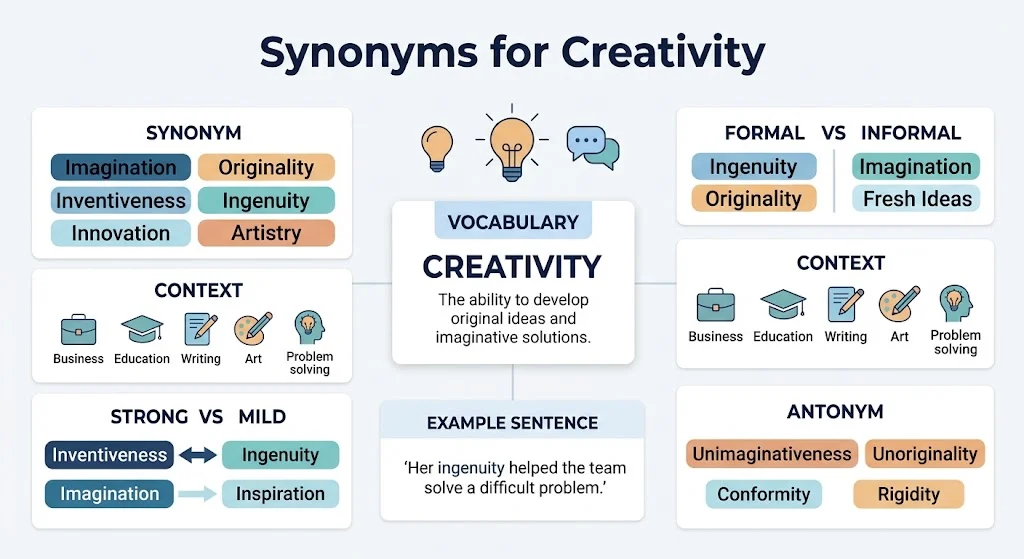
Creativity is the ability to produce original ideas, express imagination, or find new ways to solve problems. Common synonyms include imagination, originality, inventiveness, ingenuity, innovation, and resourcefulness, depending on the context.
Do you find yourself using the word creativity repeatedly in essays, work emails, presentations, social media captions, or everyday conversations? Although it is a useful word, repeating it can make your writing sound predictable.
Choosing a more precise alternative can help you explain whether you mean imagination, originality, artistic ability, or the skill of finding new solutions. The best synonym depends on what kind of creative thinking or expression you want to describe.
This guide explores synonyms for creativity, explains their differences, and shows how to use them naturally in academic, professional, personal, and creative writing.
Meaning, Tone and Context
1. Simple Definition
Creativity is the ability to use imagination and original thinking to develop new ideas, make something meaningful, or approach a problem in an unusual way.
It can involve artistic expression, practical problem solving, innovative thinking, or the ability to combine familiar ideas in fresh ways.
2. Part of Speech
Creativity is an abstract noun.
Example: Her creativity helped the team develop an engaging advertising campaign.
3. Positive, Negative, or Neutral Tone
Creativity generally has a positive tone. It suggests imagination, originality, curiosity, and the ability to think beyond familiar approaches.
In some contexts, creativity can describe unusual or unconventional thinking without necessarily judging whether the result is useful or successful.
4. Formality Level
Creativity is suitable for both formal and informal communication. You can use it in academic essays, business reports, job applications, presentations, conversations, and personal writing.
Words such as ingenuity and inventiveness can sound more specific or sophisticated, while imagination is familiar and conversational.
5. Common Use Cases
People commonly use creativity when discussing:
- Art, music, photography, and design.
- Business ideas and product development.
- Problem solving and decision making.
- Writing, storytelling, and communication.
- Education and learning.
- Marketing, advertising, and branding.
- Personal expression and hobbies.
6. Important Word Forms
| Word Form | Meaning | Example |
| Creativity | The ability to create original ideas | Creativity improves problem solving. |
| Creative | Having or showing imagination | She is a creative designer. |
| Creatively | In an imaginative or original way | They approached the task creatively. |
| Create | To make or produce something | He wants to create a new product. |
| Creation | Something made or produced | The painting is her latest creation. |
| Creator | A person who makes something | The creator shared the design online. |
When and How to Use “Creativity”
Use creativity when you want to describe the ability to think originally, produce imaginative work, or find fresh approaches to a task.
The word works across many subjects, but the intended meaning can change with the situation.
Professional: The company encourages creativity when developing new products.
Academic: The study explores the relationship between creativity and independent thinking.
Personal: Traveling has helped her discover her creativity.
Emotional: His creativity gives him a way to express feelings that are difficult to explain.
Creative writing: The author’s creativity brings the fictional world to life.
Social media: A little creativity can turn an ordinary moment into something memorable.
Email: We welcome your creativity and suggestions for improving the campaign.
Another Word for “Creativity”
There is no single best replacement for creativity in every sentence. The right choice depends on whether you mean original thinking, artistic expression, practical problem solving, or innovation.
Here are useful alternatives by situation:
| Context | Recommended Word | Why It Works |
| Professional writing | Ingenuity | Highlights clever and practical thinking. |
| Academic writing | Originality | Emphasizes new or independent ideas. |
| Casual conversation | Imagination | Sounds natural and familiar. |
| Emotional writing | Self expression | Focuses on communicating personal feelings. |
| Creative writing | Artistry | Highlights artistic skill and expression. |
| Resume or workplace | Innovation | Shows the ability to develop new approaches. |
| Social media captions | Imagination | Feels accessible and expressive. |
| Stronger meaning | Inventiveness | Emphasizes the ability to develop original ideas. |
| Softer meaning | Inspiration | Suggests the influence behind creative ideas. |
Best Single Replacement
Imagination is often the easiest everyday alternative to creativity. However, it is not a perfect substitute in every sentence.
For example, innovation is usually better when discussing new business methods, while originality is more precise when emphasizing unique ideas.
When Not to Use “Creativity”
Although creativity is a flexible word, it can sound too broad when you need to describe a specific ability or result.
Use a more precise alternative when the context makes the intended meaning clear.
| General Sentence | More Precise Sentence | Why It Is Better |
| Her creativity solved the problem. | Her ingenuity helped solve the problem. | Ingenuity emphasizes clever problem solving. |
| The design shows creativity. | The design shows originality. | Originality highlights its distinctive qualities. |
| The company needs creativity. | The company needs innovation. | Innovation focuses on developing new methods or products. |
| His creativity is impressive. | His artistic talent is impressive. | Artistic talent identifies a particular ability. |
| She uses creativity in her paintings. | She uses artistry in her paintings. | Artistry emphasizes artistic skill and expression. |
Avoid replacing creativity with a dramatic word when a simple alternative communicates the idea more accurately.
Words Commonly Confused With Creativity
Several related words describe different parts of creative thinking. Understanding their differences helps you select the right expression.
| Word | Meaning | When It Is Better |
| Imagination | The ability to form ideas or mental images | When discussing possibilities or imagined situations. |
| Innovation | Introducing new ideas, methods, or products | When discussing business, technology, or improvement. |
| Originality | The quality of being new or distinctive | When emphasizing unique ideas or work. |
| Ingenuity | Cleverness in finding practical solutions | When discussing resourceful problem solving. |
| Inspiration | A feeling or influence that encourages ideas | When explaining what motivates creative work. |
| Artistry | Skill and imagination in artistic expression | When discussing music, writing, design, or visual art. |
Best Synonym by Context for Creativity
The most useful synonym depends on what you want readers to understand. A business presentation may need innovation, while an art review may be better with artistry.
| Context | Best Synonym | Why It Works | Example |
| Formal writing | Ingenuity | Sounds precise and emphasizes clever thinking. | The solution demonstrated considerable ingenuity. |
| Academic writing | Originality | Highlights independent and distinctive ideas. | The research contributes originality to the discussion. |
| Professional or business use | Innovation | Connects creative ideas with improvement and development. | Innovation helped the company reach new customers. |
| Resume | Innovative thinking | Communicates an ability to develop new approaches. | Applied innovative thinking to improve team processes. |
| Casual conversation | Imagination | Easy to understand and use naturally. | I love your imagination. |
| Creative writing | Artistry | Emphasizes artistic skill and expression. | Her artistry gives the story emotional depth. |
| Emotional tone | Self expression | Connects creative work with personal feelings. | Painting became a form of self expression. |
| Strong intensity | Inventiveness | Suggests a strong ability to generate original ideas. | His inventiveness transformed the project. |
| Soft or moderate tone | Inspiration | Describes the influence that encourages ideas. | Nature provided inspiration for the design. |
| Social media captions | Imagination | Works well for expressive and engaging captions. | Let your imagination lead the way. |
| Technology | Innovation | Refers to new methods, systems, or products. | Technological innovation changed the industry. |
| Art and design | Artistic flair | Highlights distinctive creative style. | The room reflects her artistic flair. |
| Problem solving | Resourcefulness | Emphasizes finding useful solutions with available resources. | Their resourcefulness kept the project moving. |
Which Synonym Should You Choose?
Before replacing creativity, consider what you actually want to communicate.
1. Check the meaning: Use imagination for mental ideas, originality for unique work, and innovation for new methods or products.
2. Consider formality: Ingenuity and originality work well in formal writing. Imagination feels more conversational.
3. Think about emotional intensity: Artistry can sound expressive, while resourcefulness is more practical and factual.
4. Consider professional value: Innovation, initiative, and problem solving can communicate useful workplace strengths.
5. Read the whole sentence: A synonym should fit the grammar and meaning of the sentence, not simply sound impressive.
Practical tip: If you are describing an idea, consider originality. If you are describing a solution, consider ingenuity. If you are describing a new process, consider innovation.
Real Life Examples of Creativity in Sentences
These examples show how to replace creativity with a more specific word or expression in everyday situations.
School: The student’s originality made her science project stand out from the rest.
Workplace: The team’s innovative thinking helped reduce production costs.
Writing: The author’s imagination makes the fictional setting feel believable.
Conversation: I admire your inventiveness. You always find a different way to approach a challenge.
Social media: A little artistic flair can make an ordinary photograph memorable.
Resume: Demonstrated resourcefulness by finding practical solutions to unexpected project challenges.
Email: We appreciate your fresh ideas and welcome suggestions for improving the presentation.
Storytelling: The storyteller’s artistry turned a simple experience into an unforgettable tale.
25 Synonyms for “Creativity”
The word creativity describes the ability to develop original ideas, express imagination, and find new ways to approach tasks or solve problems. Depending on the context, alternatives may emphasize artistic expression, originality, innovation, imagination, or practical thinking.
The following 25 synonyms and related expressions include simple meanings, recommended uses, and example sentences to help you choose the right word.
Synonyms for Creativity Meaning Imagination and Original Thinking
These words describe the ability to develop fresh ideas, imagine possibilities, and think beyond familiar approaches.
| Synonym | Simple Meaning | Best Used For | Example Sentence |
|---|---|---|---|
| 1. Imagination | The ability to form original ideas or mental pictures | Everyday conversation, storytelling, and art | Her imagination helped her create a fascinating fictional world. |
| 2. Originality | The quality of being new, distinctive, or independent | Academic work, design, and writing | The originality of his research attracted attention. |
| 3. Inventiveness | The ability to develop new and unusual ideas | Product development and creative problem-solving | Her inventiveness led to a more efficient design. |
| 4. Novelty | The quality of being new, unusual, or original | Product design, research, and creative concepts | The novelty of the concept attracted early interest. |
| 5. Unconventionality | The quality of being different from traditional approaches | Experimental art and unusual ideas | The unconventionality of her designs makes them distinctive. |
| 6. Original thought | An idea developed through independent thinking | Essays, research, and intellectual work | The essay stands out because of its original thought. |
| 7. Fertile imagination | An especially active ability to produce ideas | Literature, storytelling, and artistic expression | The novelist’s fertile imagination produced a memorable series. |
| 8. Fancifulness | A tendency toward imaginative or unusual ideas | Fantasy, playful writing, and imaginative expression | The fancifulness of the story appeals to young readers. |
Synonyms for Creativity Meaning Innovation and Problem-Solving
Use these alternatives when creativity involves finding practical solutions, improving methods, or developing useful ideas.
| Synonym | Simple Meaning | Best Used For | Example Sentence |
|---|---|---|---|
| 9. Innovation | The introduction of new ideas, methods, or products | Business, technology, and research | Innovation helped the company improve its services. |
| 10. Ingenuity | Cleverness in finding practical solutions | Professional and technical situations | The engineer used ingenuity to repair the equipment. |
| 11. Resourcefulness | The ability to find effective solutions with available resources | Workplace challenges and everyday problems | His resourcefulness helped the team finish the project on time. |
| 12. Cleverness | The ability to think quickly and find smart ideas | Informal conversation and practical situations | The cleverness of the advertisement made it memorable. |
| 13. Insight | A deep understanding that can lead to useful ideas | Research, analysis, and problem-solving | Her insight helped the team understand customer needs. |
| 14. Divergent thinking | The ability to generate many possible ideas or solutions | Education, brainstorming, and innovation | Divergent thinking helped students explore several answers. |
| 15. Creative thinking | The process of developing fresh ideas or approaches | Education, business, and problem-solving | Creative thinking made the lesson more engaging. |
| 16. Design thinking | A human-centered approach to solving problems through exploration and testing | Product design and business development | Design thinking helped the company improve its customer experience. |
Synonyms for Creativity Meaning Artistic Expression and Skill
These words emphasize creative talent, artistic technique, distinctive style, and the ability to express ideas through art.
| Synonym | Simple Meaning | Best Used For | Example Sentence |
|---|---|---|---|
| 17. Artistry | Artistic skill combined with imagination and expression | Music, painting, writing, and design | Her artistry is evident in every detail of the portrait. |
| 18. Talent | A natural or developed ability to do something well | Artistic ability and personal skills | His talent for storytelling is easy to recognize. |
| 19. Flair | A distinctive and attractive way of doing something | Style, design, fashion, and communication | She decorated the room with remarkable flair. |
| 20. Artistic ability | The skill to create or interpret art | Painting, music, illustration, and visual design | Her artistic ability became clear during the exhibition. |
Synonyms for Creativity Meaning Vision and Initiative
These alternatives describe the ability to recognize opportunities, take action, and guide original ideas toward a goal.
| Synonym | Simple Meaning | Best Used For | Example Sentence |
|---|---|---|---|
| 21. Inspiration | A motivating influence that encourages new ideas | Art, writing, and personal expression | The ocean became her inspiration for a new painting. |
| 22. Vision | The ability to imagine a possible future or direction | Leadership, business, and creative planning | The designer had a clear vision for the campaign. |
| 23. Enterprise | Initiative and willingness to develop ideas or opportunities | Business and entrepreneurship | Her enterprise helped turn a small idea into a successful business. |
| 24. Initiative | The ability to take action without waiting for instructions | Professional and personal development | His initiative encouraged the team to explore a better approach. |
| 25. Creative vision | A distinctive ability to imagine and guide an original concept | Leadership, design, film, and artistic projects | Her creative vision shaped the entire exhibition. |
How to Choose the Right Synonym for “Creativity”
Choose a synonym based on the aspect of creativity you want to emphasize. Use imagination when describing the ability to form ideas, originality when highlighting uniqueness, and inventiveness when discussing new approaches. Choose innovation for introducing new products or methods and ingenuity for clever practical solutions.
For artistic contexts, artistry, flair, and artistic ability may be more appropriate. In professional writing, creative thinking, design thinking, and creative vision can communicate different aspects of developing and applying original ideas.
Important usage note: These alternatives are not interchangeable in every sentence. Innovation usually refers to introducing something new, while artistry focuses on the skill and expression involved in artistic work. Insight emphasizes deep understanding, and initiative refers to taking action independently. Choose the word that matches your intended meaning.
Synonym Groups and Usage Differences
Professional vs. Personal Synonyms
Professional communication often focuses on what creative thinking achieves. Words such as innovation, ingenuity, resourcefulness, and initiative highlight practical value.
Personal communication may focus more on imagination, expression, and individual style. Words such as imagination, inspiration, and artistry often work better in those situations.
Formal vs. Conversational Synonyms
| Formal or Professional | Conversational | Difference |
| Ingenuity | Cleverness | Both suggest smart thinking, but ingenuity often emphasizes practical solutions. |
| Originality | Fresh ideas | Originality focuses on distinctiveness, while fresh ideas sounds more conversational. |
| Innovation | New approach | Innovation often suggests meaningful development or improvement. |
| Resourcefulness | Thinking on your feet | Both describe finding solutions, but the second is more conversational. |
| Artistic ability | Artistic flair | Artistic ability is more neutral, while flair suggests distinctive style. |
Use formal alternatives in reports, academic writing, business proposals, and professional presentations. Conversational alternatives are usually better for texts, informal emails, and everyday discussions.
Academic Synonyms
Academic writing benefits from words that identify a specific intellectual skill.
- Originality: Useful when discussing an independent argument, research contribution, or distinctive interpretation.
- Divergent thinking: Appropriate when discussing the generation of multiple possible ideas.
- Creative thinking: Useful for explaining a process of developing new approaches.
- Ingenuity: Suitable when describing clever solutions to complex challenges.
- Innovation: Best when discussing the development or introduction of new methods.
For example: The assignment encourages originality and independent thinking among students.
Professional and Business Synonyms
In workplace communication, the strongest alternative depends on the result you want to emphasize.
- Innovation: Developing or introducing new methods, products, or services.
- Resourcefulness: Solving problems with the tools and resources available.
- Initiative: Taking action without waiting for someone else to begin.
- Ingenuity: Finding clever ways to overcome practical challenges.
- Creative vision: Imagining and guiding a new direction for a project or organization.
For a resume, phrases such as innovative thinking, creative problem solving, and resourcefulness are often more informative than simply listing creativity as a skill.
Creative or Literary Synonyms
Creative and literary writing often benefits from words that suggest imagination, style, and expression.
- Artistry: Highlights skill and beauty in creative work.
- Imagination: Emphasizes the ability to picture new possibilities.
- Flair: Suggests an appealing personal style.
- Fertile imagination: Describes an especially productive imagination.
- Inspiration: Refers to a source of motivation or creative influence.
Example: The filmmaker’s artistry and imagination gave the story a distinctive atmosphere.
Slang or Modern Synonyms
There is no exact slang replacement for creativity that works in every situation. Informal expressions can communicate a similar idea, but they often have narrower meanings.
| Informal Expression | Meaning | Best Used For |
| Outside the box thinking | Approaching a problem in an unconventional way | Casual workplace conversations |
| Fresh ideas | New or interesting suggestions | Meetings and everyday discussions |
| A creative spark | A sudden source of inspiration | Personal and artistic conversations |
| Thinking on your feet | Responding quickly with useful ideas | Informal professional situations |
These expressions can make conversations sound natural, but formal essays and research papers usually benefit from more precise vocabulary.
Strongest vs. Weaker Synonyms
The following scale shows how different words emphasize particular aspects of creative ability. It is a guide to meaning, not a universal ranking of creative talent.
| Intensity | Word or Expression | What It Emphasizes |
| Mild | Inspiration | A source of ideas or motivation |
| Mild | Imagination | The ability to picture possibilities |
| Moderate | Flair | A distinctive personal style |
| Moderate | Originality | Independent and distinctive ideas |
| Strong | Inventiveness | A strong ability to develop new ideas |
| Strong | Ingenuity | Clever and practical problem solving |
| Strong | Innovation | The development or introduction of new approaches |
Emotional vs. Neutral Synonyms
Some alternatives communicate personal expression, while others focus on practical ability.
More expressive words: Artistry, inspiration, imagination, and creative vision.
More neutral words: Originality, innovation, resourcefulness, and divergent thinking.
Choose an expressive word when discussing feelings or artistic work. Choose a neutral word when describing research, professional skills, or measurable outcomes.
Antonyms of “Creativity”
Creativity does not have one exact opposite in every context. Its opposite may refer to a lack of imagination, an unwillingness to explore new ideas, or a preference for following established methods instead of developing original approaches.
The following 15 words and expressions are contextual antonyms and contrasting terms rather than perfect replacements in every sentence.
Antonyms of Creativity Meaning Lack of Imagination or Originality
These expressions describe an absence of fresh ideas, independent thinking, or distinctive creative ability.
| Antonym | Meaning | Example Sentence |
|---|---|---|
| 1. Unimaginativeness | A lack of imagination or original ideas | The unimaginativeness of the proposal made it forgettable. |
| 2. Unoriginality | The quality of lacking distinctive or new ideas | The unoriginality of the campaign disappointed the audience. |
| 3. Lack of imagination | An inability or failure to think beyond familiar ideas | A lack of imagination made the presentation less engaging. |
| 4. Imitation | Copying something instead of developing an original approach | The project relied on imitation rather than original thinking. |
Antonyms of Creativity Meaning Conformity or Conventional Thinking
These terms describe following accepted patterns, familiar practices, or established expectations instead of exploring different possibilities.
| Antonym | Meaning | Example Sentence |
|---|---|---|
| 5. Conventionality | Following familiar or accepted ways of doing things | The design’s conventionality made it look ordinary. |
| 6. Conformity | Following established rules, expectations, or behavior | Excessive conformity can discourage independent ideas. |
| 7. Routine | A regular way of doing something | The team followed its routine instead of testing new ideas. |
| 8. Formulaic thinking | Relying on fixed patterns instead of exploring new ideas | Formulaic thinking prevented the writers from trying a different style. |
| 9. Mechanical thinking | Following procedures without much independent thought | Mechanical thinking left little room for experimentation. |
| 10. Repetition | Doing or producing the same thing again | Repetition without improvement can make the work feel predictable. |
Antonyms of Creativity Meaning Rigidity or Resistance to Change
These alternatives emphasize an unwillingness to adapt, consider new approaches, or move beyond existing methods.
| Antonym | Meaning | Example Sentence |
|---|---|---|
| 11. Rigidity | An unwillingness to change methods or consider alternatives | Management’s rigidity limited the team’s options. |
| 12. Inflexibility | An inability or unwillingness to adapt | Inflexibility made it difficult to explore new solutions. |
| 13. Inertia | A tendency to remain unchanged or avoid action | Organizational inertia slowed the development of new products. |
| 14. Stagnation | A lack of progress or development | Creative stagnation affected the department’s performance. |
Antonyms of Creativity Meaning Predictability
This term describes something that is easy to anticipate and lacks surprise or originality.
| Antonym | Meaning | Example Sentence |
|---|---|---|
| 15. Predictability | The quality of being expected or unsurprising | The predictability of the story weakened its impact. |
How to Choose the Right Antonym for “Creativity”
The best opposite depends on the aspect of creativity you want to describe. Use unimaginativeness when discussing a lack of imagination, unoriginality when describing copied or ordinary work, and conformity when referring to pressure to follow established expectations.
Choose rigidity or inflexibility when someone resists new methods. Use formulaic thinking when ideas follow predictable patterns, and stagnation when creative progress has stopped.
Important usage note: These expressions are not exact dictionary opposites of creativity. For example, routine is simply a regular way of doing something and does not always prevent creativity. Similarly, conventionality can describe familiar methods without necessarily suggesting a lack of creative ability. Select the term that accurately expresses the contrast in your sentence.
Comparison: Creativity vs. Similar Words
Understanding the differences between creativity and related terms helps prevent awkward word choices.
Creativity vs. Imagination
Main difference: Creativity involves developing or expressing original ideas. Imagination is the ability to form mental pictures, possibilities, or ideas.
Which is stronger? Creativity suggests the ability to develop or use ideas, while imagination focuses on forming them.
Which is more formal? Both are suitable for formal and informal writing.
Examples:
- Creativity: Her creativity helped turn the concept into a successful product.
- Imagination: Her imagination allowed her to picture a completely different world.
Creativity vs. Innovation
Main difference: Creativity involves generating original ideas. Innovation involves introducing or applying new ideas, methods, or products.
Which is stronger? Innovation often suggests that an idea has been developed or implemented. Creativity does not necessarily require a finished result.
Which is more formal? Both work in professional settings, but innovation is especially common in business and technology.
Examples:
- Creativity: The team used creativity to develop several possible solutions.
- Innovation: The company introduced an innovation that improved customer service.
Creativity vs. Originality
Main difference: Creativity is the ability to produce or develop ideas. Originality describes how distinctive or independent those ideas are.
Which is stronger? Neither is universally stronger. Originality emphasizes uniqueness, while creativity describes the broader ability.
Which is more formal? Both are appropriate for academic and professional writing.
Examples:
- Creativity: The course helps students develop their creativity.
- Originality: The originality of her argument made the essay stand out.
Creativity vs. Ingenuity
Main difference: Creativity can involve artistic expression, imagination, and new ideas. Ingenuity emphasizes cleverness, particularly when solving practical problems.
Which is stronger? Ingenuity is more specific and often suggests an effective solution.
Which is more formal? Both are suitable for professional writing, but ingenuity can sound more precise in technical contexts.
Examples:
- Creativity: The campaign showed the team’s creativity.
- Ingenuity: The engineer’s ingenuity helped solve the technical problem.
Creativity vs. Inspiration
Main difference: Creativity is an ability or process. Inspiration is a feeling, influence, or source that encourages someone to create.
Which is stronger? They describe different things, so neither is inherently stronger.
Which is more formal? Both work in formal and informal contexts.
Examples:
- Creativity: Her creativity is reflected in her paintings.
- Inspiration: Nature was the inspiration for her latest painting.
Creativity vs. Artistry
Main difference: Creativity applies to many areas, including science, business, and problem solving. Artistry focuses on artistic skill, style, and expression.
Which is stronger? Artistry is more specific to artistic work, while creativity has a wider meaning.
Which is more formal? Both are appropriate in formal writing, particularly when discussing art and design.
Examples:
- Creativity: The project required creativity and careful planning.
- Artistry: The artist’s artistry is visible in the painting’s fine details.
Common Phrases and Expressions with Creativity
These expressions help you use creativity naturally in conversations, professional writing, and academic work.
1. Creative Thinking
Meaning: The process of developing fresh ideas or considering different ways to approach a situation.
Example sentence: Creative thinking helped the students find several solutions to the challenge.
2. Creative Freedom
Meaning: The opportunity to express ideas and make decisions without unnecessary restrictions.
Example sentence: The company gives its designers creative freedom when developing new campaigns.
3. Spark of Creativity
Meaning: A sudden moment of inspiration or an idea that encourages creative work.
Example sentence: A conversation with her mentor sparked a new wave of creativity.
4. Creative Expression
Meaning: Communicating thoughts, feelings, or ideas through artistic or imaginative activities.
Example sentence: Photography became his favorite form of creative expression.
5. Think Outside the Box
Meaning: Consider ideas or solutions that differ from conventional approaches.
Example sentence: We need to think outside the box to improve the customer experience.
6. Creative Process
Meaning: The steps involved in developing, exploring, and producing an original idea or work.
Example sentence: The creative process took several weeks because the designer tested different concepts.
7. Creative Potential
Meaning: A person’s ability to develop original ideas or produce imaginative work.
Example sentence: The workshop helped students recognize their creative potential.
8. Creative Vision
Meaning: A distinctive idea or direction that guides an artistic or innovative project.
Example sentence: Her creative vision shaped the look and feel of the entire campaign.
Common Mistakes to Avoid
Even familiar words can create problems when they are used too broadly or in the wrong context.
1. Using Creativity When You Mean Innovation
Creativity refers to developing original ideas, while innovation often involves introducing or applying them.
Less precise: The company needs more creativity in its technology.
More precise: The company needs more innovation in its technology.
2. Confusing Creativity With Imagination
Imagination is the ability to picture possibilities. Creativity often involves developing or expressing ideas.
Less precise: His imagination produced a new advertising campaign.
Clearer: His creativity helped him develop a new advertising campaign.
3. Using a Casual Expression in Formal Writing
Expressions such as thinking outside the box can sound informal in academic or highly formal writing.
Informal: The research team thought outside the box.
More formal: The research team used unconventional approaches to investigate the problem.
4. Using an Overly Dramatic Synonym
Words such as genius and brilliance can exaggerate an ordinary creative contribution.
Overstated: Her genius helped organize the office presentation.
More natural: Her resourcefulness helped organize the office presentation.
5. Repeating Creativity Too Often
Repeating the same word can make a paragraph sound monotonous.
Repetitive: The course develops creativity. Creativity helps students solve problems. Creativity also improves communication.
Improved: The course develops creativity, encourages original thinking, and helps students solve problems more effectively.
6. Choosing a Synonym With the Wrong Meaning
Not every creative alternative describes the same ability.
For example, inspiration is often the influence behind an idea, while ingenuity describes cleverness in developing a solution.
Choose the word that matches the actual meaning of your sentence.
7. Using Slang in Academic or Professional Writing
Casual phrases can be effective in conversation, but they may weaken the tone of a research paper or formal report.
Informal: The team came up with some cool ideas.
Professional: The team developed several innovative ideas.
FAQs
1. What Is the Best Synonym for Creativity?
Imagination is a common everyday alternative. Originality, inventiveness, ingenuity, and innovation are more precise choices for particular types of creative thinking.
2. What Is a Formal Synonym for Creativity?
Ingenuity is a strong formal alternative when discussing clever solutions. Originality is suitable when emphasizing independent ideas or distinctive work.
3. What Is an Informal Synonym for Creativity?
Imagination is a natural informal alternative. Fresh ideas and creative spark are also useful expressions in casual conversations.
4. What Is Another Word for Creativity in Professional Writing?
Innovation is useful for business development, while resourcefulness and ingenuity highlight practical problem solving and the ability to develop effective approaches.
5. What Is the Difference Between Creativity and Innovation?
Creativity involves generating original ideas. Innovation involves introducing or applying new ideas, methods, or products to create a change or improvement.
6. What Is the Opposite of Creativity?
There is no single perfect opposite. Unimaginativeness, unoriginality, conformity, and rigid thinking describe different ways creativity may be limited.
Conclusion
Creativity is the ability to develop original ideas, use imagination, and solve problems in new ways. Common synonyms include imagination, originality, inventiveness, ingenuity, innovation, and artistry.
Choose originality for unique ideas, ingenuity for clever solutions, innovation for new approaches, and artistry for creative expression. Always consider context and verify definitions with trusted dictionaries to ensure accurate word usage.