
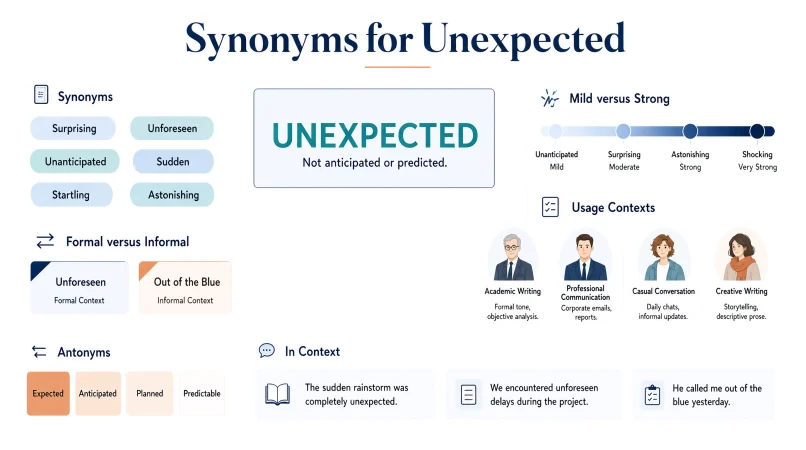
Unexpected means not anticipated, predicted, or known in advance. Common synonyms include surprising, unforeseen, unanticipated, sudden, unplanned, and startling. Choose unforeseen for formal writing, surprising for everyday use, and startling when something causes a strong reaction.
Have you ever used the word unexpected several times in an essay, email, report, or social media caption? It is a useful adjective, but repeating it can make your writing feel limited.
The right alternative depends on what happened. An unforeseen event may be difficult to predict, a surprising result may be exciting, and a sudden change may happen with little warning. These expressions are related, but each communicates a slightly different idea.
This guide explores synonyms for unexpected with practical examples, tone differences, and recommendations for academic, professional, casual, and creative writing. You will learn how to choose a word that sounds natural while preserving your intended meaning.
Meaning, Tone and Context
Simple Definition
Unexpected describes something that happens or appears without being anticipated or predicted. It can refer to events, news, changes, results, visits, opportunities, or reactions.
For example, an unexpected phone call happens when someone did not think the call would come at that time.
Part of Speech
Unexpected is an adjective. It describes a noun by explaining that something was not anticipated.
Examples:
- We received an unexpected invitation.
- The company faced an unexpected expense.
- Her unexpected arrival surprised everyone.
Tone and Formality
Unexpected is generally neutral. It does not automatically suggest that an event is good or bad.
The emotional meaning comes from the context. An unexpected promotion may be positive, while an unexpected delay may be frustrating.
The word is suitable for casual conversation, professional communication, academic writing, journalism, and creative work.
Common Use Cases
- Daily conversation: An unexpected visitor or phone call.
- Business: Unexpected expenses, delays, or changes.
- Education: Unexpected results or discoveries.
- Personal life: Unexpected opportunities, news, or experiences.
- Creative writing: Unexpected twists, encounters, and endings.
- News reporting: Unexpected developments or incidents.
Important Word Forms
| Word Form | Part of Speech | Meaning | Example |
| Expect | Verb | To think something will happen | We expect good results. |
| Expected | Adjective | Considered likely or anticipated | The expected delivery arrived. |
| Unexpected | Adjective | Not anticipated | An unexpected visitor arrived. |
| Unexpectedly | Adverb | In a way that was not anticipated | The meeting ended unexpectedly. |
| Unexpectedness | Noun | The quality of being unexpected | The unexpectedness of the news shocked us. |
| Unexpecting | Adjective | Not anticipating something | The unexpecting audience enjoyed the surprise. |
Usage note: Unexpecting is uncommon in everyday English. In most situations, unprepared or not expecting it sounds more natural.
When and How to Use “Unexpected”
Use unexpected when an event, result, situation, or action happens without being anticipated. It works for both positive and negative situations.
Here are practical examples from different contexts.
1. Professional: The project faced an unexpected delay because of a supplier issue.
2. Personal: I received an unexpected message from an old friend.
3. Academic: The experiment produced an unexpected result.
4. Emotional: Her unexpected kindness made a difficult day better.
5. Creative: The story takes an unexpected turn near the end.
6. Social media: Sometimes, the most beautiful moments are unexpected.
7. Email: We apologize for the unexpected change to the meeting schedule.
Another Word for “Unexpected”
The best single replacement for unexpected is usually surprising in everyday communication. However, the most accurate choice depends on whether you mean something was difficult to predict, happened suddenly, or caused a strong reaction.
| Situation | Recommended Alternative | Why It Works |
| Professional writing | Unforeseen | Sounds precise in reports and business communication. |
| Academic writing | Unanticipated | Fits research findings and results. |
| Casual conversation | Surprising | Natural and easy to understand. |
| Emotional writing | Astonishing | Communicates strong amazement. |
| Creative writing | Unanticipated | Works well for twists and developments. |
| Resume or workplace use | Unplanned | Describes changes or tasks that were not scheduled. |
| Social media captions | Surprising | Short and familiar. |
| Stronger meaning | Startling | Suggests a sudden and powerful reaction. |
| Softer meaning | Unanticipated | Sounds measured and less emotional. |
Quick Recommendations
- Professional: Use unforeseen for events or problems that could not reasonably be predicted.
- Academic: Use unanticipated for findings or outcomes that were not expected.
- Casual: Use surprising for everyday situations.
- Emotional: Use astonishing or shocking when the reaction is strong.
- Creative: Use startling for a sudden, dramatic moment.
- Workplace: Use unplanned for changes that were not part of the original schedule.
When Not to Use “Unexpected”
Although unexpected is flexible, it can be too general when you want to explain exactly how something happened.
Choose a more precise word when timing, predictability, emotional impact, or planning matters.
| General Sentence | More Precise Sentence | Why It Is Better |
| We had an unexpected meeting. | We had an unplanned meeting. | Shows that the meeting was not scheduled. |
| The news was unexpected. | The news was astonishing. | Emphasizes a strong reaction. |
| There was an unexpected delay. | An unforeseen delay affected the delivery. | Sounds more formal and professional. |
| The change was unexpected. | The change was abrupt. | Highlights how suddenly it happened. |
| The ending was unexpected. | The ending was unpredictable. | Emphasizes that the outcome was difficult to guess. |
Do not choose a dramatic alternative simply to make a sentence sound stronger. A word such as shocking suggests a much stronger reaction than surprising.
Words Commonly Confused With “Unexpected”
These related words have different meanings and should be selected carefully.
| Word | Meaning | Difference From Unexpected |
| Unpredictable | Difficult to predict or forecast | Describes something whose behavior or outcome cannot be reliably predicted. |
| Unplanned | Not arranged or scheduled beforehand | Focuses on the absence of planning. |
| Sudden | Happening quickly or without warning | Focuses on timing rather than whether something was anticipated. |
| Unforeseen | Not anticipated or considered in advance | Often emphasizes that an event could not reasonably have been predicted. |
| Unusual | Different from what is normal or common | Describes something uncommon, not necessarily surprising. |
| Surprising | Causing someone to feel surprise | Emphasizes the reaction of the person experiencing it. |
For example, an unusual event may be familiar to someone who has experienced it before. An unexpected event is one that was not anticipated by the person involved.
Best Synonym by Context for Unexpected
The best synonym depends on the purpose of your sentence, the audience, and the kind of event you are describing.
| Context | Best Synonym | Why It Works | Example |
| Formal writing | Unforeseen | Professional and precise | The company experienced unforeseen expenses. |
| Academic writing | Unanticipated | Suitable for research and findings | The study revealed an unanticipated result. |
| Professional or business use | Unplanned | Clearly describes a change outside the schedule | The team handled an unplanned revision. |
| Resume or workplace | Unplanned | Describes additional work or changes | Adapted quickly to unplanned project requirements. |
| Casual conversation | Surprising | Natural and familiar | That was a surprising phone call. |
| Creative writing | Startling | Adds dramatic impact | A startling discovery changed the story. |
| Emotional tone | Astonishing | Communicates strong amazement | Her astonishing success inspired everyone. |
| Strong intensity | Shocking | Suggests a powerful and often upsetting reaction | The shocking announcement silenced the room. |
| Soft or moderate tone | Unanticipated | Communicates surprise without strong emotion | We received an unanticipated response. |
| Social media captions | Surprising | Short and engaging | Life brings surprising moments. |
| News reporting | Sudden | Highlights an event that happened quickly | A sudden change in weather affected the region. |
| Story endings | Unpredictable | Highlights an outcome that was difficult to guess | The film had an unpredictable ending. |
US and UK Usage
Most common synonyms for unexpected are understood in both American and British English. There is no major difference in their basic meanings.
Words such as surprising, unforeseen, unanticipated, and startling are standard in both varieties.
Which Synonym Should You Choose?
Use these practical steps to select the right alternative.
1. Identify what happened. If an event was not planned, use unplanned. If it was difficult to predict, use unforeseen or unpredictable.
2. Consider the timing. Choose sudden or abrupt when the speed of an event matters more than the surprise itself.
3. Think about the reaction. Use surprising for ordinary surprise, astonishing for strong amazement, and shocking for an intense or disturbing reaction.
4. Match the audience. Use unanticipated in research writing and surprising in everyday conversation.
5. Avoid exaggeration. An unexpected email is not necessarily a shocking email. Match the strength of the word to the actual experience.
6. Check the full sentence. A synonym should preserve the original meaning and fit naturally with the noun it describes.
A useful rule is to describe the reason something was unexpected, rather than simply replacing the word with another adjective.
Real Life Examples of Unexpected in Sentences
These examples show how stronger and more precise alternatives can improve everyday writing.
| Situation | Example Sentence |
| School | The students achieved an unexpected result in the science competition. |
| Workplace | The company had to respond to an unforeseen supply shortage. |
| Academic writing | Researchers identified an unanticipated pattern in the data. |
| Conversation | It was surprising to see you here. |
| Social media | The best memories sometimes come from unexpected moments. |
| Resume | Adapted effectively to sudden changes in project priorities. |
| We apologize for the unforeseen delay in processing your request. | |
| Storytelling | A startling discovery revealed the truth behind the mystery. |
25 Synonyms for “Unexpected”
The word unexpected describes something that happens without being anticipated, predicted, or planned. Depending on the context, you can use alternatives that express surprise, suddenness, uncertainty, unusual circumstances, or an unplanned event.
The following 25 synonyms and related expressions include simple meanings, recommended uses, and example sentences to help you choose the right alternative.
Common Synonyms for Unexpected
These words work well in everyday writing and conversation when something happens that people did not expect.
| Synonym | Simple Meaning | Best Used For | Example Sentence |
|---|---|---|---|
| 1. Surprising | Causing surprise | Everyday communication | Her visit was a surprising moment. |
| 2. Unforeseen | Not anticipated beforehand | Formal and professional writing | Unforeseen circumstances delayed the launch. |
| 3. Unanticipated | Not expected or predicted | Academic and analytical writing | The experiment produced an unanticipated result. |
| 4. Unplanned | Not arranged in advance | Meetings and activities | We made an unplanned stop along the way. |
| 5. Unlooked-for | Not anticipated or expected | Literary and formal expression | The unlooked-for opportunity changed her career. |
| 6. Out of the blue | Happening without warning | Informal conversation | He called me out of the blue. |
Synonyms for Unexpected Meaning Sudden or Startling
Use these alternatives when an event happens quickly, without warning, or causes a strong immediate reaction.
| Synonym | Simple Meaning | Best Used For | Example Sentence |
|---|---|---|---|
| 7. Sudden | Happening quickly or without warning | Events and changes | A sudden storm interrupted the outdoor event. |
| 8. Startling | Causing a strong and sudden reaction | Dramatic descriptions | The startling announcement changed everything. |
| 9. Shocking | Causing intense surprise or distress | Serious news and emotional reactions | The shocking report raised public concern. |
| 10. Abrupt | Happening suddenly or without a smooth transition | Changes and endings | The meeting came to an abrupt end. |
| 11. Flabbergasting | Extremely surprising or astonishing | Informal and expressive writing | The final score was flabbergasting. |
Synonyms for Unexpected Meaning Extraordinary or Unusual
These words describe events, experiences, or discoveries that are different from what is normal or commonly experienced.
| Synonym | Simple Meaning | Best Used For | Example Sentence |
|---|---|---|---|
| 12. Astonishing | Extremely surprising or impressive | Emotional and descriptive writing | Her astonishing performance earned a standing ovation. |
| 13. Remarkable | Unusual enough to attract attention | Positive discoveries and achievements | The team made remarkable progress. |
| 14. Extraordinary | Far beyond what is ordinary | Impressive or unusual events | They witnessed an extraordinary display of talent. |
| 15. Novel | New or unfamiliar | Academic and technical writing | The researchers introduced a novel approach. |
| 16. Uncommon | Not frequently encountered | General descriptions | It was an uncommon occurrence in the region. |
| 17. Surreal | So unusual that it seems unreal | Creative and emotional writing | The entire experience felt surreal. |
| 18. Out of the ordinary | Different from what is usual | Casual descriptions | Nothing about the day seemed out of the ordinary. |
| 19. Unprecedented | Never experienced or done before | Historical, academic, and news writing | The region faced unprecedented demand. |
Synonyms for Unexpected Meaning Unpredictable or Difficult to Explain
These alternatives are useful when an event, result, or situation cannot easily be predicted or understood.
| Synonym | Simple Meaning | Best Used For | Example Sentence |
|---|---|---|---|
| 20. Unpredictable | Difficult to forecast or anticipate | Behavior, events, and outcomes | The weather has been unpredictable this week. |
| 21. Unforeseeable | Impossible or very difficult to predict | Formal and technical contexts | The project was affected by unforeseeable events. |
| 22. Baffling | Difficult to understand or explain | Confusing situations | The sudden decision was baffling to employees. |
| 23. Unexpectedly timed | Occurring at an unanticipated time | Scheduling and events | The announcement came at an unexpected time. |
Synonyms for Unexpected Meaning Chance or Good Fortune
These expressions describe events that happen without planning. Some have a positive meaning, especially when an accidental event leads to a useful opportunity.
| Synonym | Simple Meaning | Best Used For | Example Sentence |
|---|---|---|---|
| 24. Chance | Happening without being planned or deliberately arranged | Opportunities and encounters | A chance meeting introduced them to a new business partner. |
| 25. Fortuitous | Happening by chance in a favorable way | Formal and positive writing | A fortuitous encounter led to a valuable opportunity. |
How to Choose the Right Synonym for “Unexpected”
Choose a synonym based on the kind of surprise you want to describe. Use surprising for general situations, unforeseen for formal writing, and sudden when something happens quickly. Choose startling or shocking for strong reactions, unprecedented for something never experienced before, and fortuitous for a lucky event that happens by chance.
Important usage note: Not every word in this list is an exact replacement for unexpected. Unprecedented means never experienced or done before, while fortuitous usually describes a favorable chance event. Out of the blue is an informal expression, and novel emphasizes newness rather than surprise. Choose the word that best matches your intended meaning.
Synonym Groups and Usage Differences
Professional vs. Personal Synonyms
Professional writing benefits from words that communicate the situation accurately without adding unnecessary emotion.
Use unforeseen, unanticipated, and unplanned in reports, project updates, business emails, and workplace communication.
Personal writing can be more expressive. Words such as astonishing, surprising, and startling help communicate how an event affected someone.
For example:
- Professional: The project experienced an unforeseen delay.
- Personal: I was astonished by the unexpected news.
Formal vs. Conversational Synonyms
Formal alternatives are useful in reports, essays, research papers, and official communication. Conversational expressions are more suitable for messages, informal posts, and everyday speech.
| Formal Expression | Conversational Alternative |
| Unforeseen | Surprising |
| Unanticipated | Not expected |
| Unforeseeable | Impossible to see coming |
| Unprecedented | Never seen before |
| Fortuitous | Lucky |
| Abrupt | Sudden |
Choose the expression that matches your audience. A simple word is often better than a complicated one.
Academic Synonyms
Academic writing should distinguish between an event that was not predicted and an event that was genuinely new.
Useful alternatives include:
- Unanticipated: Suitable for findings or outcomes that researchers did not expect.
- Unforeseen: Useful for circumstances that were not anticipated during planning.
- Unprecedented: Describes something without a previous example or historical equivalent.
- Unpredictable: Describes a process or outcome that is difficult to forecast.
- Novel: Describes something new or original, not necessarily surprising.
- Unforeseeable: Suitable when an event was particularly difficult or impossible to predict.
Example: “The researchers observed an unanticipated pattern in the results.”
This is more informative than simply writing, “The researchers observed an unexpected pattern.”
Professional and Business Synonyms
Business writing often discusses changes, delays, costs, and developments that were not part of the original plan.
| Situation | Recommended Term |
| Project delay | Unforeseen delay |
| Additional meeting | Unplanned meeting |
| New research finding | Unanticipated finding |
| Major market change | Unpredictable development |
| Sudden schedule change | Abrupt change |
| New business opportunity | Fortuitous opportunity |
For resumes, avoid writing “Handled unexpected things.” A stronger statement would be “Adapted quickly to unforeseen project challenges.”
This describes a useful workplace skill more clearly.
Creative or Literary Synonyms
Creative writing benefits from words that communicate atmosphere, surprise, and emotional impact.
- Startling: Creates a sudden, dramatic reaction.
- Surreal: Describes something so unusual that it seems unreal.
- Astonishing: Communicates great amazement.
- Baffling: Creates a sense of mystery or confusion.
- Flabbergasting: Adds an informal, expressive sense of disbelief.
- Out of the blue: Works naturally in dialogue and informal storytelling.
Compare these examples:
- Neutral: An unexpected visitor arrived.
- Dramatic: A startling visitor appeared at the doorway.
- Mysterious: A surreal encounter changed the evening.
The best choice depends on the mood of the scene.
Slang or Modern Synonyms
There is no single modern slang word that replaces unexpected in every situation. However, several informal expressions communicate surprise naturally.
| Expression | Meaning | Best Context |
| Out of the blue | Without warning | Casual conversation |
| Caught off guard | Surprised and unprepared | Everyday speech |
| Came out of nowhere | Appeared or happened without warning | Informal storytelling |
| Plot twist | An unexpected development in a story or situation | Social media and entertainment |
| Mind blowing | Extremely impressive or surprising | Informal conversation |
For example: “That announcement came out of nowhere.”
These expressions are suitable for casual captions, dialogue, and messages, but formal reports should use more precise alternatives.
Strongest vs. Weaker Synonyms
This scale shows general emotional intensity. The words do not all describe the same kind of unexpected event.
| Intensity | Word | General Effect |
| Mild | Unanticipated | Neutral and factual |
| Moderate | Surprising | Creates ordinary surprise |
| Noticeable | Astonishing | Communicates strong amazement |
| Strong | Startling | Suggests a sudden reaction |
| Very strong | Shocking | Suggests intense surprise or distress |
| Highly expressive | Flabbergasting | Communicates extreme disbelief in an informal way |
Choose a word based on the actual reaction or event, not simply its position on the scale.
Emotional vs. Neutral Synonyms
Neutral words describe the event without suggesting how someone should feel about it. Emotional words communicate a stronger reaction.
| Neutral Expression | Emotional Expression | Difference |
| Unforeseen | Shocking | The second suggests distress or intense surprise. |
| Unanticipated | Astonishing | The second emphasizes amazement. |
| Sudden | Startling | The second highlights a strong reaction. |
| Unplanned | Flabbergasting | The second suggests extreme disbelief. |
| Unpredictable | Surreal | The second creates an unusual or unreal impression. |
Use neutral expressions in factual reporting. Choose emotional alternatives when the reaction is an important part of the message.
Antonyms of “Unexpected”
The clearest opposite of unexpected is expected. Other antonyms include anticipated, planned, predictable, and foreseen.
The best opposite depends on whether you are describing an event that was predicted, arranged, or considered likely.
| Antonym | Meaning | Example Sentence |
| 1. Expected | Considered likely to happen | The expected delivery arrived on time. |
| 2. Anticipated | Predicted or looked forward to | The anticipated announcement attracted attention. |
| 3. Foreseen | Recognized or predicted in advance | The problem had been foreseen by the planning team. |
| 4. Predicted | Said or estimated to happen beforehand | The predicted result matched the final outcome. |
| 5. Planned | Arranged or decided in advance | The planned meeting started at noon. |
| 6. Scheduled | Set for a particular time | The scheduled inspection took place Monday. |
| 7. Intended | Planned or meant to happen | The intended outcome was achieved. |
| 8. Expectedly | In an expected manner | The team performed as expectedly as the coach had hoped. |
| 9. Predictable | Easy to anticipate | The ending was predictable from the beginning. |
| 10. Foreseeable | Able to be predicted or anticipated | The risks were foreseeable. |
| 11. Ordinary | Normal or usual | It was an ordinary afternoon at the office. |
| 12. Usual | Common or regularly experienced | The store opened at its usual time. |
| 13. Routine | Part of a regular pattern | The inspection was a routine procedure. |
| 14. Conventional | Following established practices or standards | The team used a conventional approach. |
| 15. Familiar | Already known or recognized | The familiar routine made everyone comfortable. |
Editorial note: Expected, anticipated, foreseen, and predictable are the closest opposites. Words such as ordinary, routine, and familiar are contextual contrasts rather than exact antonyms.
Comparison: Unexpected vs. Similar Words
Unexpected vs. Unforeseen
Main difference: Both describe something not anticipated. Unforeseen often appears in formal discussions about circumstances, risks, or problems.
Which is stronger: Neither is necessarily stronger. Unforeseen emphasizes the difficulty of anticipating an event.
Which is more formal: Unforeseen is generally more formal.
Examples:
- Unexpected: We experienced an unexpected delay.
- Unforeseen: The project was affected by unforeseen circumstances.
Unexpected vs. Unpredictable
Main difference: Unexpected describes something that was not anticipated. Unpredictable describes something that is difficult to forecast.
Which is stronger: Unpredictable can suggest repeated uncertainty, while unexpected can describe one event.
Which is more formal: Both work in formal writing.
Examples:
- Unexpected: The team received an unexpected result.
- Unpredictable: The weather has been unpredictable all week.
Unexpected vs. Sudden
Main difference: Unexpected focuses on anticipation. Sudden focuses on how quickly something happens or how little warning it gives.
Which is stronger: Sudden emphasizes timing, not necessarily surprise.
Which is more formal: Both are suitable for formal and informal writing.
Examples:
- Unexpected: The company announced an unexpected change.
- Sudden: A sudden change in temperature affected the crops.
Unexpected vs. Surprising
Main difference: Unexpected describes an event that was not anticipated. Surprising emphasizes the feeling of surprise it creates.
Which is stronger: Surprising can communicate a stronger personal reaction, depending on context.
Which is more formal: Unexpected is slightly more neutral, but both are widely accepted.
Examples:
- Unexpected: We received an unexpected invitation.
- Surprising: Her invitation was surprising.
Unexpected vs. Unusual
Main difference: Unexpected means not anticipated. Unusual means different from what is normal or common.
Which is stronger: Unexpected emphasizes surprise, while unusual emphasizes difference.
Which is more formal: Both are suitable for academic and professional writing.
Examples:
- Unexpected: The visitor arrived unexpectedly.
- Unusual: The visitor wore an unusual outfit.
Unexpected vs. Unprecedented
Main difference: Unexpected means not anticipated. Unprecedented means something has no previous example or has never happened before in a particular context.
Which is stronger: Unprecedented makes a stronger claim about historical or previous experience.
Which is more formal: Unprecedented is more formal and often appears in news and academic writing.
Examples:
- Unexpected: The company experienced an unexpected increase in sales.
- Unprecedented: The company recorded unprecedented sales growth.
Common Phrases and Expressions with “Unexpected”
These expressions are useful in everyday conversation, professional writing, and storytelling.
1. Unexpected Surprise
Meaning: A surprise that was not anticipated. The phrase is somewhat repetitive because a surprise is normally unexpected, but it is common in informal emphasis.
Example sentence: The birthday party was a wonderful unexpected surprise.
2. Unexpected Turn of Events
Meaning: A sudden or unanticipated development that changes a situation.
Example sentence: An unexpected turn of events changed the outcome of the competition.
3. Unexpected Circumstances
Meaning: Situations or conditions that were not anticipated.
Example sentence: The meeting was postponed due to unexpected circumstances.
4. Unexpected Outcome
Meaning: A result that was different from what people anticipated.
Example sentence: The experiment produced an unexpected outcome.
5. Unexpected Visitor
Meaning: Someone who arrives without being anticipated.
Example sentence: An unexpected visitor arrived just before dinner.
6. Unexpected Opportunity
Meaning: A chance or possibility that appears without being anticipated.
Example sentence: She received an unexpected opportunity to work abroad.
7. Out of the Blue
Meaning: An informal expression describing something that happens without warning.
Example sentence: An old friend contacted me out of the blue.
8. Take Someone by Surprise
Meaning: To cause someone to feel surprised because they did not anticipate an event.
Example sentence: The announcement took the entire team by surprise.
Common Mistakes to Avoid
Choosing a synonym without checking its exact meaning can make your writing inaccurate. Avoid these common mistakes.
1. Using Unexpected When a More Precise Word Is Better
If something was not scheduled, unplanned may be clearer.
Instead of: We had an unexpected meeting.
Better: We had an unplanned meeting.
2. Confusing Unexpected With Unusual
Something can be unusual without being unexpected.
Instead of: Her unusual arrival surprised me because nobody had informed me.
Better: Her unexpected arrival surprised me because nobody had informed me.
3. Using Casual Expressions in Formal Writing
Expressions such as out of the blue and came out of nowhere are informal.
Instead of: The delay came out of nowhere.
Better: The delay was unforeseen.
4. Using an Overly Dramatic Synonym
Shocking and flabbergasting communicate strong reactions. They are not suitable for every minor surprise.
Instead of: The unexpected email was shocking.
Better: The unexpected email was surprising.
5. Repeating Unexpected Too Often
Repeated use can make an article or report sound monotonous.
Instead of: The unexpected result created an unexpected problem and an unexpected delay.
Better: The surprising result created an unforeseen problem and a sudden delay.
6. Choosing the Wrong Emotional Tone
Unforeseen sounds neutral, while astonishing communicates strong amazement. Choose according to the reaction you want to describe.
7. Using Slang in Academic or Professional Writing
Expressions such as out of the blue may sound natural in conversation but are less suitable for formal research or official reports.
Use unanticipated, unforeseen, or unexpected instead.
FAQs
1. What Is the Best Synonym for Unexpected?
Surprising is the best general alternative in everyday English. Unforeseen and unanticipated are better for formal writing, while startling expresses stronger surprise.
2. What Is a Formal Synonym for Unexpected?
Unforeseen and unanticipated are useful formal synonyms. They work particularly well when describing circumstances, research findings, changes, or unexpected outcomes.
3. What Is an Informal Synonym for Unexpected?
Surprising is a natural informal alternative. Expressions such as out of the blue and came out of nowhere are also common in conversation.
4. What Is Another Word for Unexpected in Professional Writing?
Use unforeseen, unanticipated, or unplanned in professional writing. Choose unforeseen for circumstances, unanticipated for results, and unplanned for unscheduled activities.
5. What Is the Difference Between Unexpected and Unpredictable?
Unexpected describes something that was not anticipated. Unpredictable describes something that is difficult to forecast or know in advance.
6. What Is the Opposite of Unexpected?
Expected is the clearest opposite of unexpected. Other alternatives include anticipated, planned, foreseen, predictable, and scheduled, depending on context.
Conclusion
Unexpected describes something that happens without warning or prior expectation.Useful synonyms include surprising, unforeseen, unanticipated, sudden, startling, and astonishing.
For academic and professional writing, choose unforeseen or unanticipated. For casual communication, surprising sounds natural. Also for creative writing, startling, surreal, and astonishing can add emotional impact.
Choose the right word based on whether the event happened unexpectedly, was difficult to predict, occurred suddenly, or caused emotional surprise.
A practical vocabulary tip: Before replacing unexpected, ask whether you want to describe the event, its timing, or someone’s reaction. That small distinction can make your writing more precise and engaging.