
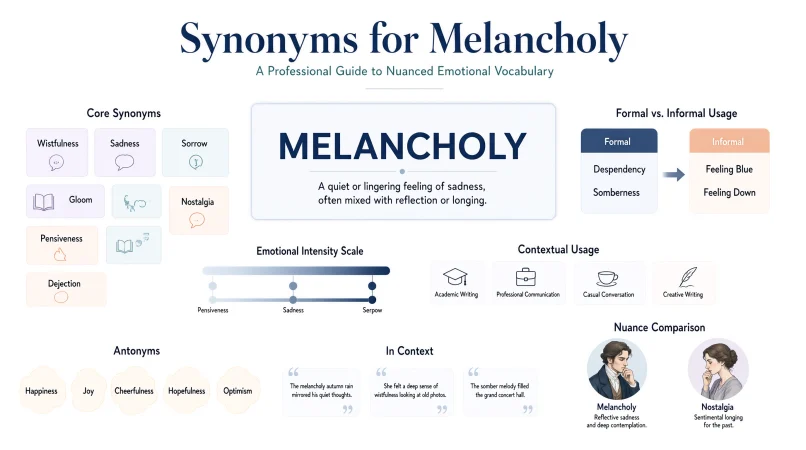
Melancholy is a quiet, thoughtful, or lingering feeling of sadness, often connected with longing or reflection. Common alternatives include sadness, gloom, wistfulness, sorrow, pensiveness, and dejection, depending on emotional intensity and context.
Have you ever described a character, a memory, or a difficult day as melancholy but struggled to find another word that captures the exact feeling? In essays, stories, captions, and personal writing, repeating the same emotional word can make your message feel less expressive.
Melancholy describes a thoughtful kind of sadness, often mixed with longing, reflection, or nostalgia. It is not always as intense as despair, and it does not necessarily mean someone is grieving.
This guide explores synonyms for melancholy with clear meanings, natural examples, and practical differences. You will learn which words work best in academic writing, professional communication, everyday conversation, and creative descriptions.
Meaning, Tone and Context
Simple Definition
Melancholy describes a feeling or mood of gentle, thoughtful, or lasting sadness. It can arise from memories, loneliness, disappointment, loss, or awareness that something meaningful has changed.
For example, an old photograph may bring a sense of melancholy because it reminds someone of a happier time that cannot return.
Part of Speech
Melancholy can function as both a noun and an adjective.
As a noun:
- A feeling of melancholy settled over the room.
- She experienced melancholy when she remembered her childhood.
- The music expressed a deep sense of melancholy.
As an adjective:
- He had a melancholy expression.
- The movie ended with a melancholy scene.
- Rainy afternoons often create a melancholy atmosphere.
Tone and Formality
Melancholy is generally neutral to negative in emotional meaning, but it can also have a reflective or poetic quality.
It is more literary and expressive than the everyday word sadness. It works particularly well in literature, thoughtful essays, personal reflections, and descriptions of mood.
Common Use Cases
- Emotional experiences: A quiet feeling of sadness or longing.
- Memories: Nostalgia for people, places, or earlier experiences.
- Literature: A character’s reflective or sorrowful mood.
- Music and art: A gentle, somber, or emotionally moving atmosphere.
- Weather and settings: A gloomy or subdued environment.
- Personal writing: Descriptions of loss, change, loneliness, or reflection.
Important Word Forms
| Word Form | Part of Speech | Meaning | Example |
| Melancholy | Noun | A thoughtful or lingering sadness | Melancholy filled her thoughts. |
| Melancholy | Adjective | Having a sad or reflective quality | It was a melancholy afternoon. |
| Melancholic | Adjective | Characterized by melancholy | He wrote a melancholic poem. |
| Melancholically | Adverb | In a melancholy manner | She smiled melancholically. |
| Melancholia | Noun | A historical or specialized term for a profound state of sadness | The novel explores themes of melancholia. |
When and How to Use “Melancholy”
Use melancholy when you want to describe sadness that feels thoughtful, lingering, or connected to memories. It is especially useful when the emotion is quieter and more reflective than intense grief or despair.
Here are realistic examples from different contexts.
1. Professional: The documentary presents a melancholy reflection on the decline of traditional industries.
2. Personal: I felt a little melancholy after visiting my childhood home.
3. Academic: The novel uses melancholy to explore memory, identity, and the passage of time.
4. Emotional: A quiet sense of melancholy followed their final goodbye.
5. Creative: The melancholy melody drifted through the empty hall.
6. Social media: Some memories bring a little melancholy, even when they make us smile.
7. Email: The announcement brought a melancholy feeling to the team because several longtime colleagues were leaving.
Another Word for “Melancholy”
There is no single replacement that captures every shade of melancholy. The best alternative depends on whether you mean ordinary sadness, deep sorrow, reflective longing, or a gloomy atmosphere.
| Situation | Recommended Alternative | Why It Works |
| Professional writing | Somberness | Describes a serious or subdued emotional tone. |
| Academic writing | Sorrow | Clearly identifies sadness or emotional pain. |
| Casual conversation | Sadness | Simple, familiar, and easy to understand. |
| Emotional writing | Heartache | Expresses personal emotional pain or loss. |
| Creative writing | Wistfulness | Captures gentle sadness mixed with longing. |
| Resume or workplace use | Concern | More appropriate when describing a serious professional issue rather than a personal mood. |
| Social media captions | Nostalgia | Works when sadness comes from remembering the past. |
| Stronger meaning | Despondency | Communicates a deeper loss of hope or confidence. |
| Softer meaning | Pensiveness | Suggests thoughtful reflection without necessarily implying sadness. |
Usage tip: Wistfulness is often a close alternative when melancholy involves longing. Pensiveness is better when the person is thoughtful but not necessarily sad.
When Not to Use “Melancholy”
Although melancholy is expressive, it is not the best choice for every kind of sadness. It can sound too literary, too mild, or too reflective when the situation calls for a more precise word.
| General Sentence | More Precise Sentence | Why It Is Better |
| She felt melancholy after the accident. | She felt devastated after the accident. | Communicates much stronger emotional pain. |
| He was melancholy about the exam. | He was disappointed about the exam. | Identifies a specific reaction to an outcome. |
| The room had a melancholy feeling. | The room had a gloomy atmosphere. | Describes the setting rather than a person’s inner mood. |
| She felt melancholy about her childhood. | She felt nostalgic about her childhood. | Emphasizes memories of the past. |
| He looked melancholy during the meeting. | He looked thoughtful during the meeting. | Avoids assuming that a thoughtful expression means sadness. |
Use melancholy when the sadness is quiet, reflective, or lingering. Choose grief, despair, or heartbreak when the emotion is much more intense.
Words Commonly Confused With “Melancholy”
Several words describe sadness or reflection, but they carry different emotional meanings.
| Word | Meaning | Difference From Melancholy |
| Sadness | An unhappy emotional state | A broad everyday term that does not necessarily involve reflection or longing. |
| Nostalgia | Affectionate or bittersweet longing for the past | Focuses on memories and earlier experiences. |
| Gloom | A dark, sad, or discouraging mood | Often feels heavier or more negative. |
| Sorrow | Deep sadness, often caused by loss | Usually suggests more serious emotional pain. |
| Wistfulness | Gentle longing mixed with sadness | Often comes closest to melancholy when remembering something unavailable. |
| Despair | A complete or overwhelming loss of hope | Much stronger and more severe than ordinary melancholy. |
For example, nostalgia describes missing an earlier time, while melancholy describes the sadness that may accompany that memory. Despair suggests a much more serious loss of hope.
Best Synonym by Context for Melancholy
The most suitable alternative depends on the source, intensity, and purpose of the emotion.
| Context | Best Synonym | Why It Works | Example |
| Formal writing | Sorrow | Clearly communicates sadness without sounding overly poetic | The event caused considerable sorrow among residents. |
| Academic writing | Despondency | Describes a low emotional state or loss of hope | The character’s despondency shapes the final chapters. |
| Professional or business use | Somberness | Describes a serious or subdued atmosphere | A sense of somberness followed the announcement. |
| Resume or workplace use | Concern | Communicates a serious reaction without making an emotional claim | The team expressed concern about the proposed changes. |
| Casual conversation | Sadness | Simple and familiar | I felt some sadness when the trip ended. |
| Creative writing | Wistfulness | Adds gentle longing and reflection | A wistfulness entered her voice as she spoke. |
| Emotional tone | Heartache | Expresses personal pain connected with loss | The song reminded him of the heartache of separation. |
| Strong intensity | Despair | Communicates a severe loss of hope | Despair overcame him after repeated setbacks. |
| Soft or moderate tone | Pensiveness | Suggests quiet thought rather than intense sadness | She sat in pensiveness by the window. |
| Social media captions | Nostalgia | Works for bittersweet memories | A little nostalgia for the days that shaped us. |
| Literary description | Languor | Suggests a subdued, low energy state | A quiet languor settled over the afternoon. |
| Serious atmosphere | Somberness | Emphasizes a serious mood | The ceremony was marked by somberness. |
| US and UK usage | Sadness | A familiar and natural word in both varieties of English | He felt sadness when his friends moved away. |
Which Synonym Should You Choose?
Before replacing melancholy, consider what kind of sadness you want to communicate.
1. Identify the source of the feeling. Use nostalgia for memories of the past, grief for deep sadness after a loss, and disappointment when expectations are not met.
2. Consider emotional intensity. Pensiveness is gentle and reflective. Sorrow is more serious, while despair suggests a much stronger loss of hope.
3. Think about your audience. Use sadness in everyday conversation. Choose wistfulness or melancholy for creative writing and literary descriptions.
4. Match the word to the sentence. Somberness can describe an atmosphere, while heartache usually describes personal emotional pain.
5. Avoid exaggeration. Do not use despair when you mean mild disappointment or a passing feeling of sadness.
6. Read the sentence aloud. The best synonym should sound natural and preserve the intended emotional meaning.
Simple rule: Choose wistfulness for gentle longing, nostalgia for bittersweet memories, sorrow for deeper sadness, and despair for an intense loss of hope.
Real Life Examples of Melancholy in Sentences
These examples show how related words can make descriptions more specific in different situations.
| Situation | Example Sentence |
| School | The poem uses wistfulness to express the speaker’s longing for childhood. |
| Workplace | A somber mood followed the news that the local office would close. |
| Writing | The author creates a melancholy atmosphere through quiet imagery and reflective language. |
| Conversation | I felt a little sadness when everyone went home. |
| Social media | A touch of nostalgia for places we may never visit again. |
| Resume | Demonstrated empathy and professionalism when supporting colleagues through organizational changes. |
| We recognize that this announcement may bring sadness to team members who have worked here for many years. | |
| Storytelling | A deep sense of sorrow followed her as she walked through the house where she had grown up. |
25 Synonyms for “Melancholy”
The word melancholy describes a deep, thoughtful, or lasting feeling of sadness, often mixed with loneliness, reflection, or longing. Unlike ordinary sadness, melancholy can have a quiet, nostalgic, or poetic quality.
The following 25 synonyms and context-specific alternatives will help you express different shades of melancholy in everyday conversations, creative writing, essays, and professional communication.
Common Synonyms for Melancholy and Sadness
These words are useful when describing general unhappiness, emotional pain, or a low mood.
| Synonym | Simple Meaning | Best Used For | Example Sentence |
|---|---|---|---|
| 1. Sadness | The feeling of being unhappy | Everyday conversation and general writing | A wave of sadness came over him. |
| 2. Sorrow | Deep sadness, often connected with loss | Formal and emotional writing | Her voice carried the sorrow of many difficult years. |
| 3. Gloom | A dark or unhappy mood | Feelings and atmosphere | The news brought gloom to the small community. |
| 4. Dejection | Sadness and loss of confidence | Personal reactions and descriptions | She tried to hide her dejection after the rejection. |
| 5. Downheartedness | A state of feeling sad or discouraged | Everyday and descriptive writing | A sense of downheartedness followed the disappointing news. |
| 6. Despondency | A low state of mind with little hope | Formal and literary writing | His despondency grew after several unsuccessful attempts. |
Synonyms for Melancholy Related to Grief and Emotional Pain
These alternatives describe deeper sadness, especially when it comes from loss, disappointment, or difficult personal experiences.
| Synonym | Simple Meaning | Best Used For | Example Sentence |
|---|---|---|---|
| 7. Heartache | Emotional pain caused by loss or disappointment | Personal and emotional writing | The farewell brought back years of heartache. |
| 8. Grief | Deep sadness after a significant loss | Serious personal experiences | The family was united in grief. |
| 9. Despair | An intense loss of hope | Strong emotional descriptions | Despair seemed to take over after the final setback. |
| 10. Disconsolateness | A state of being deeply unhappy and difficult to comfort | Formal or literary writing | Her disconsolateness lasted long after the farewell. |
| 11. Lamentation | An expression of grief or sorrow | Literature, speeches, and formal descriptions | The poem is a lamentation for a lost home. |
| 12. Dolor | Deep sorrow or emotional pain | Literary and formal writing | The novel conveys the dolor of a family separated by war. |
Synonyms for Melancholy Related to Nostalgia and Reflection
These words express sadness mixed with memories, longing, quiet thoughtfulness, or regret about the past.
| Synonym | Simple Meaning | Best Used For | Example Sentence |
|---|---|---|---|
| 13. Wistfulness | Gentle sadness mixed with longing | Memories and reflective writing | There was wistfulness in her smile as she remembered school. |
| 14. Pensiveness | Quiet thoughtfulness, sometimes tinged with sadness | Reflective and literary writing | A look of pensiveness crossed her face. |
| 15. Nostalgia | Bittersweet longing for the past | Memories, captions, and personal writing | The old photographs filled him with nostalgia. |
| 16. Ruefulness | Sadness or regret about something that happened | Reflective and literary writing | He gave a rueful smile when he recalled the mistake. |
| 17. Regret | Sadness about something done or not done | Personal and professional reflection | She expressed regret over the missed opportunity. |
Synonyms for Melancholy Related to Loneliness and Emptiness
These alternatives describe feelings of isolation, abandonment, emotional emptiness, or deep discouragement.
| Synonym | Simple Meaning | Best Used For | Example Sentence |
|---|---|---|---|
| 18. Desolation | A feeling or condition of emptiness, loneliness, or devastation | Emotional and atmospheric descriptions | A sense of desolation filled the abandoned town. |
| 19. Forlornness | A feeling of loneliness, abandonment, or sadness | Emotional and creative writing | The empty playground gave her a sense of forlornness. |
| 20. Despondence | A state of hopelessness or discouragement | Literary and formal writing | A period of despondence followed the disappointing result. |
| 21. Mournfulness | A quality of sadness associated with mourning | Descriptive and literary writing | The mournfulness of the music moved the audience. |
Synonyms for Melancholy Related to Mood and Atmosphere
These words are particularly useful for describing a person’s expression, the emotional tone of a setting, or the overall feeling of a scene.
| Synonym | Simple Meaning | Best Used For | Example Sentence |
|---|---|---|---|
| 22. Sullenness | A silent, gloomy, or resentful mood | Character descriptions | His sullenness made the conversation uncomfortable. |
| 23. Somberness | A serious, subdued, or gloomy quality | Formal writing and atmosphere | The somberness of the ceremony was unmistakable. |
| 24. Heaviness | An emotional burden or weight | Personal and conversational writing | A feeling of heaviness stayed with her all evening. |
| 25. Downcast mood | A state of sadness or low spirits | Everyday and descriptive writing | His downcast mood worried his friends. |
How to Choose the Right Synonym for “Melancholy”
The best synonym depends on the emotion you want to communicate. Use sadness for general unhappiness, sorrow for deeper emotional pain, and grief for sadness caused by significant loss. Choose wistfulness or nostalgia when sadness is connected with memories and longing.
For literary descriptions, desolation, forlornness, and dolor can express deeper emotional experiences. Use somberness when describing a serious atmosphere rather than an individual’s personal feelings.
Important usage note: These words are not interchangeable in every context. Nostalgia focuses on longing for the past, regret involves sadness about a decision or event, and despair suggests a stronger loss of hope. Melancholy can include several of these feelings without meaning exactly the same thing.
Synonym Groups and Usage Differences
Professional vs. Personal Synonyms
Professional writing usually benefits from neutral and specific language. Words such as concern, disappointment, and somberness can describe reactions or workplace atmospheres without sounding overly emotional.
Personal writing allows more expressive choices. Heartache, wistfulness, sorrow, and longing communicate feelings more directly and can make personal stories more engaging.
For example, a workplace report might say, “The announcement created a somber atmosphere.” A personal reflection might say, “I felt heartache when I remembered our final conversation.”
Formal vs. Conversational Synonyms
Formal alternatives are useful in essays, reports, speeches, and literary analysis. Conversational words are more natural in everyday discussions, texts, and informal messages.
| Formal Expression | Conversational Alternative |
| Despondency | Feeling down |
| Dejection | Sadness |
| Sorrow | Feeling sad |
| Somberness | A serious mood |
| Lamentation | Expression of grief |
| Disconsolateness | Deep unhappiness |
| Pensiveness | Being lost in thought |
For example, “The character experienced despondency” sounds formal. “The character felt deeply down” is more conversational.
Academic Synonyms
Academic writing should use words that accurately describe the emotion, literary technique, or psychological state being discussed.
Useful alternatives include:
- Sorrow: A clear term for deep sadness.
- Despondency: A state of discouragement or reduced hope.
- Dejection: Sadness associated with disappointment or loss of confidence.
- Wistfulness: A gentle longing for something unavailable or in the past.
- Somberness: A serious or subdued emotional quality.
- Nostalgia: A bittersweet emotional connection to earlier experiences.
For example, instead of writing “The character feels melancholy,” explain the specific emotion: “The character’s wistfulness reflects a longing for the security of childhood.”
Professional and Business Synonyms
In workplace communication, melancholy can sound too personal or literary. Choose a word that describes the observable situation or reaction.
| Situation | Recommended Word | Example |
| Difficult company announcement | Somberness | A somber atmosphere followed the announcement. |
| Disappointing project result | Disappointment | The team expressed disappointment with the outcome. |
| Concern about a change | Concern | Employees shared concerns about the transition. |
| Loss of a colleague | Sadness | The staff expressed sadness at her departure. |
| Reflective discussion | Thoughtfulness | His comments showed thoughtfulness about the decision. |
| Serious organizational event | Seriousness | The seriousness of the situation was clear. |
For resumes, avoid describing yourself as melancholy. Focus on professional qualities such as empathy, resilience, and the ability to support colleagues during difficult changes.
Creative or Literary Synonyms
Creative writing can use more specific alternatives to establish mood, personality, and atmosphere.
- Wistfulness: Gentle longing for something remembered or unavailable.
- Forlornness: A feeling of being lonely, abandoned, or without comfort.
- Mournfulness: A quality associated with mourning or grief.
- Desolation: A deep sense of loneliness, emptiness, or devastation.
- Dolor: A literary word for deep sorrow.
- Ruefulness: Sadness mixed with regret.
For example:
- Simple: She felt melancholy.
- More reflective: She felt wistful as she remembered her childhood.
- More emotional: A sense of forlornness followed her through the silent house.
Slang or Modern Synonyms
There is no exact modern slang replacement for melancholy. Informal expressions can describe a similar feeling, but they may carry different levels of seriousness.
| Expression | Meaning | Best Context |
| Feeling blue | Feeling sad | Casual conversation |
| Feeling down | Experiencing low spirits | Everyday speech |
| In a funk | Being in a low or unmotivated mood | Informal conversation |
| Down in the dumps | Feeling unhappy or discouraged | Friendly conversation |
| Having the blues | Experiencing sadness | Casual speech and music related contexts |
These expressions are suitable for conversation, dialogue, and informal captions. They are generally too casual for academic research or formal business reports.
Strongest vs. Weaker Synonyms
The following scale shows general emotional intensity. The exact strength depends on the situation and sentence.
| Level | Word | General Meaning |
| Mild | Pensiveness | Quiet thoughtfulness |
| Gentle | Wistfulness | Soft sadness mixed with longing |
| Moderate | Sadness | General unhappiness |
| Strong | Sorrow | Deep emotional sadness |
| Very strong | Grief | Intense sadness associated with loss |
| Severe | Despair | An overwhelming loss of hope |
Melancholy often sits between gentle wistfulness and deeper sorrow. It can be mild or profound depending on the context.
Emotional vs. Neutral Synonyms
Some words simply describe a mood, while others communicate a particular emotional experience.
| Neutral or General Word | More Emotional Word | Difference |
| Sadness | Heartache | Heartache suggests personal emotional pain. |
| Thoughtfulness | Wistfulness | Wistfulness adds longing and gentle sadness. |
| Seriousness | Sorrow | Sorrow communicates actual sadness. |
| Low mood | Despondency | Despondency suggests discouragement and reduced hope. |
| Reflection | Nostalgia | Nostalgia connects reflection to memories of the past. |
| Gloom | Desolation | Desolation can suggest deeper loneliness or devastation. |
Choose neutral words when describing an observable mood. Choose emotional words when the sentence needs to communicate the person’s inner experience.
Antonyms of “Melancholy”
The most useful opposites of melancholy include happiness, cheerfulness, and joy. The best antonym depends on whether you mean sadness, a gloomy atmosphere, or reflective longing.
The following table includes 15 direct or contextual opposites. Not every entry is an exact antonym in every situation.
| Antonym | Meaning | Example Sentence |
| 1. Happiness | A state of feeling pleased or content | Happiness filled the room during the celebration. |
| 2. Joy | A strong feeling of pleasure or delight | Her face showed pure joy. |
| 3. Cheerfulness | A bright and positive mood | His cheerfulness lifted everyone’s spirits. |
| 4. Gladness | A feeling of pleasure or happiness | She expressed gladness at seeing her friends. |
| 5. Contentment | A peaceful feeling of satisfaction | He felt contentment while sitting in the garden. |
| 6. Optimism | A hopeful attitude about the future | Her optimism helped the team remain motivated. |
| 7. Hopefulness | A belief that something good may happen | Hopefulness returned after the positive news. |
| 8. Exuberance | Energetic excitement and enthusiasm | The children greeted the visitors with exuberance. |
| 9. Elation | A feeling of great happiness | The team celebrated with elation after winning. |
| 10. Euphoria | An intense feeling of happiness or excitement | The crowd experienced euphoria after the announcement. |
| 11. Delight | Great pleasure or happiness | She smiled with delight at the surprise. |
| 12. Lightheartedness | A cheerful and carefree mood | Their lightheartedness made the gathering enjoyable. |
| 13. Enthusiasm | Strong interest and excitement | He approached the new opportunity with enthusiasm. |
| 14. Serenity | A calm and peaceful state | Serenity replaced the sadness she had felt earlier. |
| 15. Vivacity | Liveliness, energy, and spirit | Her vivacity brought life to the conversation. |
Important distinction: Happiness and joy are direct emotional opposites of sadness. Optimism contrasts with hopelessness, while serenity contrasts with a troubled or gloomy state.
Comparison: Melancholy vs. Similar Words
Melancholy vs. Sadness
Main difference: Melancholy suggests thoughtful or lingering sadness, often connected with reflection. Sadness is a general term for being unhappy.
Which is stronger: Sadness can range from mild to severe. Melancholy often describes a quieter, more reflective mood.
Which is more formal: Melancholy sounds more literary, while sadness is more common and straightforward.
Examples:
- Melancholy: A feeling of melancholy came over him as he watched the sunset.
- Sadness: She felt sadness when her friend moved away.
Melancholy vs. Nostalgia
Main difference: Melancholy is a reflective kind of sadness. Nostalgia is a sentimental longing for the past, sometimes mixed with happiness.
Which is stronger: Neither is automatically stronger. Nostalgia may be pleasant, while melancholy usually has a sad quality.
Which is more formal: Both are suitable for formal writing, though melancholy has a more literary tone.
Examples:
- Melancholy: The empty house filled her with melancholy.
- Nostalgia: The old photographs filled her with nostalgia for childhood.
Melancholy vs. Sorrow
Main difference: Melancholy often suggests quiet or lingering sadness. Sorrow usually communicates deeper emotional pain, especially after a loss.
Which is stronger: Sorrow is generally stronger.
Which is more formal: Both are suitable for formal and literary writing.
Examples:
- Melancholy: A quiet melancholy followed the end of summer.
- Sorrow: The family experienced profound sorrow after the loss.
Melancholy vs. Gloom
Main difference: Melancholy often describes an inward, reflective sadness. Gloom can describe a person’s mood or a dark, discouraging atmosphere.
Which is stronger: Gloom can sound heavier or more negative when describing an atmosphere.
Which is more formal: Both work in descriptive writing, but melancholy is more literary.
Examples:
- Melancholy: She listened to the song with melancholy.
- Gloom: Gloom spread through the office after the disappointing news.
Melancholy vs. Wistfulness
Main difference: Melancholy describes a broader feeling of thoughtful sadness. Wistfulness specifically suggests gentle longing for something remembered or unavailable.
Which is stronger: Melancholy can feel deeper, while wistfulness is often softer.
Which is more formal: Both are appropriate for literary and reflective writing.
Examples:
- Melancholy: A sense of melancholy stayed with him throughout the evening.
- Wistfulness: She spoke with wistfulness about her childhood home.
Melancholy vs. Despair
Main difference: Melancholy is often quiet and reflective. Despair suggests an intense loss of hope or belief that circumstances can improve.
Which is stronger: Despair is considerably stronger.
Which is more formal: Both are used in formal writing, but despair has a more direct and severe meaning.
Examples:
- Melancholy: The character felt melancholy after leaving home.
- Despair: The character fell into despair after losing all hope of finding a solution.
Common Phrases and Expressions with “Melancholy”
These expressions help describe sadness, longing, reflection, and emotional atmosphere.
1. A Sense of Melancholy
Meaning: A general feeling of quiet or lingering sadness.
Example sentence: A sense of melancholy came over her as she walked through her childhood neighborhood.
2. Deep Melancholy
Meaning: A strong or lasting feeling of sadness.
Example sentence: The character struggled with deep melancholy after losing his closest friend.
3. Melancholy Mood
Meaning: A state of mind characterized by sadness or reflection.
Example sentence: The rainy afternoon put her in a melancholy mood.
4. Melancholy Music
Meaning: Music that creates a sad, reflective, or emotional atmosphere.
Example sentence: The melancholy music reminded him of his years away from home.
5. Melancholy Smile
Meaning: A smile that expresses sadness, longing, or mixed emotions.
Example sentence: She gave a melancholy smile when she remembered their final summer together.
6. Melancholy Memories
Meaning: Memories that bring sadness, longing, or bittersweet feelings.
Example sentence: Their old family photographs brought back melancholy memories.
7. A Touch of Melancholy
Meaning: A small or gentle amount of sadness.
Example sentence: There was a touch of melancholy in her voice as she said goodbye.
8. Overcome by Melancholy
Meaning: Strongly affected by a feeling of sadness.
Example sentence: He was overcome by melancholy when he returned to the town where he had grown up.
Common Mistakes to Avoid
Choosing an alternative without understanding its emotional meaning can change the message of a sentence. Avoid these common mistakes.
1. Using Melancholy When a More Precise Word Is Better
Melancholy is broad enough to describe several kinds of sadness, but it may not identify the exact emotion.
Instead of: She felt melancholy after failing the test.
Better: She felt disappointed after failing the test.
Disappointment explains the reason for her reaction more clearly.
2. Confusing Melancholy With Nostalgia
Nostalgia focuses on longing for the past. Melancholy describes sadness that may or may not involve memories.
Use nostalgia when someone misses an earlier period of life. Use melancholy when the focus is on the reflective sadness itself.
3. Using a Casual Expression in Formal Writing
Expressions such as feeling blue and down in the dumps are conversational.
Instead of: The character was feeling blue throughout the novel.
Better: The character experienced persistent sadness throughout the novel.
4. Using an Overly Dramatic Synonym
Despair and grief communicate much stronger emotions than ordinary melancholy.
Do not use them to describe a mild feeling of nostalgia or a quiet, reflective afternoon.
5. Repeating Melancholy Too Often
Repeatedly using the same word can make creative writing sound predictable.
Instead of: The melancholy song created a melancholy mood in the melancholy room.
Better: The sorrowful melody created a reflective mood throughout the quiet room.
6. Choosing a Synonym With the Wrong Emotional Tone
Pensiveness suggests thoughtful reflection, while despondency suggests discouragement and reduced hope.
Do not use them interchangeably without considering the intended emotion.
7. Using Slang in Academic or Professional Writing
Expressions such as in a funk and down in the dumps are usually too informal for research papers and official reports.
Choose sadness, sorrow, despondency, or somberness when the context calls for a more formal tone.
FAQs
1. What Is the Best Synonym for Melancholy?
Wistfulness is a close alternative when melancholy involves gentle longing. Sadness, sorrow, and gloom work better for other kinds of emotional experiences.
2. What Is a Formal Synonym for Melancholy?
Despondency, dejection, sorrow, and somberness are useful formal alternatives. Choose one based on whether you mean discouragement, sadness, or a serious atmosphere.
3. What Is an Informal Synonym for Melancholy?
Sadness, feeling blue, and feeling down are natural informal alternatives. They work well in conversations, messages, and everyday personal writing.
4. What Is Another Word for Melancholy in Professional Writing?
Somberness, concern, and sadness are useful choices for workplace communication. They describe serious moods or reactions without sounding unnecessarily poetic.
5. What Is the Difference Between Melancholy and Nostalgia?
Melancholy is a reflective kind of sadness. Nostalgia is a sentimental longing for the past, which may include both happiness and sadness.
6. What Is the Opposite of Melancholy?
Happiness, joy, and cheerfulness are common opposites of melancholy. Optimism and hopefulness are suitable when the contrast involves outlook or expectations.
Conclusion
Melancholy describes a quiet, thoughtful, or lingering kind of sadness, often connected with memories, longing, or reflection. Useful alternatives include wistfulness, sadness, sorrow, gloom, nostalgia, and pensiveness.
For academic and professional writing, choose precise words such as sorrow, despondency, or somberness. For everyday conversation, sadness and feeling down sound natural. Also For creative writing, wistfulness, forlornness, and mournfulness can add emotional depth.
The best synonym depends on the reason for the sadness and how strongly you want to express it. A gentle longing is not the same as grief, and ordinary disappointment is not the same as despair.
Vocabulary tip: Before replacing melancholy, identify whether the feeling comes from memory, loss, loneliness, disappointment, or reflection. Choosing the word that names the actual emotion will make your writing more precise and meaningful.