
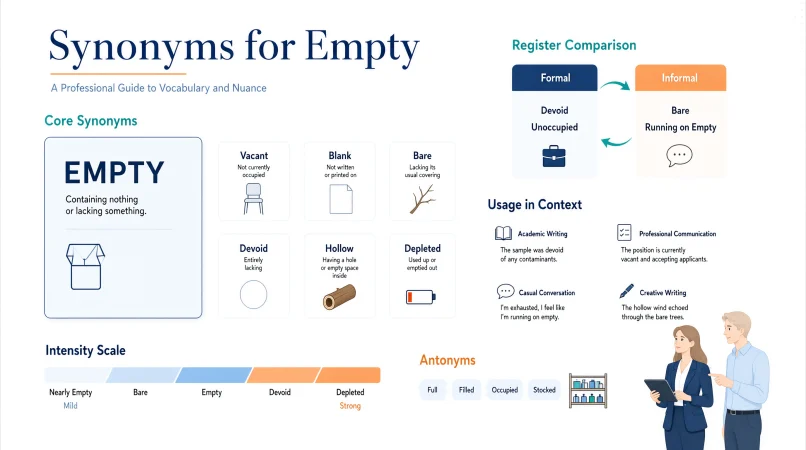
Empty means containing nothing, having no occupants, or lacking something expected or needed. Common alternatives include vacant, bare, unoccupied, blank, hollow, and depleted, depending on the object, situation, or emotional meaning.
Have you ever used the word empty several times in an essay, email, caption, or conversation because you could not think of a better alternative? It is a simple and useful word, but repeating it can make your writing sound less descriptive.
The word empty has several meanings. It can describe a room with no furniture, a bottle with no liquid, a person feeling lonely, or a promise that has no real value. Each situation calls for a different word.
This guide explores synonyms for empty with clear definitions, natural examples, and practical recommendations. You will learn how to choose accurate alternatives for academic writing, professional communication, creative work, and everyday conversation.
Meaning, Tone and Context
Simple Definition
Empty describes something that has nothing inside, contains less than expected, or lacks a particular quality or substance.
For example, an empty glass contains no liquid. An empty room has no occupants or furniture, depending on the context. An empty promise lacks genuine intention or value.
Part of Speech
Empty is most commonly an adjective, but it can also function as a verb.
As an adjective:
- The parking lot was empty.
- She opened an empty box.
- His apology sounded empty.
As a verb:
- Please empty the trash can.
- They emptied the storage room.
- She emptied the contents of her bag onto the table.
Tone and Formality
Empty is a neutral word in most situations. It works in casual conversation, academic writing, business communication, and creative writing.
Its emotional tone changes with context. An empty room is usually a factual description, while an empty heart suggests sadness, loneliness, or emotional loss.
Common Use Cases
- Physical objects: An empty bottle, box, container, or bag.
- Places: An empty room, house, parking lot, or street.
- Emotional situations: An empty feeling, lonely heart, or sense of loss.
- Information: An empty field, blank page, or missing entry.
- Promises and statements: An empty promise or meaningless remark.
- Resources: Empty shelves, depleted supplies, or exhausted reserves.
Important Word Forms
| Word Form | Part of Speech | Meaning | Example |
| Empty | Adjective | Containing nothing or lacking something | The room is empty. |
| Empty | Verb | To remove everything from something | Please empty the container. |
| Emptiness | Noun | The state of being empty | She felt a sense of emptiness. |
| Emptying | Verb form or gerund | The act of removing contents | Emptying the boxes took an hour. |
| Emptied | Past tense or past participle | Removed the contents | He emptied the drawer. |
| Empty handed | Adjective phrase or adverbial expression | Having nothing to show or carry after an effort | They returned empty handed. |
When and How to Use “Empty”
Use empty when describing a lack of contents, people, activity, information, or emotional fulfillment. It is especially useful when the reader can understand what should be present but is missing.
Here are realistic examples from different situations.
1. Professional: The conference room was empty before the meeting began.
2. Personal: I found an empty seat beside my friend.
3. Academic: The researcher submitted an empty response field by mistake.
4. Emotional: He felt empty after saying goodbye to his closest friend.
5. Creative: An empty street stretched beneath the pale evening sky.
6. Social media: Sometimes, an empty space gives you room to grow.
7. Email: Please do not leave any required fields empty when completing the application.
Another Word for “Empty”
There is no single replacement that fits every meaning of empty. The best synonym depends on whether you are describing a place, container, space, feeling, or statement.
| Situation | Recommended Alternative | Why It Works |
| Professional writing | Vacant | Describes an available or unoccupied space or position. |
| Academic writing | Devoid | Emphasizes the absence of a particular quality or element. |
| Casual conversation | Bare | Describes something with very few contents or decorations. |
| Emotional writing | Hollow | Suggests an inner feeling of sadness or lack of fulfillment. |
| Creative writing | Desolate | Creates an image of an abandoned or lonely place. |
| Resume or workplace use | Unoccupied | Clearly describes a position, room, or space without an occupant. |
| Social media captions | Blank | Works for an empty page, expression, or mental state. |
| Stronger meaning | Depleted | Indicates that a supply or resource has been used up. |
| Softer meaning | Nearly empty | Indicates that very little remains without suggesting complete absence. |
Usage tip: Vacant is not a universal replacement for empty. A vacant apartment may be available for someone to occupy, while an empty apartment simply has no one inside.
When Not to Use “Empty”
Although empty is easy to understand, it can be too general when the sentence needs a more specific description.
For example, an empty room may be unoccupied, bare, or vacant. An empty battery is better described as depleted or discharged. The right choice depends on what is missing.
| General Sentence | More Precise Sentence | Why It Is Better |
| The room was empty. | The room was unoccupied. | Emphasizes that nobody was there. |
| The shelves were empty. | The shelves were bare. | Highlights the lack of items on display. |
| The battery is empty. | The battery is depleted. | Describes a power supply that has run out. |
| His apology was empty. | His apology was insincere. | Explains that the apology lacked genuine feeling. |
| The page was empty. | The page was blank. | Identifies a page without writing or marks. |
| She felt empty. | She felt emotionally numb. | Describes a particular emotional experience. |
Use empty when the meaning is clear. Choose a more specific word when you want readers to picture the exact condition.
Words Commonly Confused With “Empty”
Several words describe a lack of something, but their meanings are not identical.
| Word | Meaning | Difference From Empty |
| Vacant | Not occupied or currently in use | Often describes rooms, buildings, seats, and positions. |
| Blank | Without writing, marks, or visible information | Commonly describes pages, forms, screens, and expressions. |
| Hollow | Having an empty space inside | Can describe physical objects or emotional experiences. |
| Bare | Without coverings, decorations, or many contents | Emphasizes simplicity or lack of visible items. |
| Depleted | Reduced or used up | Usually describes supplies, energy, resources, or reserves. |
| Void | An empty space or complete absence | Often sounds more formal, abstract, or literary. |
For example, a blank page has no writing, while a bare desk has very few objects. A hollow container has an empty interior, while a vacant room has no occupants.
Best Synonym by Context for Empty
The best synonym depends on the thing being described and the type of absence involved.
| Context | Best Synonym | Why It Works | Example |
| Formal writing | Devoid | Clearly indicates the absence of a quality or element | The report was devoid of supporting evidence. |
| Academic writing | Lacking | Identifies something that is missing | The study was lacking sufficient data. |
| Professional or business use | Vacant | Describes an unoccupied space or position | The manager discussed the vacant office. |
| Resume or workplace use | Unoccupied | Clearly describes an unused position or space | The conference room remained unoccupied. |
| Casual conversation | Bare | Sounds natural when describing a space with few items | The apartment was almost bare. |
| Creative writing | Desolate | Creates an image of loneliness or abandonment | A desolate road crossed the valley. |
| Emotional tone | Hollow | Expresses an inner sense of loss or emptiness | She felt hollow after the farewell. |
| Strong intensity | Depleted | Indicates that a supply or resource has been used up | The emergency supplies were depleted. |
| Soft or moderate tone | Nearly empty | Suggests that very little remains | The bottle was nearly empty. |
| Social media captions | Blank | Works for an expression, page, or state of mind | My mind is completely blank today. |
| Product descriptions | Unfilled | Describes a container or space that has not been filled | The package contains an unfilled storage pouch. |
| Emotional or literary writing | Void | Communicates a deep absence or loss | His departure left a void in her life. |
| US and UK usage | Empty | Standard and natural in both varieties | The parking lot was empty. |
Which Synonym Should You Choose?
Before replacing empty, identify what is missing and why it matters.
1. Consider the object. Use vacant for an unoccupied room or position, blank for a page without writing, and bare for a space with few objects.
2. Identify the kind of absence. Use depleted when supplies or resources have been used up. Use devoid when a particular quality or element is missing.
3. Think about formality. Words such as devoid, unoccupied, and depleted are useful in formal contexts. Bare and blank often sound more conversational.
4. Choose the right emotional tone. Use hollow for an emotional experience and desolate for a lonely or abandoned setting.
5. Check the strength of the meaning. Nearly empty allows some contents to remain, while completely empty means nothing is left within the relevant context.
6. Read the complete sentence. A synonym must fit both the grammar and the intended meaning. A vacant room and a depleted battery describe different conditions.
Simple rule: Choose vacant for occupancy, blank for missing marks or information, bare for a lack of contents, and depleted for used up resources.
Real Life Examples of Empty in Sentences
These examples show how more precise alternatives can improve everyday and professional communication.
| Situation | Example Sentence |
| School | The student submitted a blank answer sheet. |
| Workplace | The company has several vacant positions in its sales department. |
| Writing | The article felt devoid of useful examples. |
| Conversation | The refrigerator is almost empty. |
| Social media | A quiet mind is better than an overcrowded one. |
| Resume | Maintained accurate records and ensured no required fields were left blank. |
| Please complete all unfilled sections before returning the application. | |
| Storytelling | The abandoned house stood desolate beneath the winter sky. |
25 Synonyms for “Empty”
The word empty can describe a space with nothing inside, a place without people, a container without contents, or something lacking meaning or substance. The best synonym depends on the situation and the type of emptiness you want to express.
Below are 25 alternatives to “empty,” organized by meaning, with simple definitions, suitable uses, and example sentences.
Synonyms for Empty Meaning Vacant or Unoccupied
These words describe rooms, buildings, seats, or other places that are not being used or occupied.
| Synonym | Simple Meaning | Best Used For | Example Sentence |
|---|---|---|---|
| 1. Vacant | Not occupied or in use | Rooms, seats, buildings, and positions | We found a vacant table near the window. |
| 2. Unoccupied | Not being used or lived in | Rooms, buildings, and positions | The apartment remained unoccupied for months. |
| 3. Uninhabited | Having no people living there | Islands, buildings, and regions | They explored an uninhabited island. |
| 4. Deserted | Left behind or without people | Streets, buildings, and places | The beach was deserted after sunset. |
| 5. Abandoned | Left without care or use | Buildings, vehicles, and possessions | An abandoned warehouse stood near the tracks. |
| 6. Unpeopled | Without people or inhabitants | Landscapes and geographic descriptions | The explorers crossed an unpeopled valley. |
| 7. Desolate | Lonely, deserted, or lacking signs of life | Landscapes and emotional descriptions | The village looked desolate after the storm. |
Synonyms for Empty Meaning Blank, Bare, or Without Contents
Use these alternatives when describing surfaces, pages, containers, or spaces that lack objects, writing, or other contents.
| Synonym | Simple Meaning | Best Used For | Example Sentence |
|---|---|---|---|
| 8. Blank | Without writing, marks, or information | Pages, forms, screens, and expressions | She handed in a blank worksheet. |
| 9. Bare | Without many objects or decorations | Rooms, surfaces, and landscapes | The walls were bare after the renovation. |
| 10. Hollow | Empty inside or lacking substance | Containers, objects, and feelings | The old tree had a hollow trunk. |
| 11. Unfilled | Not filled with contents or information | Forms, spaces, containers, and positions | Several fields on the application were unfilled. |
| 12. Clear | Free from objects or obstructions | Tables, surfaces, and spaces | Keep the hallway clear of boxes. |
| 13. Void | A completely empty space or an absence | Formal, abstract, and literary writing | Her departure left a void in the family. |
| 14. Hollowed out | Made empty inside by removing material | Buildings, objects, and structures | Workers hollowed out the old tree trunk. |
Synonyms for Empty Meaning Used Up or Depleted
These words describe supplies, energy, money, or containers that have been emptied or used up. They are useful when the original word refers to a lack of remaining resources.
| Synonym | Simple Meaning | Best Used For | Example Sentence |
|---|---|---|---|
| 15. Exhausted | Completely used up or spent | Supplies, energy, and resources | The team’s emergency funds were exhausted. |
| 16. Depleted | Reduced because some or all has been used | Batteries, reserves, and supplies | The water supply was depleted. |
| 17. Drained | Emptied of liquid, energy, or resources | Containers, pools, and energy levels | The pool was drained for maintenance. |
| 18. Unloaded | Having its cargo or contents removed | Vehicles, trucks, and containers | The delivery truck was unloaded before noon. |
Synonyms for Empty Meaning Lacking Something
These alternatives describe something that has little or none of a particular quality, resource, or meaningful content.
| Synonym | Simple Meaning | Best Used For | Example Sentence |
|---|---|---|---|
| 19. Devoid | Completely lacking a particular thing | Formal and academic writing | The argument was devoid of evidence. |
| 20. Vacuous | Lacking meaningful content or intelligence | Statements, expressions, or ideas | The speech contained several vacuous statements. |
| 21. Hollow-sounding | Seeming insincere or lacking genuine meaning | Promises, apologies, and claims | His explanation sounded hollow. |
| 22. Barren | Unable to support much growth or life | Land, soil, and figurative descriptions | The barren field produced no crops. |
Additional Context-Specific Alternatives for Empty
These expressions describe particular situations in which a place, space, or storage area lacks people, objects, or expected goods.
| Synonym | Simple Meaning | Best Used For | Example Sentence |
|---|---|---|---|
| 23. Unused | Not currently being used | Equipment, space, and resources | The office has an unused storage room. |
| 24. Unstocked | Not supplied with the expected goods | Shops, shelves, and storage areas | The store’s shelves were temporarily unstocked. |
| 25. Unoccupied space | An area without people or objects | Property and workplace descriptions | The company rented the unoccupied space. |
How to Choose the Right Synonym for “Empty”
Choose vacant or unoccupied when describing a room or seat without anyone using it. Use blank for a page without writing, bare for a surface without objects, and hollow for something empty inside. When discussing supplies or resources, depleted, exhausted, and drained may be more precise.
For abstract meanings, choose devoid when something completely lacks a quality or vacuous when an idea or statement lacks meaningful content.
Important usage note: Not every word in this list is interchangeable with empty. For example, uninhabited describes a place without residents, while depleted describes something that has been reduced through use. Expressions such as unoccupied space and hollow-sounding apply only in particular contexts.
Synonym Groups and Usage Differences
Professional vs. Personal Synonyms
Professional writing should describe the exact condition rather than rely on a vague word.
For example, vacant works for an available position, unoccupied describes a room without occupants, and depleted describes resources that have been used up.
Personal writing can be more expressive. Words such as hollow, desolate, and void can communicate loneliness, sadness, or a sense of loss.
Formal vs. Conversational Synonyms
Formal alternatives are useful in reports, essays, applications, and official communication. Conversational alternatives are easier to understand in everyday speech.
| Formal Expression | Conversational Alternative |
| Devoid of | Without |
| Unoccupied | Empty |
| Depleted | Used up |
| Uninhabited | Without people |
| Vacant | Available |
| Lacking | Missing |
| The absence of | Not having |
For example, “The report was devoid of supporting evidence” sounds formal. “The report had no supporting evidence” is simpler and more direct.
Academic Synonyms
Academic writing benefits from precise terms that explain what is missing.
Useful choices include:
- Devoid of: Completely lacking a particular quality or element.
- Lacking: Not having something necessary or expected.
- The absence of: The condition of something not being present.
- Depleted: Reduced or used up, particularly when discussing resources.
- Uninhabited: Having no permanent human residents.
- Barren: Unable to support much plant growth or life.
For example, instead of writing “The research was empty of useful findings,” write “The research lacked useful findings.”
Professional and Business Synonyms
In workplace communication, the best alternative depends on what is empty.
| Situation | Recommended Word | Example |
| Available job position | Vacant | We are hiring for a vacant position. |
| Room without occupants | Unoccupied | The meeting room is unoccupied. |
| Missing application details | Blank | Please complete the blank fields. |
| Used up supplies | Depleted | The office supplies are depleted. |
| Storage area with no contents | Bare | The storage shelves are bare. |
| Missing information | Lacking | The proposal is lacking important details. |
For a resume, avoid saying “I managed empty office spaces.” Use a specific achievement, such as “Managed office space allocation and room scheduling.”
Creative or Literary Synonyms
Creative writing can use more descriptive alternatives to create atmosphere and emotion.
- Desolate: Suggests a lonely, abandoned, or lifeless place.
- Hollow: Can suggest physical emptiness or emotional loss.
- Void: Creates an image of a deep absence.
- Barren: Suggests land or a setting without growth or life.
- Deserted: Creates an image of a place left behind.
- Bare: Emphasizes simplicity or a lack of decoration.
For example:
- Simple: The house was empty.
- More descriptive: The house stood deserted at the end of the road.
- More emotional: The house felt hollow without its former residents.
Slang or Modern Synonyms
There is no single modern slang word that replaces empty in every context. Informal expressions usually describe a particular situation.
| Expression | Meaning | Best Context |
| All out | Having none remaining | Supplies or resources |
| Out of stock | Having no products available | Shopping and business |
| Running on empty | Having very little energy or capacity left | Casual conversation |
| Nothing left | Having no remaining contents | Everyday speech |
| Wiped out | Completely exhausted | Informal conversation about energy |
For example, “I am running on empty” means that someone feels exhausted, not that their physical body is literally empty.
Strongest vs. Weaker Synonyms
These expressions differ in the kind and degree of absence they communicate. This is a contextual guide rather than a universal ranking.
| Level | Word or Expression | General Meaning |
| Mild | Nearly empty | A small amount remains. |
| Moderate | Bare | Very few contents or decorations remain. |
| Clear absence | Empty | Nothing is present within the relevant context. |
| Strong | Devoid | Completely lacking a particular element. |
| Resource exhaustion | Depleted | A supply or resource has been used up. |
| Emotional or literary | Hollow | Suggests a deep physical or emotional absence. |
Use nearly empty when something still contains a little. Use devoid when a particular quality or element is completely missing.
Emotional vs. Neutral Synonyms
Some alternatives describe a physical condition, while others communicate feelings or emotional experiences.
| Neutral Expression | Emotional Expression | Difference |
| Empty | Hollow | Hollow can suggest emotional pain or lack of fulfillment. |
| Unoccupied | Desolate | Desolate adds a feeling of loneliness or abandonment. |
| Bare | Barren | Barren can suggest lifelessness or lack of growth. |
| Absence | Void | Void can communicate a deep sense of loss. |
| Blank | Numb | Numb describes an emotional state, not a physically empty space. |
Choose neutral words for factual descriptions. Use emotional expressions when the sentence is intended to communicate a person’s feelings or create a particular atmosphere.
Antonyms of “Empty”
The most direct opposite of empty is full, meaning containing as much as possible or having the expected contents.
Other opposites depend on context. A room may be occupied, a shelf may be stocked, and a person may feel fulfilled. The following 15 terms include direct antonyms and contextual contrasts.
| Antonym | Meaning | Example Sentence |
| 1. Full | Containing the expected or maximum amount | The bottle is full of water. |
| 2. Filled | Having contents placed inside | The box was filled with books. |
| 3. Occupied | Being used or containing people | Every seat was occupied. |
| 4. Crowded | Filled with many people or things | The restaurant was crowded. |
| 5. Packed | Filled tightly or containing many items | The suitcase was packed with clothes. |
| 6. Loaded | Filled with goods, contents, or a load | The truck was loaded with supplies. |
| 7. Stocked | Supplied with goods or materials | The store was fully stocked. |
| 8. Complete | Having all necessary parts | The application is complete. |
| 9. Abundant | Available in large quantities | Fresh water was abundant in the region. |
| 10. Plentiful | Existing in a large amount | Food was plentiful after the harvest. |
| 11. Rich | Containing a large amount of something valuable or desirable | The soil is rich in nutrients. |
| 12. Overflowing | So full that contents spill or extend beyond the limit | The basket was overflowing with fruit. |
| 13. Populated | Having people living in an area | The island is densely populated. |
| 14. Fulfilled | Feeling satisfied or having a sense of purpose | She felt fulfilled after completing the project. |
| 15. Engaged | Occupied or actively involved in an activity | The children were engaged in creative work. |
Important: Full is the clearest direct opposite of empty when discussing contents. Occupied works for spaces, while fulfilled is a contextual opposite when describing emotional emptiness.
Comparison: Empty vs. Similar Words
Empty vs. Vacant
Main difference: Empty means containing nothing or lacking something. Vacant usually means that a place or position is not occupied or currently in use.
Which is stronger: Neither is universally stronger. Empty describes contents, while vacant emphasizes availability or nonoccupancy.
Which is more formal: Both are appropriate in formal writing. Vacant is common in property and employment contexts.
Examples:
- Empty: The room was empty of furniture.
- Vacant: The apartment is vacant and ready for a new tenant.
Empty vs. Blank
Main difference: Empty refers to a lack of contents. Blank usually describes a surface, page, or space without writing, marks, or information.
Which is stronger: Neither is stronger. They describe different conditions.
Which is more formal: Both are neutral and widely used.
Examples:
- Empty: The box was empty.
- Blank: The application form had a blank section.
Empty vs. Bare
Main difference: Empty means nothing is inside or present. Bare means lacking coverings, decorations, or many visible objects.
Which is stronger: Empty may suggest a complete absence. Bare can mean that a few things remain.
Which is more formal: Both are suitable for formal and informal writing.
Examples:
- Empty: The cupboard was empty.
- Bare: The cupboard contained only a few bare shelves.
Empty vs. Hollow
Main difference: Empty describes a lack of contents. Hollow describes something with an empty space inside or a lack of emotional substance.
Which is stronger: Hollow can carry a stronger emotional meaning.
Which is more formal: Both work in formal writing, although hollow is often more descriptive.
Examples:
- Empty: The container was empty.
- Hollow: The tree had a hollow center.
Empty vs. Depleted
Main difference: Empty means nothing remains or is present. Depleted means a supply or resource has been reduced or used up.
Which is stronger: Depleted more specifically emphasizes the reduction of resources.
Which is more formal: Depleted is especially useful in technical, academic, and professional contexts.
Examples:
- Empty: The fuel tank was empty.
- Depleted: The emergency fuel reserves were depleted.
Empty vs. Devoid
Main difference: Empty describes a lack of contents or occupants. Devoid means completely lacking a particular quality, feature, or element.
Which is stronger: Devoid is stronger when emphasizing the complete absence of something specific.
Which is more formal: Devoid is more formal.
Examples:
- Empty: The room was empty.
- Devoid: The room was devoid of natural light.
Common Phrases and Expressions with “Empty”
These expressions are useful in everyday conversation, professional writing, and creative descriptions.
1. Empty Handed
Meaning: Having nothing to show or carry after an attempt or visit.
Example sentence: She returned empty handed after searching for the missing document.
2. Running on Empty
Meaning: Having very little energy, motivation, or resources left.
Example sentence: After working three long shifts, he was running on empty.
3. Empty Promise
Meaning: A promise that is not supported by genuine intention or action.
Example sentence: The employees were tired of hearing empty promises about better working conditions.
4. Empty Nest
Meaning: A home in which children have grown up and moved away.
Example sentence: The couple enjoyed their new routine after experiencing the empty nest stage.
5. Empty Space
Meaning: An area that contains nothing or has no objects in it.
Example sentence: Leave some empty space around the text to improve the design.
6. Empty Calories
Meaning: Calories from foods or drinks that provide little nutritional value.
Example sentence: She reduced her intake of sugary drinks and other sources of empty calories.
7. Empty Gesture
Meaning: An action that appears helpful or meaningful but lacks genuine commitment.
Example sentence: The public considered the announcement an empty gesture because no action followed it.
8. Empty Words
Meaning: Statements that lack sincerity, meaning, or practical action.
Example sentence: He wanted real solutions rather than empty words.
Common Mistakes to Avoid
Using a synonym without checking its exact meaning can make a sentence inaccurate. Avoid these common mistakes.
1. Using Empty When a More Precise Word Is Better
Empty does not always explain what is missing.
Instead of: The office was empty.
Better: The office was unoccupied.
The second sentence makes it clear that nobody was there.
2. Confusing Empty With Vacant
A vacant room is unoccupied or available for use. An empty room may simply have no furniture or contents.
Use vacant when discussing available apartments, rooms, seats, or jobs.
3. Using Casual Expressions in Formal Writing
Expressions such as running on empty and the whole lot may sound too informal in reports or academic essays.
Choose depleted, unoccupied, or lacking when those terms accurately describe the situation.
4. Using an Overly Dramatic Synonym
Words such as desolate and void can create strong emotional effects.
Do not use them to describe an ordinary empty box or a room waiting for furniture.
5. Repeating Empty Too Often
Repeatedly using the same word can make an article sound monotonous.
Instead of: The room was empty. The shelves were empty. The cupboard was empty.
Better: The room was bare, the shelves were unstocked, and the cupboard contained nothing.
6. Choosing a Synonym With the Wrong Emotional Tone
Hollow can suggest emotional loss, while vacant usually describes a physical space or position.
Choose a word that matches the feeling or condition you intend to describe.
7. Using Slang in Academic or Professional Writing
Phrases such as running on empty are natural in conversation but may be unsuitable in research papers or official documents.
Use exhausted, depleted, or lacking sufficient resources when the context requires a formal expression.
FAQs
1. What Is the Best Synonym for Empty?
Vacant is useful for unoccupied spaces, blank for pages, bare for surfaces, and devoid for something completely lacking a particular quality.
2. What Is a Formal Synonym for Empty?
Devoid, unoccupied, depleted, and lacking are useful formal alternatives. Choose the one that accurately describes the missing contents, quality, or resource.
3. What Is an Informal Synonym for Empty?
Bare, all out, and running on empty are common informal alternatives. Their meanings depend on whether you describe a space, supply, or energy level.
4. What Is Another Word for Empty in Professional Writing?
Use vacant for available positions, unoccupied for rooms, blank for missing information, and depleted for resources that have been used up.
5. What Is the Difference Between Empty and Vacant?
Empty means containing nothing or lacking something. Vacant usually means a room, building, seat, or position is not occupied or in use.
6. What Is the Opposite of Empty?
Full is the most direct opposite of empty. Other contextual opposites include occupied, filled, stocked, packed, abundant, and fulfilled.
Conclusion
Empty describes something that contains nothing, lacks a particular quality, or has no occupants. Useful alternatives include vacant, blank, bare, hollow, devoid, and depleted, but each word has a different purpose.
For academic and professional writing, choose precise terms such as devoid, lacking, or unoccupied. For everyday conversation, bare and almost empty sound natural. Also For creative and emotional writing, hollow, desolate, and void can add descriptive depth.
The key is to understand what is missing before choosing a replacement. A vacant room, a blank page, and a depleted battery are all different situations.
Vocabulary tip: Instead of asking only what another word for empty is, ask what kind of emptiness you want to describe. That small change can make your writing more accurate, natural, and engaging.