
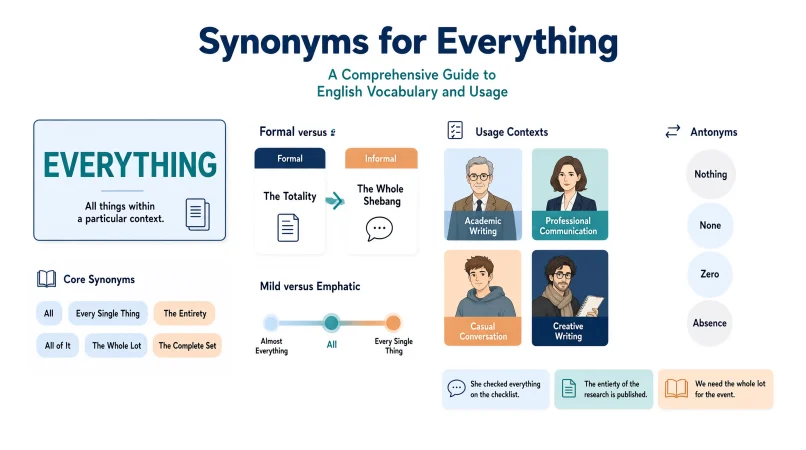
Everything means all things, objects, details, or matters within a particular situation or group. Common alternatives include all, the whole lot, every single thing, the entire range, and the totality, depending on context.
Do you find yourself using the word everything repeatedly in essays, emails, conversations, captions, or professional writing? It is a useful word, but relying on it too often can make your sentences sound broad or repetitive.
The challenge is that everything can refer to all things, every detail, an entire situation, or something that matters deeply to a person. Words such as all, every single thing, the whole lot, and the entire range can work as alternatives, but they do not always fit the same sentence.
This guide explores synonyms for everything by meaning, tone, and context. You will learn which alternatives sound natural in everyday conversation, which suit academic and professional writing, and how to choose a precise expression without changing your intended meaning.
Meaning, Tone and Context
Simple Definition
Everything refers to all things considered together, without leaving anything out within the intended context.
For example, if someone says, “I packed everything,” they mean they packed all the necessary or relevant items.
The exact meaning depends on what the speaker is discussing. It can refer to physical objects, information, responsibilities, experiences, or abstract matters.
Part of Speech
Everything is an indefinite pronoun. It refers to all things as a complete group.
Examples:
- Everything is ready for the meeting.
- She explained everything clearly.
- Everything changed after the announcement.
Tone and Formality
Everything is neutral and widely used in spoken and written English. It works in casual conversation, personal writing, emails, and many professional situations.
However, it can sound vague when a sentence needs specific details. In formal or academic writing, expressions such as all relevant information, the entire collection, or the totality of the evidence may communicate the intended meaning more clearly.
Common Use Cases
The word appears in many everyday situations:
- Daily conversation: Talking about all the things someone needs or does.
- Education: Referring to all information, topics, or course materials.
- Professional communication: Discussing tasks, responsibilities, or project details.
- Emotional writing: Expressing how important someone or something is.
- Creative writing: Describing a complete experience or situation.
- Social media: Making broad statements about life, relationships, or personal interests.
Important Word Forms and Related Expressions
| Word or Expression | Part of Speech | Meaning | Example |
| Everything | Indefinite pronoun | All things within a context | Everything is organized. |
| Every | Determiner | Each individual member of a group | Every student received a certificate. |
| Entire | Adjective | Complete or whole | She read the entire book. |
| Entirely | Adverb | Completely or fully | The plan was entirely different. |
| All | Determiner, pronoun, or adverb | The whole amount or number | All the documents are ready. |
| Wholeness | Noun | The state of being complete | The design emphasizes wholeness. |
Grammar tip: Everything normally takes a singular verb. Write “Everything is ready,” not “Everything are ready.”
When and How to Use “Everything”
Use everything when you want to refer to all relevant things as one complete group. It is especially useful when the details are already understood or do not need to be listed separately.
Here are examples from different situations.
1. Professional: Everything is ready for the client presentation.
2. Personal: Everything reminds me of our time together.
3. Academic: Everything discussed in the lecture will be covered in the review.
4. Emotional: You mean everything to me.
5. Creative: Everything around her seemed unfamiliar after the journey.
6. Social media: Sometimes, everything changes when you least expect it.
7. Email: Please review everything before submitting the final report.
Another Word for “Everything”
There is no single perfect replacement for everything in every situation. The best choice depends on whether you mean all objects, all information, a complete collection, or the full extent of something.
| Situation | Recommended Alternative | Why It Works |
| Professional writing | All relevant information | Makes a broad statement more specific. |
| Academic writing | The totality | Refers to a complete body of information or evidence. |
| Casual conversation | The whole lot | Sounds natural and informal. |
| Emotional writing | My whole world | Expresses deep personal importance, not literal equivalence. |
| Creative writing | The entire universe | Creates a broad or imaginative impression. |
| Resume or workplace use | All responsibilities | Identifies the complete range of duties. |
| Social media captions | All of it | Short and conversational. |
| Stronger meaning | Every single thing | Adds emphasis and completeness. |
| Softer meaning | Almost everything | Allows for a few exceptions. |
Best Choice by Writing Purpose
- For professional writing, use all relevant details, the complete set, or the entire range when those expressions are accurate.
- For academic writing, the totality or all available evidence may be more precise.
- For everyday conversation, all of it, the whole lot, and every single thing are natural alternatives.
- For emotional writing, expressions such as my whole world communicate importance rather than literal completeness.
When Not to Use “Everything”
Although everything is convenient, it can be too broad when readers need to know exactly what you mean.
Use a more specific expression when referring to particular objects, facts, tasks, or responsibilities.
| General Sentence | More Precise Sentence | Why It Is Better |
| I reviewed everything. | I reviewed all the project documents. | Identifies what was reviewed. |
| Everything is included. | All required items are included. | Clarifies the scope. |
| She knows everything. | She knows every detail of the case. | Makes the knowledge being described more specific. |
| We discussed everything. | We discussed all the main topics on the agenda. | Shows which subjects were covered. |
| He does everything at work. | He manages the team’s daily operations. | Gives a clearer description of his responsibilities. |
Avoid replacing everything with a more complicated word just to sound formal. The best alternative is the one that makes the sentence clearer.
Words Commonly Confused With “Everything”
These words are related to everything, but they have different grammatical roles or meanings.
| Word | Meaning | Difference From Everything |
| All | The complete amount or number of something | Often needs a noun or a clear context, as in “all the books.” |
| Anything | Any thing, without specifying which one | Often appears in questions and negative sentences. |
| Everything else | All remaining things apart from those already mentioned | Excludes something previously identified. |
| Everyone | Every person in a group | Refers to people, not objects or abstract matters. |
| Whole | Complete or entire | Usually describes a noun, as in “the whole story.” |
| Anything and everything | A wide range of possible things | Often emphasizes variety rather than a defined complete group. |
Example: “Everyone attended the meeting” refers to all people invited. “Everything was discussed” refers to all relevant subjects.
Best Synonym by Context for Everything
The best alternative depends on the kind of things you are describing and how formal your sentence needs to sound.
| Context | Best Synonym | Why It Works | Example |
| Formal writing | The entirety | Refers to something as a complete whole | The report examines the entirety of the available evidence. |
| Academic writing | The totality | Suitable for discussing a complete body of information | The study considers the totality of the findings. |
| Professional or business use | All relevant details | Makes the scope clear | Please include all relevant details in your report. |
| Resume | All responsibilities | Describes the complete range of duties | Managed all responsibilities associated with daily operations. |
| Casual conversation | The whole lot | Natural and informal | I bought the whole lot at the store. |
| Creative writing | The entire world | Creates a broad, imaginative impression | It felt as though the entire world had changed. |
| Emotional tone | My whole world | Expresses deep personal importance | You have become my whole world. |
| Strong emphasis | Every single thing | Stresses that nothing is excluded | I checked every single thing before leaving. |
| Soft or qualified meaning | Almost everything | Allows for a few exceptions | Almost everything is ready for the event. |
| Social media captions | All of it | Short and conversational | I would do all of it again. |
| Instructions | All items | Clearly identifies a complete set of objects | Place all items on the table. |
| Reports and research | All available information | Defines the information being considered | The review considered all available information. |
| US and UK usage | Everything | Standard and natural in both varieties | Everything is going according to plan. |
Which Synonym Should You Choose?
Before replacing everything, consider these five points.
1. Identify what you mean. Are you talking about objects, information, people, tasks, experiences, or an entire situation? Choose a phrase that identifies the correct category.
2. Consider formality. Use the entirety or the totality in suitable formal contexts. Use all of it or the whole lot in casual conversation.
3. Check the level of emphasis. Every single thing adds emphasis. Almost everything makes the statement less absolute.
4. Think about professional value. In workplace communication, phrases such as all assigned tasks, all relevant information, and the complete set are often more useful than a vague reference to everything.
5. Read the full sentence. A replacement should preserve the original meaning and fit the grammar. For example, “Everything is ready” cannot always be changed to “All is ready” without affecting the tone.
Simple rule: Use everything for a broad reference, all for a complete amount or group, and a specific noun phrase when the details matter.
Real Life Examples of Everything in Sentences
These examples show how different expressions can replace everything naturally.
| Situation | Example Sentence |
| School | The teacher explained all the topics that would appear on the exam. |
| Workplace | Please make sure all assigned tasks are completed before Friday. |
| Writing | The article covers the entire subject in a clear and organized way. |
| Conversation | I packed the whole lot before checking out. |
| Social media | All of it happened for a reason. |
| Resume | Coordinated all aspects of the customer service process. |
| I have attached all the relevant information for your review. | |
| Storytelling | For one brief moment, the entire world seemed silent. |
These alternatives make the sentence more informative because they tell readers what everything includes.
25 Synonyms for “Everything”
The word everything refers to all things, items, details, or aspects within a particular situation or subject. Depending on the context, synonyms for everything can express completeness, an entire collection, a full range of options, or the total extent of something.
Below are 25 alternatives to “everything,” with simple meanings, suitable contexts, and example sentences to help you choose the right expression.
Common Synonyms for Everything
These expressions work well in everyday conversations, general writing, and situations where you want to refer to all relevant things without unnecessary complexity.
| Synonym | Simple Meaning | Best Used For | Example Sentence |
|---|---|---|---|
| 1. All | The complete amount or number | Everyday and formal writing | All the documents are ready. |
| 2. All things | Every relevant thing in a group | General explanations | All things considered, the decision was reasonable. |
| 3. Every single thing | Each thing without exception | Strong emphasis | She checked every single thing before leaving. |
| 4. All of it | The complete amount or subject already mentioned | Informal speech and writing | I enjoyed all of it. |
| 5. The whole thing | A complete object, event, or situation | Everyday conversation | The whole thing happened unexpectedly. |
Formal and Academic Synonyms for Everything
These alternatives are useful in essays, research papers, reports, and professional communication when you want to emphasize completeness or the total amount of something.
| Synonym | Simple Meaning | Best Used For | Example Sentence |
|---|---|---|---|
| 6. The entirety | The complete extent of something | Formal writing | The entirety of the document was reviewed. |
| 7. Totality | The complete amount or whole | Academic and analytical writing | The researchers examined the totality of the evidence. |
| 8. The sum total | The complete amount when everything is combined | Financial and analytical contexts | The sum total of the expenses exceeded our estimate. |
| 9. The full extent | The complete scale or degree of something | Formal and analytical writing | Nobody understood the full extent of the problem. |
| 10. All that exists | Everything in existence | Philosophical or abstract writing | The question concerns all that exists. |
Synonyms for Everything Meaning a Complete Collection
Use these expressions when referring to every item in a group, a collection of products, or all the components of a particular set.
| Synonym | Simple Meaning | Best Used For | Example Sentence |
|---|---|---|---|
| 11. The whole lot | The complete group or collection | Casual conversation | He sold the whole lot in one afternoon. |
| 12. The complete set | Every member of a particular collection | Shopping and organization | The complete set arrived this morning. |
| 13. The entire collection | Every item in a collection | Books, products, and archives | The museum displayed the entire collection. |
| 14. The lot | The complete group of items | Informal conversation, especially British English | She decided to keep the lot. |
| 15. The works | Everything available or included | Informal conversation | The package includes the works. |
Informal and Conversational Alternatives to Everything
These expressions add a relaxed or expressive tone to everyday speech. Some are idiomatic and should generally be avoided in formal academic writing.
| Synonym | Simple Meaning | Best Used For | Example Sentence |
|---|---|---|---|
| 16. The whole shebang | The entire thing or complete arrangement | Very informal speech | They organized the whole shebang for Saturday. |
| 17. The full monty | The complete version or full amount | Informal British English, sometimes understood in the US | The upgraded package offers the full monty. |
Synonyms for Everything Meaning All Details or Aspects
These expressions are especially useful in professional writing, instructions, planning, and detailed explanations.
| Synonym | Simple Meaning | Best Used For | Example Sentence |
|---|---|---|---|
| 18. All the details | Every relevant piece of information | Reports and instructions | Please send me all the details. |
| 19. All the information | The complete amount of available information | Academic and professional writing | The presentation contains all the information we need. |
| 20. Every aspect | Each part or feature of something | Analysis and planning | We considered every aspect of the proposal. |
| 21. The full range | All types or varieties within a category | Business and academic writing | The course covers the full range of topics. |
| 22. The complete range | Every option or type within a category | Product and service descriptions | The store offers the complete range of sizes. |
Broad and Figurative Expressions for Everything
These expressions can refer to a very broad scope, the universe, or an entire world of possibilities. They are often used in creative, emotional, or philosophical writing.
| Synonym | Simple Meaning | Best Used For | Example Sentence |
|---|---|---|---|
| 23. All possible things | Every possible item or option | Explanatory writing | The team considered all possible things before deciding. |
| 24. The entire universe | Everything in the universe, or a figurative whole | Scientific or creative writing | She felt connected to the entire universe. |
| 25. The whole world | Everything or everyone within a broad figurative context | Emotional and creative writing | He seemed to have the whole world ahead of him. |
How to Choose the Right Synonym for “Everything”
The best alternative depends on what you are describing. Use all for a simple and natural replacement, the entirety for formal writing, and every aspect when discussing different parts of a subject. Choose the complete set for collections, the full range for available options, and the full extent when referring to the scale or degree of something.
Important usage note: These expressions are not interchangeable in every sentence. For example, the full extent describes the degree or scale of something, while the complete set refers to a collection. Similarly, the entire universe is generally literal or figurative rather than a direct replacement in everyday sentences.
Synonym Groups and Usage Differences
Professional vs. Personal Synonyms
Professional writing usually benefits from clear, specific expressions. Instead of saying “I handled everything,” explain the actual responsibilities, such as “I managed all customer inquiries and daily operations.”
Personal writing can be more expressive. Phrases such as my whole world, all of it, and every single thing can communicate affection, excitement, or strong feelings.
Formal vs. Conversational Synonyms
Formal expressions are useful in reports, essays, business documents, and presentations. Conversational alternatives work better in everyday speech, messages, and informal posts.
| Formal Expression | Conversational Alternative |
| The entirety | The whole thing |
| The totality | All of it |
| The complete set | The whole lot |
| The full range | Everything available |
| All relevant information | All the details |
| The sum total | The whole amount |
Use the formal version when precision matters. Choose the conversational version when a relaxed tone sounds more natural.
Academic Synonyms
Academic writing often requires a clear description of the complete evidence, subject, or set of findings.
Useful expressions include:
- The totality: The complete body or extent of something.
- The entirety: The whole of a particular subject or collection.
- All available evidence: Every piece of evidence accessible to the researcher.
- Every aspect: Each individual part of a topic.
- The full range: All varieties or categories within a subject.
- The sum total: The complete amount resulting from combining parts.
For example, instead of writing “Everything supports the argument,” write “All available evidence supports the argument.” The revised sentence is more specific and academically useful.
Professional and Business Synonyms
In business communication, everything can leave readers wondering which tasks, files, or responsibilities are included.
Use expressions that define the scope:
| Situation | Recommended Expression |
| Project updates | All project requirements |
| Email instructions | All relevant details |
| Financial reports | The total amount |
| Product descriptions | The complete range |
| Team responsibilities | All assigned duties |
| Document reviews | The entire document |
| Meeting preparation | All necessary materials |
For resumes, avoid vague statements such as “Responsible for everything in the office.” Describe the work you actually performed, such as “Managed scheduling, customer communication, and office records.”
Creative or Literary Synonyms
Creative writing can use broader and more expressive alternatives to create mood or emphasize importance.
- The whole world: Suggests a complete personal or emotional experience.
- The entire universe: Creates a grand or imaginative impression.
- Every single thing: Adds emphasis and emotional intensity.
- The whole shebang: Gives dialogue a playful, informal tone.
- All that exists: Suits philosophical or reflective writing.
For example, “You are everything to me” can become “You are my whole world.” The second version is more personal and emotional, rather than a literal statement about all things.
Slang or Modern Synonyms
Some expressions are informal rather than true slang. They can make conversations and dialogue sound relaxed, but they may not suit formal writing.
| Expression | Meaning | Best Context |
| The whole lot | The complete group | Casual conversation |
| The works | Everything included | Informal speech |
| The whole shebang | The entire event or arrangement | Humor and casual dialogue |
| The full monty | The complete version | Informal British English |
In the United States, the whole lot and the whole shebang are understood, but the whole thing and all of it are often more natural everyday choices.
Strongest vs. Weaker Synonyms
The expressions below differ in emphasis. This is a practical scale of completeness and emphasis, not a ranking of dictionary meaning.
| Level | Expression | Effect |
| Qualified | Almost everything | Allows some exceptions. |
| General | All | Refers to a complete amount or group. |
| Complete | The entirety | Emphasizes the whole of something. |
| Emphatic | Every single thing | Stresses that nothing is excluded. |
| Broad or grand | All that exists | Refers to everything within a very wide scope. |
Use almost everything when exceptions exist. Use every single thing when you want to emphasize that nothing was left out.
Emotional vs. Neutral Synonyms
Some alternatives simply describe a complete group. Others communicate personal importance or emotional intensity.
| Neutral Expression | Emotional Expression | Difference |
| All of it | My whole world | The second expresses personal importance. |
| The entire situation | Everything to me | The second communicates deep attachment. |
| Every detail | Every little thing | The second can sound more affectionate or expressive. |
| The whole experience | My everything | The second emphasizes emotional significance. |
| The complete collection | The whole world | The second is figurative and much broader. |
Do not use emotional expressions in factual reports unless they accurately reflect the intended tone.
Antonyms of “Everything”
The most direct opposite of everything is nothing, meaning not anything or no thing at all. However, other words and expressions can describe emptiness, absence, or a very small amount, depending on the context.
The following list includes 15 useful opposites and contextual contrasts. Not all of them are exact dictionary antonyms, so choose the expression that best matches your intended meaning.
Direct Antonyms of Everything
These expressions communicate that no items, people, or things are present or included.
| Antonym | Meaning | Example Sentence |
|---|---|---|
| 1. Nothing | Not anything at all | Nothing was left on the table. |
| 2. Not anything | No thing of any kind | She did not find anything useful. |
| 3. No thing | Not a single thing | There was no thing in the box. |
| 4. None | Not one or not any of something | None of the files were missing. |
| 5. Not a thing | Nothing at all, in informal language | I could find not a thing in the drawer. |
Antonyms of Everything Related to Absence or Emptiness
These words describe a condition in which something is missing, empty, or completely absent.
| Antonym | Meaning | Example Sentence |
|---|---|---|
| 6. Nothingness | A state of having or containing nothing | The story explores the idea of nothingness. |
| 7. Absence | The state of something not being present | The absence of evidence made the conclusion uncertain. |
| 8. Emptiness | The condition of containing nothing | The room’s emptiness made it feel unusually large. |
| 9. Void | An empty space or complete absence | The sudden departure left a void in her life. |
| 10. Nonexistence | The state of not existing | The theory assumes the nonexistence of such a system. |
Antonyms of Everything Related to Zero or Lack
These terms are useful when discussing quantities, resources, information, or situations where something is unavailable or insufficient.
| Antonym | Meaning | Example Sentence |
|---|---|---|
| 11. Zero | No amount or quantity | The account showed zero available funds. |
| 12. Lack | A shortage or absence of something | There was a lack of information. |
Expressions Meaning Almost Nothing
These expressions do not mean a complete absence. Instead, they describe a very small amount or something close to nothing.
| Antonym or Contrasting Expression | Meaning | Example Sentence |
|---|---|---|
| 13. Hardly anything | Almost nothing | There was hardly anything left to eat. |
| 14. Little or nothing | A very small amount or no amount | The change made little or no difference to the result. |
A Contextual Contrast to Everything
This word can contrast with nothing in certain sentences, although it is not a direct antonym of everything.
| Antonym or Contrasting Term | Meaning | Example Sentence |
|---|---|---|
| 15. Something | A thing or an unspecified amount, in contrast with nothing | I expected something, but received nothing. |
How to Choose the Right Opposite of “Everything”
The best opposite depends on the meaning of your sentence. Use nothing when you mean not anything at all, none when referring to zero members of a particular group, and zero when describing a quantity. Choose absence, emptiness, or void when discussing something missing or an empty condition.
If you mean that only a small amount remains, use hardly anything or little or nothing instead of nothing.
Important distinction: Nothing is the clearest opposite of everything. Expressions such as hardly anything and little or nothing suggest a small amount rather than an absolute absence. Also, something is a contextual contrast, not a true antonym.
Comparison: Everything vs. Similar Words
Everything vs. All
Main difference: Everything is an indefinite pronoun referring to all things. All can function as a determiner or pronoun and often appears with a noun or a clear reference.
Which is stronger: Neither is automatically stronger. Everything can sound more complete in a standalone statement.
Which is more formal: Both are neutral and suitable for formal and casual writing.
Examples:
- Everything is ready.
- All the equipment is ready.
Everything vs. Anything
Main difference: Everything refers to all things in a relevant group. Anything refers to any thing, without identifying a particular one.
Which is stronger: Everything is more comprehensive. Anything leaves the choice open.
Which is more formal: Both are standard in formal English.
Examples:
- Everything is available.
- You can choose anything from the list.
Everything vs. Everyone
Main difference: Everything refers to things, details, or matters. Everyone refers to all people in a group.
Which is stronger: Neither is stronger. They refer to different categories.
Which is more formal: Both are neutral and widely accepted.
Examples:
- Everything is in place.
- Everyone is in place.
Everything vs. Whole
Main difference: Everything is a pronoun. Whole is usually an adjective or noun describing something complete.
Which is stronger: Neither is stronger. Their grammatical functions differ.
Which is more formal: Both are suitable for formal and casual writing.
Examples:
- Everything was damaged in the storm.
- The whole building was damaged in the storm.
Everything vs. Entirety
Main difference: Everything is a general word for all things. Entirety is a noun referring to the complete extent of a particular thing.
Which is stronger: Entirety can sound more precise and formal.
Which is more formal: Entirety is more formal.
Examples:
- Everything was included in the package.
- The entirety of the collection was included in the package.
Everything vs. Anything and Everything
Main difference: Everything refers to all relevant things. Anything and everything is an emphatic expression suggesting a very wide range of possibilities or choices.
Which is stronger: Anything and everything often sounds more emphatic.
Which is more formal: Everything is generally more suitable for formal writing.
Examples:
- She knows everything about the subject.
- She is willing to discuss anything and everything about the subject.
Common Phrases and Expressions with “Everything”
These phrases are useful in everyday conversation, professional communication, and creative writing.
1. Everything Is in Place
Meaning: All necessary things are ready or properly arranged.
Example sentence: Everything is in place for tomorrow’s presentation.
2. Everything Happens for a Reason
Meaning: An expression suggesting that events may have a purpose or lead to an outcome.
Example sentence: She believes everything happens for a reason.
3. Everything Under Control
Meaning: A situation is being managed successfully.
Example sentence: The project manager assured the team that everything was under control.
4. Everything and More
Meaning: All expected things, along with additional benefits or qualities.
Example sentence: The new apartment offered everything and more.
5. Everything but the Kitchen Sink
Meaning: Almost every possible item or thing, often more than necessary.
Example sentence: He packed everything but the kitchen sink for the weekend trip.
6. Everything Comes to an End
Meaning: Every situation, experience, or period eventually finishes.
Example sentence: Even difficult times eventually come to an end.
7. Give It Your Everything
Meaning: Put all your effort, energy, or commitment into something.
Example sentence: She gave it her everything during the final competition.
8. You Mean Everything to Me
Meaning: A way of expressing that someone is extremely important in your life.
Example sentence: You mean everything to me, and I appreciate your support.
Common Mistakes to Avoid
Choosing the wrong alternative can make a sentence unclear or grammatically incorrect. Watch out for these common mistakes.
1. Using Everything When a More Precise Phrase Is Better
Everything may hide important details.
Instead of: I completed everything at work.
Better: I completed all assigned tasks and submitted the weekly report.
2. Confusing Everything With Everyone
Everything refers to things, while everyone refers to people.
Incorrect: Everything attended the meeting.
Correct: Everyone attended the meeting.
3. Using a Casual Expression in Formal Writing
Expressions such as the whole shebang and the works are informal.
Instead of: The report covers the whole shebang.
Better: The report covers the entire process.
4. Using an Overly Formal Synonym in Everyday Conversation
The totality and the entirety can sound unnecessarily formal in casual speech.
Instead of: I enjoyed the entirety of the movie.
More natural: I enjoyed the whole movie.
5. Repeating Everything Too Often
Using the same word in every sentence can make writing sound repetitive.
Instead of: Everything was ready. Everything was clean. Everything looked perfect.
Better: Everything was ready, the room was clean, and the decorations looked perfect.
6. Choosing a Phrase With the Wrong Meaning
Every single thing emphasizes completeness, while almost everything allows exceptions.
Do not use almost everything if you mean that absolutely nothing was excluded.
7. Ignoring Grammar and Subject Agreement
Everything takes a singular verb.
Incorrect: Everything are ready.
Correct: Everything is ready.
Also remember that all can take a singular or plural verb depending on the noun or meaning: “All the information is correct” and “All the files are ready.”
FAQs
1. What Is the Best Synonym for Everything?
All is the simplest alternative in many sentences. Every single thing, the entirety, and the whole lot are useful when the context requires emphasis or a different tone.
2. What Is a Formal Synonym for Everything?
The entirety and totality are formal alternatives. All relevant information and the complete set are often clearer when describing specific details or collections.
3. What Is an Informal Synonym for Everything?
The whole lot, all of it, and the whole thing are common informal alternatives. The whole shebang is more playful and conversational.
4. What Is Another Word for Everything in Professional Writing?
Use all relevant information, all assigned tasks, the complete set, or the full range. These expressions make workplace communication more specific.
5. What Is the Difference Between Everything and Anything?
Everything refers to all things within a relevant group. Anything refers to any thing, without specifying which one or suggesting that all are included.
6. What Is the Opposite of Everything?
Nothing is the clearest opposite of everything. Other contrasting expressions include none, zero, emptiness, absence, and hardly anything, depending on context.
Conclusion
Everything means all things within a particular situation or group. Useful alternatives include all, every single thing, all of it, the entirety, and the whole lot.
For academic and professional writing, choose precise expressions such as all available information, the totality, or the complete set. In everyday conversation, the whole thing and all of it sound more natural. For emotional or creative writing, my whole world and the entire universe can add expressive meaning.
Remember that not every synonym fits every sentence. Identify what you are describing, consider your audience, and choose an expression that preserves the original meaning.
A simple vocabulary tip: When you write everything, ask yourself whether you can name exactly what it includes. A more specific phrase often makes your writing clearer, stronger, and easier to understand.