
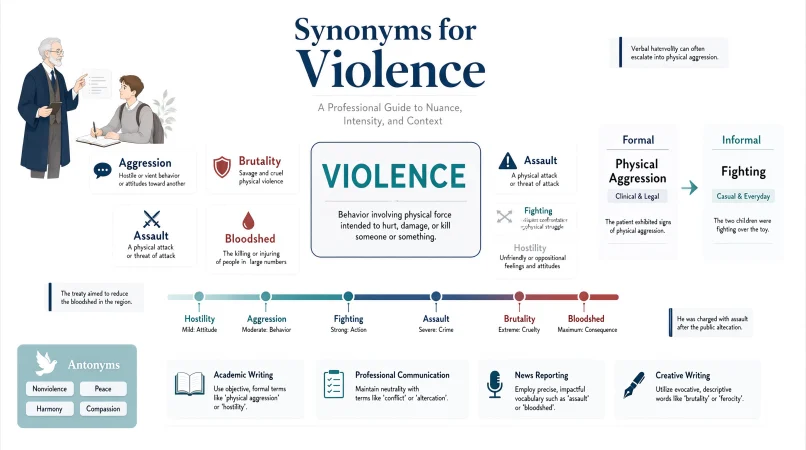
Violence means using physical force, threats, or aggressive actions to hurt people, damage property, or intimidate others. Common alternatives include aggression, brutality, assault, bloodshed, and force, depending on the situation and level of harm.
Using the word violence repeatedly can make an essay, report, news article, or professional discussion sound repetitive. However, replacing it with just any similar word can change the meaning or make a sentence sound more emotional than intended.
The best alternative depends on what you are describing. Physical attacks, aggressive behavior, threats, cruelty, armed conflict, and social unrest each have different vocabulary. Understanding these differences helps you communicate clearly and choose words that fit your audience.
This guide explains synonyms for violence with practical meanings, natural examples, formal alternatives, and context based recommendations. It also explores words that describe the absence of violence, so you can express both sides of an issue accurately.
Meaning, Tone and Context
Simple Definition
Violence is behavior involving physical force, threats, or harmful actions intended to injure, intimidate, control, or damage. It can happen between individuals, groups, or nations.
Violence is not limited to physical attacks. In some contexts, threats and coercive behavior are also described as forms of violence.
Part of Speech
Violence is a noun. It names an action, behavior, or condition involving harmful force or aggression.
Examples:
- The community organized a campaign against violence.
- The report examined the causes of domestic violence.
- The authorities worked to prevent further violence.
Tone and Formality
Violence generally has a negative and serious tone. It is suitable for academic writing, journalism, legal discussions, public policy, and everyday conversation.
Some related words are stronger or more emotional. For example, brutality suggests extreme cruelty, while aggression can describe hostile behavior without necessarily involving physical injury.
Common Use Cases
The word appears in several contexts:
- Social issues: Domestic violence, school violence, and community violence.
- Law and public safety: Violent crime, assault, and threats.
- Politics: Political violence, state violence, and civil unrest.
- War and international affairs: Armed violence and military conflict.
- Media and entertainment: Violence in films, games, and books.
- Education: Bullying, school safety, and prevention programs.
Important Word Forms
| Word Form | Part of Speech | Meaning | Example |
| Violence | Noun | Harmful force or aggressive behavior | Violence affects entire communities. |
| Violent | Adjective | Involving or likely to involve violence | The protest became violent. |
| Violently | Adverb | In a forceful or aggressive manner | The argument ended violently. |
| Nonviolence | Noun | The practice of avoiding violence | The movement promoted nonviolence. |
| Nonviolent | Adjective | Not involving violence | They organized a nonviolent protest. |
When and How to Use “Violence”
Use violence when discussing harmful force, physical attacks, threats, or aggressive actions. It is especially useful when the exact type of harm is not yet known or when discussing the issue broadly.
Here are realistic examples across different contexts.
1. Academic: The study explores the relationship between poverty and community violence.
2. Professional: The organization introduced new policies to prevent workplace violence.
3. Personal: She decided to leave the relationship because of repeated violence.
4. Social issue: Community leaders called for stronger measures to reduce youth violence.
5. News reporting: Authorities are investigating the violence that occurred after the match.
6. Creative writing: The story reveals how years of violence changed the village.
7. Social media: Everyone deserves to live in a world free from violence.
Another Word for “Violence”
There is no single replacement that works in every sentence. The most accurate choice depends on the kind of harmful behavior being described.
Here are useful recommendations by writing situation.
| Situation | Recommended Alternative | Why It Works |
| Professional writing | Aggression | Describes hostile or forceful behavior clearly. |
| Academic writing | Violent behavior | Provides a precise, research friendly description. |
| Casual conversation | Fighting | Sounds natural when discussing physical confrontations. |
| Emotional writing | Brutality | Communicates extreme cruelty and suffering. |
| Creative writing | Bloodshed | Creates a vivid image of deadly violence. |
| Resume or workplace use | Conflict | May describe workplace disputes without implying physical harm. |
| Social media captions | Aggression | Communicates hostility in a concise way. |
| Stronger meaning | Savagery | Suggests extreme and uncontrolled brutality. |
| Softer meaning | Aggressive behavior | Describes hostility without automatically implying physical injury. |
Important: Words such as conflict and aggression are related to violence, but they are not always direct synonyms. A disagreement, for example, is not necessarily violent.
When Not to Use “Violence”
Although violence is a useful general term, it can be too broad when a sentence requires a specific description.
For example, saying that a person experienced violence does not explain whether they faced threats, physical assault, emotional abuse, or another form of harm.
Consider these improvements:
| General Sentence | More Precise Sentence | Why It Is Better |
| The violence continued for hours. | The fighting continued for hours. | Identifies an ongoing physical confrontation. |
| The report discussed violence at home. | The report discussed domestic abuse. | Specifies harmful behavior within a domestic setting. |
| The violence caused injuries. | The assault caused several injuries. | Identifies a specific attack. |
| The group used violence to control people. | The group used intimidation and physical force to control people. | Explains the methods of control. |
| The violence spread across the city. | The riots spread across the city. | Identifies public disorder and unrest. |
Use the broader word when the details are unknown or when discussing the issue generally. Choose a narrower term when the type of behavior matters.
Words Commonly Confused With “Violence”
Several words are connected to violence but have different meanings.
| Word | Meaning | Difference From Violence |
| Aggression | Hostile, threatening, or forceful behavior | Aggression may occur without physical harm. |
| Conflict | A disagreement or struggle between people or groups | Conflict can remain peaceful. |
| Abuse | Harmful treatment of another person | Abuse can be physical, emotional, verbal, or financial. |
| Assault | An attack or an act that causes someone to fear immediate harm, depending on legal context | Assault is more specific and may have a particular legal definition. |
| Hostility | An unfriendly, antagonistic, or threatening attitude | Hostility does not always involve physical force. |
| Brutality | Extreme cruelty or violent treatment | Brutality emphasizes the severity and cruelty of the behavior. |
These distinctions matter in academic, legal, and professional writing. A precise word helps readers understand what happened without exaggerating or minimizing the situation.
Best Synonym by Context for Violence
The best synonym depends on the situation, the type of harm, and the level of intensity you want to communicate.
| Context | Best Synonym | Why It Works | Example |
| Formal writing | Aggression | Describes hostile or forceful conduct | The report examines rising aggression among rival groups. |
| Academic writing | Violent behavior | Clearly identifies actions involving violence | Researchers studied the causes of violent behavior. |
| Professional or business use | Aggression | Works in discussions about threatening conduct | The company has a strict policy against workplace aggression. |
| Resume or workplace discussion | Conflict | Describes disputes without automatically suggesting physical harm | I helped resolve conflicts between team members. |
| Casual conversation | Fighting | Common and easy to understand | The neighbors heard fighting outside. |
| Creative writing | Bloodshed | Adds dramatic detail when deaths or serious injuries occur | The battle left a trail of bloodshed. |
| Emotional writing | Brutality | Highlights cruelty and severe treatment | The novel portrays the brutality of war. |
| Strong intensity | Savagery | Suggests extreme and uncontrolled cruelty | The account describes the savagery of the attack. |
| Soft or moderate tone | Aggressive behavior | Describes hostile conduct without assuming physical injury | The school introduced rules to address aggressive behavior. |
| Social media captions | Aggression | Concise and widely understood | Choose kindness over aggression. |
| News reporting | Clashes | Describes confrontations between opposing groups | Clashes broke out after the announcement. |
| Legal discussion | Assault | Identifies a specific type of alleged attack | Police investigated the reported assault. |
There is no universal formal or informal replacement. For example, assault is more specific than violence, while fighting is more conversational.
Which Synonym Should You Choose?
Use these practical questions before replacing violence.
1. What exactly happened? Use assault for a specific attack, fighting for a physical confrontation, and intimidation for threats or pressure.
2. How serious was the behavior? Choose aggression for hostile conduct, brutality for extreme cruelty, and bloodshed when serious injury or death is involved.
3. Who will read your writing? Academic and professional readers usually benefit from precise terms such as violent behavior, physical aggression, or assault.
4. What emotional tone do you want? Use brutality or savagery for stronger emotional impact. Use aggressive behavior for a more measured description.
5. Could the replacement change the facts? Do not call every disagreement violence. A conflict can be peaceful, and aggression does not always result in physical harm.
A useful rule is to choose the most specific accurate word, rather than the most dramatic one.
Real Life Examples of Violence in Sentences
The following examples show how related words can improve clarity in everyday and professional communication.
| Situation | Example Sentence |
| School | The school introduced a program to prevent bullying and aggressive behavior. |
| Workplace | Management responded quickly to reports of workplace intimidation. |
| Academic writing | The research examines the causes of interpersonal violence. |
| Conversation | The argument turned into a physical fight. |
| Social media | Communities deserve safety, respect, and freedom from violence. |
| Resume | Helped resolve team conflicts through clear communication and cooperation. |
| Please report any threats or aggressive conduct to the appropriate department. | |
| Storytelling | The village struggled to recover after years of brutality. |
Notice that conflict is appropriate for a resume because it can describe ordinary workplace disagreements. Using violence in that sentence would suggest a much more serious situation.
25 Synonyms for “Violence”
The word violence refers to the use of physical force, aggression, or harmful actions against people, animals, or property. Depending on the context, synonyms for violence can describe physical attacks, cruelty, hostility, armed conflict, or severe public disorder.
The following 25 alternatives include their meanings, best uses, and example sentences. Some describe specific forms of violence rather than exact replacements, so context matters when choosing the right word.
Common Synonyms for Violence and Aggressive Behavior
These words are useful when discussing hostile actions, physical force, or harmful behavior in everyday, academic, and professional writing.
| Synonym | Simple Meaning | Best Used For | Example Sentence |
|---|---|---|---|
| 1. Aggression | Hostile or forceful behavior | General discussions and professional writing | The school is working to reduce aggression among students. |
| 2. Fighting | Physical confrontation between people or groups | Casual writing and everyday conversation | Fighting broke out near the stadium. |
| 3. Force | Physical power used to make something happen | Law, security, and physical power | The attacker used force to break the door. |
| 4. Physical aggression | Forceful behavior directed toward another person | Psychology, education, and workplace reports | The counselor discussed ways to manage physical aggression. |
| 5. Violent conduct | Actions involving harmful or threatening force | Formal reports and policies | The policy prohibits violent conduct on school property. |
| 6. Assault | A physical attack or legally defined threatening act | Legal and public safety contexts | The suspect was questioned about the assault. |
Synonyms for Violence Meaning Cruelty or Severe Harm
These alternatives emphasize extreme cruelty, suffering, or harmful treatment. They are particularly useful in discussions about crimes, human rights, and social issues.
| Synonym | Simple Meaning | Best Used For | Example Sentence |
|---|---|---|---|
| 7. Brutality | Extreme cruelty or violent treatment | Serious crimes, war, and human rights discussions | The documentary exposed the brutality of the conflict. |
| 8. Cruelty | Behavior that causes suffering without compassion | Emotional and moral discussions | The story highlights the cruelty of the captors. |
| 9. Savagery | Extreme cruelty or uncontrolled violence | Literary and strongly emotional writing | The account describes the savagery of the attack. |
| 10. Atrocity | An extremely cruel or shocking act | War crimes and human rights discussions | The investigation documented an atrocity against civilians. |
| 11. Barbarity | Extremely cruel or brutal behavior | Historical and literary writing | The novel describes the barbarity of the invasion. |
| 12. Physical abuse | Harmful physical treatment of another person | Domestic safety and social services | The organization provides support for victims of physical abuse. |
Synonyms for Violence Meaning Threats, Fear, or Hostility
These words describe behavior that creates fear, pressure, or an atmosphere of conflict. Some may involve threats without physical contact.
| Synonym | Simple Meaning | Best Used For | Example Sentence |
|---|---|---|---|
| 13. Hostility | An unfriendly or threatening attitude | Social and workplace behavior | Hostility between the groups increased. |
| 14. Coercion | Using threats or pressure to control someone | Legal, social, and political writing | The investigation examined allegations of coercion. |
| 15. Intimidation | Making someone afraid through threats or pressure | Bullying, harassment, and public safety | The witness reported repeated intimidation. |
| 16. Oppression | Unfair and harsh control over people | Politics and human rights | The movement challenged years of oppression. |
| 17. Persecution | Repeated cruel treatment of a person or group | Human rights and historical writing | The community faced persecution because of its beliefs. |
| 18. Terror | Extreme fear caused by threats or violent actions | War, terrorism, and dramatic writing | The attack spread terror throughout the region. |
Synonyms for Violence in War and Armed Conflict
These terms are commonly used when describing battles, military operations, attacks, and violent confrontations between opposing groups.
| Synonym | Simple Meaning | Best Used For | Example Sentence |
|---|---|---|---|
| 19. Warfare | Armed conflict between countries or groups | Military and historical discussions | Modern warfare has changed the nature of conflict. |
| 20. Combat | Fighting between opposing forces | Military and action writing | The soldiers returned from combat. |
| 21. Bloodshed | Killing or serious injury involving violence | War, riots, and historical accounts | Leaders called for an end to the bloodshed. |
| 22. Clashes | Physical confrontations between opposing groups | News reports and public demonstrations | Clashes occurred after the protest. |
| 23. Ferocity | Intense aggression or fierceness | Descriptions of attacks and battles | The animal defended itself with unexpected ferocity. |
Synonyms for Violence Meaning Disorder and Destruction
These expressions are useful when describing violent public disturbances, widespread damage, or situations involving severe disorder.
| Synonym | Simple Meaning | Best Used For | Example Sentence |
|---|---|---|---|
| 24. Rioting | Violent public disorder involving a group | News and public safety | Rioting damaged several buildings downtown. |
| 25. Mayhem | Severe disorder, destruction, or injury | Informal and dramatic descriptions | The sudden panic created mayhem in the street. |
How to Choose the Right Synonym for “Violence”
The best alternative depends on the type of harm or conflict you want to describe. Use aggression for hostile behavior, brutality for extreme cruelty, and assault for a specific type of attack. Choose intimidation when threats create fear, warfare for armed conflict, and rioting for violent public disorder.
Important usage note: These terms are not interchangeable in every sentence. For example, warfare refers to armed conflict, assault describes a particular type of attack, and intimidation can involve threats without physical contact. Select a word that accurately describes the situation.
Synonym Groups and Usage Differences
Professional vs. Personal Synonyms
Professional writing benefits from neutral and specific language. Words such as aggression, assault, intimidation, and violent conduct are useful in workplace policies, incident reports, and formal communication.
Personal writing may use more direct or emotional expressions. Fighting, cruelty, and brutality can communicate an experience in a more natural or expressive way.
Formal vs. Conversational Synonyms
Formal terms are suitable for research, reports, public statements, and official documents. Conversational terms work better in everyday speech and informal writing.
| Formal Expression | Conversational Alternative |
| Physical aggression | Fighting |
| Violent conduct | Aggressive behavior |
| Armed conflict | Fighting between armed groups |
| Physical assault | Physical attack |
| Public disorder | Rioting |
The conversational version may be easier to understand, but the formal version can be more accurate in official contexts.
Academic Synonyms
Academic writing should prioritize accuracy over variety. Replacing violence with a more specific term can make an argument easier to evaluate.
Useful academic expressions include:
- Interpersonal violence: Harmful behavior between individuals.
- Physical aggression: Forceful behavior directed toward another person.
- Structural violence: Social or institutional conditions that systematically harm people.
- Political violence: Violence connected to political goals, power, or disputes.
- Domestic violence: Abuse or violence within a domestic or intimate relationship.
- Collective violence: Violence involving groups of people.
These expressions have distinct meanings. Define specialized terms when introducing them in research or academic writing.
Professional and Business Synonyms
Workplace communication should be clear, factual, and proportionate to the situation.
Consider these choices:
| Situation | Recommended Term |
| Threatening a coworker | Intimidation |
| Physical attack at work | Assault |
| Hostile workplace conduct | Aggression |
| Repeated harmful treatment | Abuse |
| Ordinary disagreement | Conflict |
| A formal policy violation | Violent conduct |
Do not describe a routine disagreement as violence unless the behavior genuinely involves threats or harmful force.
Creative or Literary Synonyms
Creative writing often benefits from words that communicate intensity and atmosphere.
Bloodshed suggests death or serious injury. Brutality emphasizes cruelty. Savagery creates a strong impression of uncontrolled violence, while mayhem suggests chaos and destruction.
For example:
- Neutral: The battle involved violence.
- More vivid: The battle left widespread bloodshed.
- More emotional: The story exposed the brutality of the invasion.
Use emotionally powerful words carefully. Their intensity should match the scene.
Slang or Modern Synonyms
There is no single modern slang word that accurately replaces violence in every situation. Informal expressions such as a fight, a brawl, or a beatdown describe particular kinds of physical confrontation.
A brawl usually means a noisy physical fight involving several people. A beatdown is informal and refers to a severe physical beating.
These expressions may work in casual conversation or dialogue, but they are generally unsuitable for academic papers, legal documents, and professional reports.
Strongest vs. Weaker Synonyms
The following scale is a practical guide to tone, not a scientific ranking. The words describe different types of behavior and cannot always replace one another.
| Intensity | Word or Expression | General Effect |
| Mild or indirect | Hostility | Suggests an unfriendly attitude. |
| Moderate | Aggression | Indicates forceful or threatening behavior. |
| Specific | Assault | Identifies a particular attack or legal category. |
| Strong | Brutality | Emphasizes severe cruelty. |
| Very strong | Savagery | Suggests extreme and uncontrolled cruelty. |
| Severe consequences | Bloodshed | Emphasizes killing or serious injury. |
Emotional vs. Neutral Synonyms
Neutral language is often preferable when presenting facts. Emotional language is useful when the writer needs to communicate the seriousness or human impact of an event.
| Neutral or Factual | More Emotional | Difference |
| Aggression | Brutality | The second emphasizes extreme cruelty. |
| Physical attack | Dreadful attack | The second adds a strong judgment about severity. |
| Fighting | Bloodshed | The second suggests serious injury or death. |
| Threatening behavior | Terror | The second emphasizes intense fear. |
| Harmful treatment | Cruelty | The second highlights a lack of compassion. |
Choose emotional terms only when the context supports them.
Antonyms of “Violence”
The most direct opposite of violence is nonviolence, meaning the practice or principle of avoiding violent force. Other contrasting words describe peace, safety, cooperation, and the peaceful resolution of disagreements.
The following 15 terms are useful opposites or contextual contrasts. They are not all exact dictionary antonyms.
| Antonym | Meaning | Example Sentence |
| 1. Nonviolence | The practice of avoiding violence | The movement achieved change through nonviolence. |
| 2. Peace | A condition without fighting or war | Residents hoped for lasting peace. |
| 3. Harmony | A state of agreement and peaceful relationships | The community worked to restore harmony. |
| 4. Tranquility | A state of calm and quiet | The village returned to tranquility after the unrest. |
| 5. Calm | A peaceful condition without disturbance | Officials urged everyone to remain calm. |
| 6. Safety | Protection from danger or harm | The new rules improved student safety. |
| 7. Security | Protection from threats and danger | Better security helped protect the public. |
| 8. Restraint | Control over aggressive or harmful actions | Both groups showed restraint during the disagreement. |
| 9. Tolerance | Respect for differences and opposing views | Tolerance can help prevent hostility. |
| 10. Compassion | Concern for the suffering of others | Compassion encouraged people to support victims. |
| 11. Kindness | Considerate and caring behavior | Small acts of kindness can improve relationships. |
| 12. Reconciliation | Restoring friendly relations after disagreement | The leaders began a process of reconciliation. |
| 13. Diplomacy | Managing disagreements through discussion and negotiation | Diplomacy helped prevent further fighting. |
| 14. Peaceful coexistence | Living together without hostility or violence | The agreement encouraged peaceful coexistence. |
| 15. De escalation | Reducing the intensity of a tense or dangerous situation | Trained staff used de escalation techniques to calm the situation. |
Remember: Peace and nonviolence are among the closest opposites of violence. Words such as safety, compassion, and diplomacy describe conditions or actions that can help prevent violence rather than direct antonyms.
Comparison: Violence vs. Similar Words
Understanding related terms helps you avoid using a word that changes the meaning of your sentence.
Violence vs. Aggression
Main difference: Violence involves harmful force, threats, or aggressive actions. Aggression describes hostile or forceful behavior, which may not result in physical harm.
Stronger word: Violence is generally stronger when physical harm or serious threats are involved.
More formal: Both work in formal writing, but aggression can be useful when discussing behavior.
Examples:
- Violence: The investigation examined violence between rival groups.
- Aggression: The teacher noticed increasing aggression among students.
Violence vs. Conflict
Main difference: Conflict means a disagreement, struggle, or opposition. Violence involves harmful force or threatening actions.
Stronger word: Violence indicates a more serious form of behavior.
More formal: Both are appropriate in academic and professional writing.
Examples:
- Violence: The protest ended in violence.
- Conflict: The two departments had a conflict over the budget.
A disagreement does not automatically become violence.
Violence vs. Abuse
Main difference: Abuse means harmful or cruel treatment. It can be physical, emotional, verbal, sexual, or financial. Violence generally emphasizes harmful force, threats, or aggressive actions.
Stronger word: Neither is always stronger. The seriousness depends on the behavior being described.
More formal: Both are widely used in professional, legal, and academic discussions.
Examples:
- Violence: The report examined violence in the community.
- Abuse: The organization provides assistance to survivors of domestic abuse.
Violence vs. Assault
Main difference: Assault refers to a specific attack or threatening act. Its exact legal meaning varies by jurisdiction. Violence is a broader term.
Stronger word: Assault is more specific, while violence can describe a wider range of behavior.
More formal: Both are suitable for formal writing. Use assault when discussing a specific incident or legal allegation.
Examples:
- Violence: Authorities are working to reduce violence in the area.
- Assault: Police are investigating an alleged assault.
Violence vs. Brutality
Main difference: Violence refers broadly to harmful force or aggressive actions. Brutality emphasizes extreme cruelty or severe treatment.
Stronger word: Brutality usually carries a more intense emotional meaning.
More formal: Both can appear in formal writing, but brutality is more judgmental.
Examples:
- Violence: The documentary explores violence during the war.
- Brutality: The documentary reveals the brutality experienced by civilians.
Violence vs. Hostility
Main difference: Hostility describes an unfriendly, antagonistic, or threatening attitude. Violence involves harmful force, threats, or aggressive conduct.
Stronger word: Violence is generally stronger when actual harm or physical force is involved.
More formal: Both are appropriate in professional and academic writing.
Examples:
- Violence: The city introduced new measures to prevent violence.
- Hostility: Hostility between the two groups continued for months.
Common Phrases and Expressions with “Violence”
These expressions appear frequently in discussions about safety, public policy, law, education, and social issues.
1. Domestic Violence
Meaning: Violence or abuse that occurs within a domestic or intimate relationship.
Example sentence: The organization provides confidential support to people affected by domestic violence.
2. Gun Violence
Meaning: Violence involving the use of firearms.
Example sentence: The community meeting focused on ways to reduce gun violence.
3. Political Violence
Meaning: Violence connected to political disputes, movements, power, or objectives.
Example sentence: The research examines the causes of political violence.
4. School Violence
Meaning: Violent behavior that occurs in or around educational settings.
Example sentence: The school introduced safety measures to prevent school violence.
5. Workplace Violence
Meaning: Threats, intimidation, or violent acts that occur in a work environment.
Example sentence: Every employee must understand the company’s workplace violence reporting policy.
6. Gang Violence
Meaning: Violence associated with gangs or rival groups.
Example sentence: Local organizations are working together to address gang violence.
7. Violence Prevention
Meaning: Actions and programs designed to reduce or prevent violent behavior.
Example sentence: The city invested in violence prevention programs for young people.
8. Cycle of Violence
Meaning: A pattern in which violence continues across relationships, families, or generations.
Example sentence: Counseling and community support can help individuals break the cycle of violence.
Common Mistakes to Avoid
Using synonyms without understanding their differences can make writing inaccurate or unnecessarily dramatic. Avoid these common mistakes.
1. Using Violence When a More Precise Word Is Better
Violence is broad. If you know the specific behavior, identify it.
Instead of: The violence injured two people.
Better: The assault injured two people.
2. Confusing Violence With Conflict
Not every disagreement involves violence.
Instead of: The two colleagues had workplace violence over a project.
Better: The two colleagues had a workplace conflict over a project.
3. Using Casual Words in Formal Writing
Words such as beatdown and brawl may sound natural in conversation but can be unsuitable for research or official documents.
Use physical assault, violent confrontation, or another accurate formal expression when appropriate.
4. Choosing an Overly Dramatic Synonym
Words such as savagery and barbarity carry strong emotional judgments.
Do not use them to describe a minor argument or ordinary disagreement.
5. Repeating Violence Too Often
Repeatedly using the same noun can make an article difficult to read.
Replace it with precise expressions such as aggression, physical assault, violent behavior, or bloodshed when the context supports those choices.
6. Choosing the Wrong Emotional Tone
Hostility describes an unfriendly attitude, while brutality suggests extreme cruelty. They do not communicate the same level of harm.
Choose a term that reflects what actually happened.
7. Treating Every Related Word as an Exact Synonym
Words such as warfare, intimidation, and conflict describe different situations. They may relate to violence without having the same meaning.
Check the definition and sentence context before replacing the original word.
FAQs
1. What Is the Best Synonym for Violence?
Aggression is a useful general alternative, while brutality, assault, and bloodshed are better for specific situations involving cruelty, attacks, or serious injury.
2. What Is a Formal Synonym for Violence?
Violent behavior, physical aggression, and assault are useful formal expressions. Choose the term that accurately describes the action being discussed.
3. What Is an Informal Synonym for Violence?
Fighting is a common informal alternative when describing physical confrontations. Brawl is another option for a noisy fight involving several people.
4. What Is Another Word for Violence in Professional Writing?
Use aggression, intimidation, assault, or violent conduct in professional writing. The best choice depends on whether the situation involves threats, attacks, or hostile behavior.
5. What Is the Difference Between Violence and Aggression?
Violence involves harmful force, threats, or aggressive actions. Aggression describes hostile or forceful behavior and does not always involve physical injury.
6. What Is the Opposite of Violence?
Nonviolence is the closest direct opposite. Peace, harmony, restraint, and peaceful coexistence are also useful contrasting terms in different contexts.
Conclusion
Violence describes harmful force, threats, and aggressive actions. Its best alternatives include aggression, assault, brutality, fighting, and bloodshed, but each word communicates a different type or level of harm.
For academic and professional writing, choose precise expressions such as violent behavior, physical aggression, or assault. For creative writing, brutality and bloodshed can add emotional weight when the situation justifies them.
The opposite of violence is most directly expressed through nonviolence or peace, although words such as harmony, compassion, and diplomacy can also express peaceful alternatives.
The best vocabulary choice is not always the most powerful word. It is the word that describes the situation accurately and helps your reader understand exactly what you mean.