
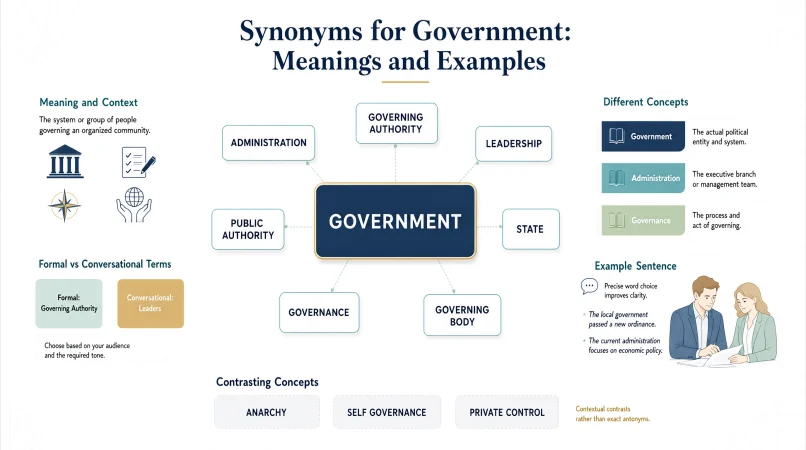
A government is the group of people and institutions that exercises authority over a country, state, or community. Common alternatives include administration, ruling authority, leadership, and governing body, depending on the political system and context.
When writing an essay, news article, workplace report, or social media post, you may find yourself repeating the word government. But the best replacement depends on whether you mean elected leaders, public institutions, a ruling authority, or the system that manages a country.
This guide to synonyms for government explains the differences between related terms and shows you how to choose the right word for academic, professional, political, and everyday communication. Each alternative is explained in context because words such as administration, state, and regime carry different meanings and tones.
Meaning, Tone and Context
What does government mean?
Government refers to the people, institutions, and arrangements responsible for making decisions, creating laws, delivering public services, and managing public affairs.
In the United States, the word can refer to federal, state, or local authorities. It can also describe the broader system through which a country is governed.
Part of speech: Noun.
Tone: Usually neutral, although it can carry positive or negative associations depending on the subject and the writer’s viewpoint.
Formality: Appropriate in everyday conversation, academic writing, journalism, business reports, and public policy discussions.
Common uses include:
- Politics: The elected leaders and officials responsible for public decisions.
- Public administration: Institutions that deliver services and enforce laws.
- Law: The authority responsible for making or implementing rules.
- Economics: Public spending, taxation, and regulation.
- International relations: The recognized authority representing a country.
- Local affairs: City councils, county authorities, and other local governing bodies.
Related word forms
| Word | Part of Speech | Meaning |
| Govern | Verb | To exercise authority or manage public affairs |
| Government | Noun | The authority or system responsible for governing |
| Governance | Noun | The process and structures through which decisions are made |
| Governing | Verb form or adjective | Exercising authority or directing a system |
| Governor | Noun | An official who leads a state or region |
| Governmental | Adjective | Related to a government |
| Nongovernmental | Adjective | Operating independently of government authority |
When and How to Use “Government”
Use government when referring to the public authority responsible for managing a country, state, or community. If you mean a specific group of leaders, institution, or political system, a more precise term may be better.
- Professional: The government announced new rules for public procurement.
- Academic: The study examines how government policies influence education.
- Personal: My family discussed the government’s role in healthcare.
- Political: The government introduced a proposal for electoral reform.
- Social media: Government decisions affect everyday life in more ways than we realize.
- Email: We are waiting for guidance from the relevant government department.
- Journalism: The government responded to questions about the proposed budget.
The word itself is neutral. The tone comes from the surrounding language, the policy being discussed, and the writer’s purpose.
Another Word for “Government”
The best single replacement for government is usually administration when referring to the current leaders and their executive team. Use governing body for an organization that makes decisions, state for a country’s public authority or institutions, and regime when emphasizing a particular system of rule.
| Situation | Best Alternative | Example |
| Professional writing | Administration | The administration released its annual policy report. |
| Academic writing | Governing authority | The study examines how the governing authority allocates resources. |
| Casual conversation | Leaders | The country’s leaders announced a new plan. |
| Political analysis | Ruling party | The ruling party introduced a new proposal. |
| Creative writing | Ruling power | The ruling power struggled to maintain control. |
| Resume or workplace use | Public sector | She has extensive experience working in the public sector. |
| Social media captions | Leadership | Strong leadership requires accountability. |
| Strong emphasis on authority | Ruling regime | The ruling regime restricted political opposition. |
| Softer, institutional meaning | Public administration | Public administration affects how services reach residents. |
These terms are related, but their meanings are not identical. For example, the ruling party is a political party, while the government may include many officials and institutions beyond that party.
When Not to Use “Government”
Although government is widely understood, replacing it with a related term can create confusion if the alternative describes a different institution or political concept.
1. When you mean the current executive team
Less precise: The government changed its communications strategy.
More specific: The administration changed its communications strategy.
Use administration when referring to the executive leadership and its policies, especially in US political reporting.
2. When you mean the political party in power
Less precise: The government won several seats in the election.
More precise: The ruling party won several seats in the election.
A government is not the same as a political party, and the wording should reflect what happened.
3. When discussing the broader public institutions of a country
Less precise: The administration includes the courts, legislature, and executive branch.
More accurate: The governmental system includes the institutions responsible for governing, including the legislature and executive, with the judiciary’s constitutional role depending on the system.
Administration often refers more narrowly to the executive branch and its leadership.
4. When describing a political system critically
Less precise: The government maintained strict control.
Alternative: The regime maintained strict control.
Regime can emphasize the structure or character of a system of rule. In some contexts, it carries a critical or negative tone, so use it carefully.
5. When referring to a city or county authority
Less precise: The government approved the local road project.
More precise: The city council approved the local road project.
Name the actual body when you know which authority made the decision.
Words Commonly Confused With “Government”
| Word | Main Difference | Example |
| Government | The public authority or system responsible for governing | The government approved the budget. |
| Administration | The executive leadership and officials managing public affairs, or the process of managing something | The administration announced its priorities. |
| State | A sovereign country or its public authority and institutions, depending on context | The state is responsible for enforcing the law. |
| Regime | A system or period of rule, sometimes with a critical tone | The regime introduced strict restrictions. |
| Governance | The processes and structures through which decisions are made and authority is exercised | Good governance requires transparency. |
| Ruling party | The political party that holds governing power | The ruling party proposed changes to tax policy. |
The most important distinction is scope. Government refers to the governing authority, administration often refers to executive leadership, governance describes how decisions are made, and ruling party identifies a political party in power.
Best Synonym by Context for “Government”
| Context | Best Synonym | Why It Works | Example |
| Formal writing | Governing authority | Emphasizes official power | The governing authority published new regulations. |
| Academic writing | State institutions | Focuses on public institutions | State institutions play a role in policy implementation. |
| Professional or business use | Government agency | Names a public organization | The company submitted the documents to a government agency. |
| Resume writing | Public sector | Refers to government related employment | Managed projects in the public sector. |
| Casual conversation | Leaders | Uses familiar language for people in charge | The leaders announced a new plan. |
| Creative writing | Ruling power | Emphasizes authority and control | The ruling power faced growing opposition. |
| Political analysis | Administration | Focuses on the executive leadership | The administration revised its economic strategy. |
| Strong emphasis on control | Regime | Highlights a system of rule | The regime tightened its restrictions. |
| Neutral institutional meaning | Public authority | Focuses on official responsibility | The public authority issued a safety notice. |
| Social media captions | Leadership | Short and accessible | Leadership and accountability matter. |
| Local government | Municipal government | Specifically identifies city or town authority | The municipal government approved the project. |
| Federal policy | Federal government | Specifies the national level in the US | The federal government updated the guidelines. |
| State policy in the US | State government | Identifies a US state level authority | The state government funded the initiative. |
| International relations | National government | Refers to a country’s central governing authority | The national government opened negotiations. |
| Decision making | Governing body | Fits an organization or institution with decision making powers | The governing body voted on the proposal. |
Which Synonym Should You Choose?
Choose the word based on the authority or concept you actually mean.
For public institutions
Use government, state institutions, or public authority. These terms emphasize official structures and responsibilities.
For people in power
Use administration, leadership, or ruling party, depending on whether you mean executive officials, decision makers, or a political party.
For the system of rule
Use political system or regime. Remember that regime can sound critical in some contexts.
For a specific department or level
Use government agency, municipal government, state government, or federal government when the exact institution matters.
Before choosing a synonym, consider its scope, formality, and tone. A precise term helps readers understand who has authority, which institution is involved, and what kind of power is being discussed.
Real Life Examples of “Government” in Sentences
| Situation | Original Sentence | More Specific Alternative |
| School | The government affects education. | Government education policies influence schools. |
| Workplace | The government issued new requirements. | The relevant government agency issued new requirements. |
| Academic writing | The government manages public programs. | Public institutions administer public programs. |
| Conversation | The government needs to explain the decision. | The country’s leaders need to explain the decision. |
| Social media | The government should be accountable. | Public leadership should be accountable. |
| Resume | I worked with the government. | I collaborated with government agencies. |
| We contacted the government about the permit. | We contacted the local government office about the permit. | |
| Storytelling | The government controlled the city. | The ruling authority controlled the city. |
The best alternative depends on the facts. If you worked for a government agency, for example, do not describe that experience as work for a political party unless that was actually your role.
25 Synonyms for “Government”
The word government refers to the group of people, institutions, or systems responsible for governing a country or community. Depending on the context, synonyms for government may describe political leadership, public authorities, government departments, or the system used to make and enforce laws.
Below are 25 alternatives to “government,” along with their meanings, best uses, and example sentences to help you choose the right word for your writing.
Common Synonyms for Government and Political Leadership
These alternatives are useful when discussing leaders, decision-makers, or the people and institutions responsible for governing.
| Synonym | Simple Meaning | Best Used For | Example Sentence |
|---|---|---|---|
| 1. Administration | Executive leaders and officials managing public affairs | Current leadership and policy | The administration announced its budget priorities. |
| 2. Governing authority | An entity with official power to govern | Formal and legal writing | The governing authority approved the regulation. |
| 3. Ruling authority | The people or institution exercising political control | Political analysis | The ruling authority faced public criticism. |
| 4. Leadership | People responsible for directing a country or organization | General and professional writing | The country’s leadership addressed the crisis. |
| 5. Ruling party | The political party currently in power | Elections and party politics | The ruling party proposed a new tax plan. |
| 6. Regime | A system or period of political rule | Political analysis and history | The regime introduced major reforms. |
| 7. Cabinet | Senior ministers or executive advisers, depending on the political system | Executive decision-making | The cabinet met to discuss the proposal. |
Synonyms for Government as a State or Political System
These terms are especially useful in civics, political science, constitutional discussions, and academic writing.
| Synonym | Simple Meaning | Best Used For | Example Sentence |
|---|---|---|---|
| 8. State | A sovereign country or its public authority | Law and political theory | The state provides certain public services. |
| 9. Political system | The structure through which political power operates | Civics and academic writing | The political system determines how leaders are selected. |
| 10. National government | The central governing authority of a country | National policy | The national government began negotiations. |
| 11. Federal government | The national level of government in a federal system | US policy and national affairs | The federal government issued updated guidance. |
| 12. State government | The governing authority of an individual US state | State laws and policy | The state government expanded its education program. |
| 13. Local government | Public authority operating at a local level | Community issues | Local government manages many neighborhood services. |
| 14. Municipal government | A city or town’s governing authority | Local services | The municipal government repaired the public park. |
Synonyms for Government Institutions and Public Administration
Use these alternatives when writing about public services, official departments, institutional responsibilities, or the implementation of policies.
| Synonym | Simple Meaning | Best Used For | Example Sentence |
|---|---|---|---|
| 15. Public authority | An official body exercising public powers | Legal and administrative contexts | The public authority issued a formal notice. |
| 16. Governing body | A group responsible for decisions and oversight | Organizations and institutions | The governing body approved the annual plan. |
| 17. Public administration | The management and implementation of public policy | Public service and academic study | Public administration helps deliver essential services. |
| 18. Executive branch | The branch responsible for implementing laws and carrying out executive functions | US government and civics | The executive branch proposed a new initiative. |
| 19. Government agency | An organization established to carry out public functions | Services and regulations | The government agency reviewed the application. |
| 20. Public sector | Government-related institutions, services, and employment | Employment and economics | She has worked in the public sector for years. |
| 21. Governing institution | An institution that exercises governing responsibilities | Academic and formal writing | The governing institution published its annual report. |
Synonyms for Government Decision-Making and Public Officials
These terms refer to specific bodies, lawmakers, or individuals involved in public decisions. They are useful when you want to identify the exact part of government being discussed.
| Synonym | Simple Meaning | Best Used For | Example Sentence |
|---|---|---|---|
| 22. Council | A group that deliberates or makes decisions | Local or organizational governance | The council voted to approve the plan. |
| 23. Legislature | The institution responsible for making laws | Lawmaking and constitutional affairs | The legislature debated the bill. |
| 24. Authority | The power to make decisions or the body entitled to exercise that power | Formal and general writing | The authority ordered a safety review. |
| 25. Public officials | People holding government positions | Reporting and public accountability | Public officials answered questions about the project. |
How to Choose the Right Synonym for “Government”
The best synonym depends on what you mean. Use administration when referring to the current executive leadership, state when discussing a country’s public authority, and political system when describing how political power is organized. Choose legislature for the lawmaking body, cabinet for senior executive ministers, and government agency for an organization responsible for a specific public function.
Important usage note: These words are not interchangeable in every sentence. For example, public sector describes a broad area of government-related employment and activity, while public officials refers to people who hold government positions. Choosing a precise term makes your writing clearer and more accurate.
Synonym Groups and Usage Differences
Professional vs. Personal Synonyms
Professional writing benefits from precise institutional terms. Use government agency when referring to a specific public organization, administration for executive leadership, and public sector for government related employment and services.
In personal writing, leaders, officials, or the people in charge may sound more natural. These expressions are easier to understand, although they may be less precise than formal terms.
Formal vs. Conversational Synonyms
In reports, essays, and speeches, terms such as governing authority, public administration, and state institutions can communicate specific ideas.
In everyday conversation, government, leaders, and officials are usually clear and natural. Choose a formal alternative only when it adds useful meaning.
Academic Synonyms
Academic writing often distinguishes the people who govern from the institutions and processes through which governing takes place.
Consider these examples:
- The government introduced a new policy.
- The administration changed its policy priorities.
- The political system determines how authority is distributed.
- Governance shapes how public decisions are made.
- Public administration concerns the implementation of public policies.
Use government for the authority itself, political system for the broader structure, governance for decision making arrangements, and public administration for managing and implementing public programs.
Professional and Business Synonyms
Businesses often interact with government agencies, regulatory authorities, and public institutions. The most appropriate word depends on the actual organization involved.
| Purpose | Recommended Term | Example |
| Applying for a permit | Government agency | The company submitted its permit application to the government agency. |
| Discussing regulations | Regulatory authority | The regulatory authority updated its requirements. |
| Describing public employment | Public sector | He moved from private industry to the public sector. |
| Discussing executive policy | Administration | The administration revised its policy guidance. |
| Describing public services | Public administration | Public administration plays a role in service delivery. |
For resumes, describe your actual responsibilities. If you coordinated with a government department, say so directly rather than using a broad term that could suggest a different role.
Creative or Literary Synonyms
Creative writing may use ruling power, authority, or regime to create a particular atmosphere. Each term has a different effect.
Ruling power emphasizes control. Authority can sound institutional or commanding. Regime can create a serious or critical tone, especially when a system is restrictive.
Example: “The government ruled the region” could become “The ruling power held the region under its control.” The second version is more dramatic and should suit the surrounding story.
Slang or Modern Synonyms
There is no universal slang synonym for government. Casual phrases such as the people in charge or those in power may work in conversation, commentary, or social media posts.
These expressions can sound vague or opinionated in academic papers and professional reports. Use government agency, administration, or the name of the actual institution when accuracy matters.
Strongest vs. Weaker Synonyms
Government related terms do not form a simple scale of intensity. The following guide compares the emphasis they create rather than ranking them as exact equivalents.
Broad
Government, leadership
General references to governing authorities or people in charge.
Specific
Administration, cabinet, legislature
Identify particular groups or branches of government.
Institutional
Public authority, governing body
Emphasize official powers and responsibilities.
Critical tone
Regime, ruling power
Can emphasize control or the character of a system of rule.
A critical term is not automatically more accurate or more forceful. Use regime when its meaning fits the facts and tone, not merely to make a sentence sound stronger.
Emotional vs. Neutral Synonyms
Most government related terms are neutral descriptions, but some can carry political associations.
Administration, public authority, and governing body are generally neutral. Leadership can sound positive in contexts emphasizing direction and responsibility. Regime can sound negative, particularly when discussing authoritarian rule, although it can also be used descriptively in political science.
For balanced writing, choose the term that describes the institution accurately and avoid using emotionally charged language unless the context supports it.
Antonyms of “Government”
The noun government has no single direct antonym that fits every meaning. Depending on the context, contrasting terms may describe the absence of governing authority, independent decision-making, private control, or reduced central oversight. These words are not exact dictionary opposites, but they can express contrasting ideas in political, economic, and social discussions.
Antonyms of Government Related to the Absence of Authority
These terms describe situations in which a recognized governing structure or central authority is missing or ineffective.
| Antonym or Contrasting Term | Meaning | Example Sentence |
|---|---|---|
| 1. Anarchy | Absence of an effective governing authority | The novel depicts a society descending into anarchy. |
| 2. Statelessness | A condition in which no recognized state governs a territory or community | The discussion examines statelessness and access to public services. |
| 3. Absence of central authority | A situation without a single central governing power | The historical account describes a period without central authority. |
Antonyms of Government Related to Independence and Self-Rule
These expressions emphasize the ability of communities, regions, or countries to make decisions without outside control.
| Antonym or Contrasting Term | Meaning | Example Sentence |
|---|---|---|
| 4. Self-governance | A community managing its own affairs without outside control | The community sought greater self-governance. |
| 5. Autonomy | The ability to govern or manage oneself independently | The region sought greater autonomy over its affairs. |
| 6. Independence | Freedom from another authority’s control | The country declared independence. |
| 7. Local autonomy | The ability of local communities to make their own decisions | Local autonomy allowed the community to set its priorities. |
| 8. Self-rule | The ability of a people or community to govern themselves | The movement called for self-rule. |
Contrasting Terms Related to Private Control and Enterprise
These terms describe arrangements in which private individuals or businesses take on roles that might otherwise be managed by public institutions. They contrast with certain forms of government involvement rather than with government itself.
| Antonym or Contrasting Term | Meaning | Example Sentence |
|---|---|---|
| 9. Private control | Management by private individuals or organizations rather than public authorities | The proposal would transfer the facility to private control. |
| 10. Privatization | Transfer of an activity or asset from public ownership or control to private ownership or control | Privatization changed how the service was managed. |
| 11. Private enterprise | Business activity conducted by privately owned organizations | Private enterprise played a larger role after the reform. |
Contrasting Terms Related to Reduced Government Intervention
These concepts describe less central control, fewer regulations, or greater freedom for local decision-makers and independent groups.
| Antonym or Contrasting Term | Meaning | Example Sentence |
|---|---|---|
| 12. Deregulation | Reduction or removal of certain government rules | Deregulation reduced restrictions in the industry. |
| 13. Nonintervention | A policy of avoiding involvement in a particular matter | The policy emphasized nonintervention in local disputes. |
| 14. Decentralization | Distribution of authority away from a central body | Decentralization gave local offices more responsibility. |
| 15. Voluntary cooperation | People coordinating without relying on compulsory central direction | Voluntary cooperation helped residents organize local support. |
How to Choose the Right Opposite of “Government”
The right contrasting term depends on the meaning of government in your sentence. Use anarchy when discussing the absence of effective governing authority, autonomy or self-rule when emphasizing independent decision-making, and privatization when describing a transfer from public to private ownership or control. Choose deregulation when referring specifically to fewer government rules and decentralization when authority is distributed away from a central body.
Important usage note: These terms are not interchangeable. Government can continue to exist in a decentralized system, an autonomous region, or an economy with extensive private enterprise. For accurate writing, choose the term that expresses the specific contrast you intend.
Comparison: Government vs. Similar Words
Government vs. Administration
Government is the broader term for public authority and governing institutions. Administration often refers to the executive leadership and officials managing public affairs.
Stronger: Neither is inherently stronger. Government has a broader scope.
More formal: Both are suitable for formal writing, but administration is useful when discussing a specific executive team.
Examples:
- Government: The government introduced new environmental rules.
- Administration: The administration revised its environmental priorities.
Government vs. State
Government refers to the governing authority or system. State can mean a sovereign country or the public authority and institutions associated with it.
Stronger: Neither is inherently stronger. State may have a broader legal or political meaning.
More formal: Both are formal, but state is especially common in legal and political theory.
Examples:
- Government: The government announced a new policy.
- State: The state has a responsibility to protect legal rights.
Government vs. Regime
Government is a relatively neutral term for the governing authority. Regime emphasizes a system or period of political rule and can carry a critical tone.
Stronger: Regime may sound more critical, depending on context.
More formal: Both appear in formal writing, including political science and history.
Examples:
- Government: The government changed its election rules.
- Regime: The regime restricted opposition activities.
Government vs. Governance
Government identifies the authority or institutions responsible for governing. Governance describes how decisions are made, authority is exercised, and institutions are held accountable.
Stronger: Neither is stronger. They refer to different concepts.
More formal: Both are common in academic and professional writing.
Examples:
- Government: The government approved the public spending plan.
- Governance: Effective governance requires transparent decision making.
Government vs. Ruling Party
Government refers to the governing authority and its institutions. Ruling party refers specifically to the political party holding governing power.
Stronger: Neither is inherently stronger.
More formal: Both are appropriate in political reporting and academic work.
Examples:
- Government: The government announced its economic program.
- Ruling party: The ruling party presented its economic platform.
Government vs. Public Sector
Government refers to the governing authority. Public sector refers more broadly to government owned or controlled organizations, services, and activities.
Stronger: Neither is stronger. Public sector emphasizes the area of activity rather than a single authority.
More formal: Both are common in economics, business, and public policy writing.
Examples:
- Government: The government funded the project.
- Public sector: The public sector employs workers across many essential services.
Common Phrases and Expressions with “Government”
1. Government Policy
Meaning: An official plan or approach adopted by a government to address an issue.
Example sentence: The new government policy aims to improve access to public transportation.
2. Government Spending
Meaning: Money spent by public authorities on services, programs, infrastructure, and other responsibilities.
Example sentence: Government spending on road repairs increased this year.
3. Government Accountability
Meaning: The responsibility of public officials and institutions to explain their decisions and answer for their actions.
Example sentence: Government accountability helps build public trust.
4. Government Intervention
Meaning: Action taken by public authorities to influence or address a situation.
Example sentence: Government intervention helped stabilize the market during the crisis.
5. Government Agency
Meaning: An organization responsible for carrying out specific public functions.
Example sentence: The government agency published updated safety guidelines.
6. Government Shutdown
Meaning: In the United States, a lapse in funding that causes some federal government activities to stop or operate on a limited basis.
Example sentence: The government shutdown disrupted several federal services.
7. Government Reform
Meaning: Changes intended to improve public institutions, procedures, or the way authority is exercised.
Example sentence: The proposal calls for government reform to make public services more efficient.
8. Form of Government
Meaning: The structure or system through which a country is governed.
Example sentence: The class compared different forms of government, including presidential and parliamentary systems.
Common Mistakes to Avoid
1. Treating every related word as an exact synonym.
Government, administration, regime, and governance have different meanings. Select the word that describes the institution or process you actually mean.
2. Confusing a government with a political party.
A political party may lead a government, but the two are not identical. Use ruling party when the party itself is the subject.
3. Using a casual expression in formal writing.
“The people in charge” can work in conversation, but government officials or the governing authority is usually more precise in an academic paper.
4. Using an overly critical term without justification.
Regime can imply a negative judgment in some contexts. Use government or administration when a neutral description is more appropriate.
5. Repeating the word too often.
Instead of writing “The government made a decision, and the government announced the decision,” name the specific body when known, such as the cabinet, the legislature, or the agency.
6. Choosing a synonym with the wrong scope.
Public sector describes a broad area of public activity, while cabinet refers to a group of senior executive officials. Replacing one with the other may change the meaning.
7. Using political terminology without checking its meaning.
Words such as state, regime, and governance have specific meanings in political science and law. Verify the intended definition before using them in research or formal writing.
FAQs
1. What is the best synonym for government?
Administration is useful when referring to current executive leaders. Use governing authority for official power, public sector for government related activities, and governing body for decision making groups.
2. What is a formal synonym for government?
Governing authority, public authority, and state institutions are useful formal alternatives. Choose according to whether you mean the people in power, official authority, or public institutions.
3. What is an informal synonym for government?
Leaders or the people in charge can work in casual conversation. These expressions are accessible, but they may be less precise than government or administration in formal writing.
4. What is another word for government in professional writing?
Administration, government agency, and public authority are useful in professional contexts. Use government agency for a specific organization and administration for executive leadership.
5. What is the difference between government and governance?
Government refers to the authority or institutions responsible for governing. Governance describes the processes, rules, and structures through which decisions are made and authority is exercised.
6. What is the opposite of government?
There is no exact opposite for every meaning of government. Depending on context, anarchy, self governance, private control, or absence of central authority may express a contrasting concept.
Conclusion
The word government refers to the public authority and institutions responsible for governing a country, state, or community. Useful synonyms for government include administration, governing authority, public authority, leadership, state, and governing body, but each term has a distinct meaning.
For academic writing, choose precise terms such as governance or state institutions when they fit your point. In professional communication, identify the relevant agency or authority. In casual writing, leaders may be enough.
The practical takeaway is simple: choose the word that identifies the right people, institution, or system, rather than replacing government with a similar sounding term.