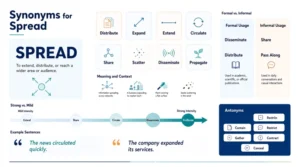

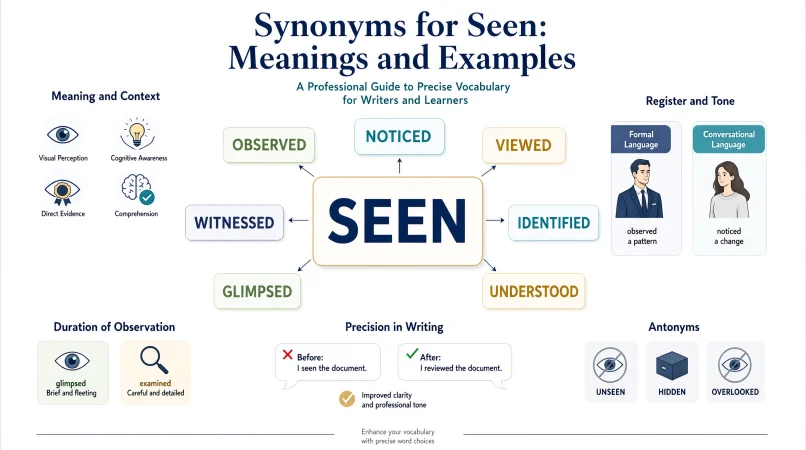
Seen means noticed, viewed, observed, or experienced, depending on context. Useful synonyms include observed for careful attention, viewed for looking at something, noticed for recognizing a detail, witnessed for an event, and recognized for identifying someone or something.
Have you ever used the word seen several times in an essay, email, report, or social media caption? Although it is a common English word, repeating it can make your writing feel less precise. Choosing a better alternative can help you describe whether something was noticed, observed, viewed, understood, or experienced.
This guide to synonyms for seen explains how these words differ in meaning, tone, and usage. You will learn which alternatives fit academic writing, professional communication, everyday conversation, emotional expression, and creative storytelling.
Meaning, Tone and Context
What does seen mean?
Seen is the past participle of the verb see. It can describe looking at something, noticing a detail, witnessing an event, understanding an idea, or meeting someone.
The exact meaning depends on the sentence. For example, I have seen that movie describes viewing, while I have seen your point means understanding your argument.
Part of speech: Verb form, used in perfect tenses and passive constructions.
Tone: Usually neutral. It can suggest surprise, understanding, awareness, or emotional recognition in certain expressions.
Formality: Suitable for casual conversation, academic writing, business communication, and professional reports. More specific verbs can make formal writing clearer.
Common uses include:
- Visual perception, such as seeing a bird in a tree.
- Careful observation, such as seeing a change in behavior.
- Witnessing an event, such as seeing an accident.
- Understanding an idea, such as seeing another person’s point.
- Meeting someone, such as seeing a doctor.
- Experience, such as seeing significant progress.
- Online communication, such as a message being seen by its recipient.
Important word forms
| Word | Part of Speech | Meaning |
| See | Verb | To look at, notice, or understand |
| Saw | Past tense verb | Looked at or noticed in the past |
| Seen | Past participle | Used with helping verbs or in passive constructions |
| Seeing | Verb form or noun | Looking at or understanding something |
| Sight | Noun | The ability to see or something viewed |
| Visible | Adjective | Able to be seen |
| Unseen | Adjective | Not seen or noticed |
When and How to Use “Seen”
Use seen when you mean that someone looked at, noticed, witnessed, understood, or experienced something. If the action is more specific, a synonym can communicate the meaning more accurately.
- Professional: We have seen a noticeable improvement in customer satisfaction.
- Academic: The results have been seen in several previous studies.
- Personal: I have seen my friends grow more confident over the years.
- Emotional: She wanted to feel seen and understood by her family.
- Social media: One of the most beautiful sunsets I have ever seen.
- Email: I have seen your message and will respond shortly.
- Storytelling: He saw a shadow move across the hallway.
Each example uses seen or saw in a different way. In the first sentence, observed or recorded might be more precise. In the emotional example, understood or recognized may capture the intended meaning.
Another Word for “Seen”
The best single replacement for seen is usually observed when describing careful attention, viewed when referring to visual content, or noticed when describing awareness of a detail. The correct choice depends on what the sentence means.
| Situation | Best Alternative | Example |
| Professional writing | Observed | We observed a change in customer behavior. |
| Academic writing | Identified | Researchers identified a recurring pattern. |
| Casual conversation | Noticed | I noticed your new haircut. |
| Emotional writing | Understood | She finally felt understood. |
| Creative writing | Beheld | They beheld the city lights from the hilltop. |
| Resume or workplace use | Monitored | Monitored customer feedback and identified recurring concerns. |
| Social media captions | Witnessed | We witnessed an unforgettable sunset. |
| Strong emphasis | Witnessed | Several people witnessed the incident. |
| Softer description | Glimpsed | I glimpsed the bird through the trees. |
For a resume, choose an action verb that describes what you actually did. Monitored, identified, examined, and observed can be useful, but they are not interchangeable.
When Not to Use “Seen”
Although seen is versatile, some sentences become clearer when you select a more specific verb.
1. When describing a discovery
Less precise: We have seen three errors in the report.
Better: We identified three errors in the report.
Identified emphasizes recognizing and pinpointing the errors.
2. When describing careful study
Less precise: The team saw the samples under a microscope.
Better: The team examined the samples under a microscope.
Examined communicates deliberate inspection.
3. When describing an event you personally witnessed
Less precise: I saw the collision.
More specific: I witnessed the collision.
Witnessed emphasizes being present when an event occurred.
4. When describing understanding
Less precise: I have seen what you mean.
More natural: I understand what you mean.
Understand expresses comprehension directly.
5. When describing a brief visual experience
Less precise: We saw a fox between the trees for a second.
More vivid: We glimpsed a fox between the trees.
Glimpsed suggests a brief or incomplete view.
6. When describing a meeting
Less precise: I saw my dentist yesterday.
More specific: I visited my dentist yesterday.
Visited emphasizes the appointment or meeting rather than simply looking at someone.
Words Commonly Confused With “Seen”
| Word | Main Difference | Example |
| Seen | Broad term for looking at, noticing, or experiencing | I have seen that film. |
| Observed | Looked at carefully, often to study something | We observed the birds in their habitat. |
| Noticed | Became aware of a detail | I noticed a spelling error. |
| Witnessed | Was present when an event happened | She witnessed the accident. |
| Viewed | Looked at visual material or considered something | We viewed the presentation online. |
| Perceived | Became aware of or interpreted something through the senses or mind | The comment was perceived as criticism. |
The main distinction is the action being described. Observed suggests attention, noticed highlights awareness, witnessed connects a person to an event, and perceived can include interpretation rather than direct sight.
Best Synonym by Context for “Seen”
| Context | Best Synonym | Why It Works | Example |
| Formal writing | Observed | Sounds precise and professional | A significant change was observed. |
| Academic writing | Identified | Emphasizes recognizing a pattern or finding | Researchers identified a relationship between the variables. |
| Professional communication | Noted | Concisely records awareness of information | We noted the changes in the report. |
| Resume writing | Monitored | Describes tracking activity or performance | Monitored quality indicators across multiple projects. |
| Casual conversation | Noticed | Sounds natural and direct | I noticed your new glasses. |
| Creative writing | Beheld | Adds a literary quality to a visual moment | She beheld the mountains at sunrise. |
| Emotional writing | Understood | Communicates emotional recognition | He felt understood for the first time. |
| Direct evidence | Witnessed | Indicates personal presence at an event | They witnessed the exchange. |
| Brief visual contact | Glimpsed | Suggests a quick or partial view | I glimpsed someone at the doorway. |
| Social media captions | Captured | Works when a moment is photographed or recorded | Captured a sunset I will never forget. |
| Scientific observation | Detected | Highlights finding something that may not be obvious | The instrument detected a small change. |
| Reading or video content | Viewed | Directly refers to visual material | The tutorial was viewed thousands of times. |
| Understanding an argument | Recognized | Emphasizes acknowledging a point or fact | She recognized the value of the proposal. |
| Medical appointment | Visited | Describes meeting a health professional | He visited his doctor on Monday. |
| US and UK usage | Observed | Common and appropriate in both varieties | The same pattern was observed in both groups. |
Which Synonym Should You Choose?
Choose a replacement by asking what seen means in your sentence.
For visual perception
Use viewed, glimpsed, or beheld. Select glimpsed for a brief look and viewed for visual material.
For careful attention
Use observed, examined, or inspected. These verbs suggest deliberate attention.
For recognizing a detail
Use noticed, detected, or identified. Pick the word that best reflects how the detail was found.
For events and people
Use witnessed for events you were present for, or met and visited when describing personal contact.
For understanding or emotions
Use understood, recognized, or perceived, depending on whether you mean comprehension, acknowledgment, or interpretation.
Also consider formality and intensity. Noticed works well in everyday speech, observed often suits reports, and beheld is generally more literary. Always check that the alternative preserves the original meaning.
Real Life Examples of “Seen” in Sentences
| Situation | Original Sentence | More Precise Alternative |
| School | We have seen this concept before. | We have studied this concept before. |
| Workplace | I have seen the latest figures. | I have reviewed the latest figures. |
| Academic writing | A similar result was seen in the experiment. | A similar result was observed in the experiment. |
| Conversation | I saw your message. | I noticed your message. |
| Social media | The most beautiful view I have ever seen. | A breathtaking view I will never forget. |
| Resume | I saw several problems with the process. | I identified several problems with the process. |
| I have seen your request. | I have reviewed your request. | |
| Storytelling | She saw a faint light in the distance. | She glimpsed a faint light in the distance. |
These alternatives are useful only when they match the intended meaning. For example, reviewed implies examining information, while noticed simply indicates awareness.
25 Synonyms for “Seen”
The word seen can refer to looking at something, noticing an event, recognizing a person, understanding an idea, or meeting someone. The best synonym depends on the context and the intended meaning.
The following 25 alternatives cover these different uses, with simple meanings, recommended contexts, and example sentences.
Synonyms for Seen Meaning Observed or Looked At
These words describe using your eyes to notice, watch, or examine something.
| Synonym | Simple Meaning | Best Used For | Example Sentence |
|---|---|---|---|
| 1. Observed | Watched carefully | Reports and research | Scientists observed the behavior over several weeks. |
| 2. Viewed | Looked at | Videos, images, and presentations | We viewed the documentary together. |
| 3. Noticed | Became aware of | Everyday writing | She noticed a small crack in the window. |
| 4. Witnessed | Saw an event happen | Events and incidents | Several residents witnessed the storm damage. |
| 5. Spotted | Saw or recognized something | Informal conversation | I spotted my friend in the crowd. |
| 6. Glimpsed | Saw briefly | Storytelling | He glimpsed a figure behind the curtain. |
| 7. Beheld | Looked at, often with wonder | Literary writing | The travelers beheld the vast canyon. |
| 8. Watched | Looked at over a period of time | Events and movement | We watched the children play outside. |
| 9. Looked at | Directed one’s eyes toward | Everyday speech | She looked at the painting for several minutes. |
| 10. Caught sight of | Saw unexpectedly or briefly | Conversation and storytelling | I caught sight of a deer near the road. |
Synonyms for Seen Meaning Detected or Recognized
These alternatives are useful when describing the discovery, identification, or interpretation of something.
| Synonym | Simple Meaning | Best Used For | Example Sentence |
|---|---|---|---|
| 11. Perceived | Became aware of or interpreted | Psychology and analysis | His silence was perceived as disagreement. |
| 12. Detected | Discovered the presence of something | Science and investigation | The test detected traces of the substance. |
| 13. Identified | Recognized or established what something was | Research and professional writing | The team identified the source of the problem. |
| 14. Recognized | Identified or acknowledged | People, facts, and ideas | I recognized her voice immediately. |
| 15. Noted | Observed or recorded a detail | Formal writing | The committee noted a difference in the results. |
Synonyms for Seen Meaning Examined or Reviewed
Use these words when discussing close inspection, research, documents, or professional assessments.
| Synonym | Simple Meaning | Best Used For | Example Sentence |
|---|---|---|---|
| 16. Examined | Looked at closely | Study and inspection | The doctor examined the patient. |
| 17. Inspected | Checked carefully | Quality control and safety | Staff inspected the equipment before use. |
| 18. Reviewed | Examined information or material | Business and academic work | The manager reviewed the submitted documents. |
Synonyms for Seen Meaning Experienced or Encountered
These expressions describe going through an event, coming across a situation, or personally observing an incident.
| Synonym | Simple Meaning | Best Used For | Example Sentence |
|---|---|---|---|
| 19. Witnessed firsthand | Personally saw an event or action | Evidence and personal accounts | The reporter witnessed the evacuation firsthand. |
| 20. Experienced | Lived through or encountered an event | Life events and changes | The town experienced rapid growth. |
| 21. Encountered | Came across or met | People, problems, and situations | We encountered several obstacles during the trip. |
Synonyms for Seen Meaning Met or Consulted
These alternatives apply when seen refers to meeting someone, visiting a person, or receiving professional advice.
| Synonym | Simple Meaning | Best Used For | Example Sentence |
|---|---|---|---|
| 22. Met | Came into contact with a person | Personal or professional meetings | She met her new supervisor on Monday. |
| 23. Visited | Went to see a person or place | Appointments and social contact | He visited his grandparents last weekend. |
| 24. Consulted | Sought professional advice or met for guidance | Medical and professional settings | She consulted a specialist about the issue. |
Synonym for Seen Meaning Understood
In some contexts, seen can suggest that someone has recognized the meaning or significance of an idea.
| Synonym | Simple Meaning | Best Used For | Example Sentence |
|---|---|---|---|
| 25. Understood | Comprehended the meaning or point | Ideas and emotional communication | At last, he understood her concerns. |
How to Choose the Right Synonym for “Seen”
The most suitable alternative depends on what you want to communicate.
- For visual observation: Use observed, viewed, or watched.
- For noticing something: Choose spotted, detected, or noticed.
- For formal inspection: Use examined, inspected, or reviewed.
- For personally witnessing an event: Choose witnessed or witnessed firsthand.
- For meeting someone: Use met, visited, or consulted.
- For understanding an idea: Choose understood.
Remember that these alternatives are not interchangeable in every sentence. Reviewed is appropriate for documents, met refers to contact with a person, and understood describes comprehension. Matching the synonym to its context makes your writing clearer and more natural.
Synonym Groups and Usage Differences
Professional vs. Personal Synonyms
Professional writing benefits from clear, specific verbs. Use reviewed for documents, observed for patterns, identified for findings, and noted for details recorded during a task.
Personal writing can be more expressive. Use noticed for small details, glimpsed for a brief view, and understood when describing emotional recognition.
Formal vs. Conversational Synonyms
For formal reports, essays, and presentations, observed, identified, examined, and perceived can communicate precise meanings.
For everyday conversation, saw, noticed, spotted, and looked at are often more natural. Use beheld sparingly because it can sound literary or old fashioned.
Academic Synonyms
Academic writing often needs to distinguish between seeing something, identifying evidence, and interpreting a result.
Consider these examples:
- Researchers observed changes in participant behavior.
- The analysis identified three recurring patterns.
- The instrument detected a small variation.
- The findings were reported in the final paper.
Choose observed for something examined, identified for something recognized, and detected when a signal or detail was discovered. If the research only reports a result, reported may be more accurate than seen.
Professional and Business Synonyms
In workplace communication, the strongest alternative depends on the task.
| Intended Meaning | Recommended Word | Example |
| Checking a document | Reviewed | I reviewed the proposal this morning. |
| Recording a detail | Noted | We noted the client’s feedback. |
| Finding a problem | Identified | The team identified a billing error. |
| Tracking activity | Monitored | We monitored customer response times. |
| Examining quality | Inspected | The technician inspected the equipment. |
On a resume, choose action verbs that accurately reflect your work. For example, replace “Saw issues with the process” with “Identified process issues” if you actually found and documented those problems.
Creative or Literary Synonyms
Creative writing often benefits from verbs that help readers imagine a scene.
Beheld can suggest wonder or admiration. Glimpsed creates a sense of a brief encounter, while spotted can make an unexpected discovery feel immediate.
Example: “She saw the ocean from the hill” becomes “She beheld the ocean stretching toward the horizon.”
The second sentence sounds more literary. In straightforward writing, the simpler verb may be preferable.
Slang or Modern Synonyms
There is no single slang word that replaces seen in every context. Informal expressions such as checked out can mean viewed or examined, as in “I checked out the new video.”
However, checked out can also mean borrowed, investigated, or left a place, depending on context. Use it in casual speech, but choose more precise verbs in formal writing.
Strongest vs. Weaker Synonyms
These words differ in intensity and purpose, so the following scale is a practical guide rather than a fixed ranking.
Brief
Glimpsed, caught sight of
Suggest a short or incomplete visual experience.
General
Saw, viewed, noticed
Describe ordinary visual perception or awareness.
Deliberate
Observed, examined, inspected
Suggest purposeful attention or closer study.
Specific
Witnessed firsthand, identified
Emphasize personal presence at an event or recognizing a specific finding.
Witnessed firsthand emphasizes direct experience. Identified emphasizes recognition. Neither is automatically more intense than saw in every sentence.
Emotional vs. Neutral Synonyms
Neutral words describe an action without adding much emotion. Viewed, observed, noticed, and examined are generally factual.
Emotional or expressive choices depend on the context. Beheld may convey wonder, while recognized can suggest acknowledgment or acceptance. In the phrase “she wanted to feel seen,” the word means understood, acknowledged, or valued, not simply looked at.
Antonyms of “Seen”
The opposite of seen depends on its meaning. For visual perception, unseen and invisible are useful opposites. For noticing something, overlooked or missed may fit. Also For understanding, misunderstood is more appropriate.
| Antonym or Opposite Expression | Meaning | Example Sentence |
| 1. Unseen | Not seen | The damage remained unseen until the inspection. |
| 2. Invisible | Unable to be seen | The gas was invisible to the naked eye. |
| 3. Hidden | Kept out of sight | The key was hidden beneath the drawer. |
| 4. Concealed | Deliberately kept from view | The evidence was concealed inside a box. |
| 5. Overlooked | Not noticed or considered | A small error was overlooked during review. |
| 6. Missed | Failed to see or notice | I missed the sign near the entrance. |
| 7. Unnoticed | Not observed by anyone | The change went unnoticed for several days. |
| 8. Undetected | Not discovered or identified | The fault remained undetected until testing. |
| 9. Unobserved | Not watched or examined | The area remained unobserved for hours. |
| 10. Ignored | Deliberately given no attention | The warning was ignored. |
| 11. Disregarded | Treated as unimportant | The reviewer disregarded the minor detail. |
| 12. Unrecognized | Not identified or acknowledged | Her contribution went unrecognized. |
| 13. Misunderstood | Not understood correctly | His explanation was misunderstood by the audience. |
| 14. Unacknowledged | Not recognized or admitted | Her efforts remained unacknowledged. |
| 15. Unwitnessed | Not personally seen by a witness | The event was unwitnessed, so details were difficult to verify. |
These are context dependent opposites, not 15 exact antonyms that fit every meaning of seen. For example, misunderstood applies to the meaning of understanding, while invisible applies to visual perception.
Comparison: Seen vs. Similar Words
Seen vs. Observed
Seen is a broad term for visual perception or awareness. Observed usually suggests paying attention to something carefully.
Stronger: Observed emphasizes attention, not necessarily intensity.
More formal: Observed is often more suitable for reports and research.
Examples:
- Seen: I have seen a change in the results.
- Observed: We observed a change in the results during testing.
Seen vs. Noticed
Seen can mean that something entered your field of vision. Noticed emphasizes becoming aware of it.
Stronger: Noticed highlights awareness.
More formal: Both work in formal writing, but noticed is often more specific when describing awareness.
Examples:
- Seen: I saw a small mark on the wall.
- Noticed: I noticed a small mark on the wall.
Seen vs. Witnessed
Seen can refer to ordinary visual perception. Witnessed often means being present when an event occurred.
Stronger: Witnessed can carry more significance when describing an important event.
More formal: Both are acceptable, but witnessed is useful for formal accounts of events.
Examples:
- Seen: I saw the argument outside the store.
- Witnessed: I witnessed the argument outside the store.
Seen vs. Viewed
Seen is general, while viewed often refers to looking at images, videos, exhibits, or other visual material.
Stronger: Neither is inherently stronger.
More formal: Viewed can sound more precise in reports about media or visual material.
Examples:
- Seen: I have seen the presentation.
- Viewed: I viewed the presentation online.
Seen vs. Perceived
Seen can describe direct visual experience. Perceived emphasizes how something is sensed or interpreted.
Stronger: Perceived adds the idea of interpretation.
More formal: Perceived is often suitable for academic or analytical writing.
Examples:
- Seen: The comment was seen as criticism.
- Perceived: The comment was perceived as criticism.
Seen vs. Recognized
Seen can mean looking at a person or thing. Recognized means identifying someone or acknowledging a fact, quality, or achievement.
Stronger: Recognized emphasizes identification or acknowledgment.
More formal: Both are useful, but recognized is more precise when the point is identification or appreciation.
Examples:
- Seen: I saw her at the conference.
- Recognized: I recognized her from a previous conference.
Common Phrases and Expressions with “Seen”
1. Seen Better Days
Meaning: Describes something that has become worn, damaged, or less successful than it once was.
Example sentence: This old laptop has seen better days, so I am planning to replace it.
2. Seen and Heard
Meaning: A phrase that can describe being acknowledged and listened to, especially in discussions about inclusion or emotional support.
Example sentence: Every student deserves to feel seen and heard in the classroom.
3. Be Seen As
Meaning: To be regarded or interpreted in a particular way.
Example sentence: Her decision was seen as a sign of strong leadership.
4. Never Seen Before
Meaning: Describes something that has not previously been witnessed or encountered.
Example sentence: The team discovered a pattern never seen before in the data.
5. Have You Seen?
Meaning: A common question used to ask whether someone has viewed, noticed, or encountered something.
Example sentence: Have you seen my keys anywhere?
6. Seeing Is Believing
Meaning: An expression suggesting that direct observation can make something easier to believe.
Example sentence: I did not believe the machine could work so quickly, but seeing is believing.
7. Seen Through Someone
Meaning: To recognize someone’s true intentions or behavior despite an attempt to hide them.
Example sentence: The manager saw through the excuse and asked for an honest explanation.
8. Seen in a New Light
Meaning: To understand or view someone or something differently after learning new information.
Example sentence: After hearing her story, I saw the situation in a new light.
Common Mistakes to Avoid
1. Using seen without a helping verb when the sentence requires one.
Incorrect: I seen the movie yesterday.
Correct: I saw the movie yesterday.
Correct: I have seen the movie before.
Use saw for the simple past and seen with a helping verb such as have, has, or had in perfect tenses.
2. Confusing seen with saw.
Saw is the simple past form of see. Seen is the past participle.
Incorrect: She has saw the report.
Correct: She has seen the report.
3. Using witnessed for every visual experience.
You might see a painting, but you generally witness an event. Choose witnessed when being present during an occurrence is important.
4. Using an overly formal synonym in casual writing.
“I beheld your text message” sounds unnatural in everyday conversation. “I saw your message” is simpler and more appropriate.
5. Repeating seen too often.
Instead of “I have seen the issue, seen the results, and seen the improvement,” choose specific verbs such as identified, reviewed, and observed, if they accurately describe what happened.
6. Choosing a synonym with the wrong meaning.
Observed means watched carefully, while understood means comprehended. Replacing one with the other can change the meaning of a sentence.
7. Using vague language in professional writing.
“I saw problems with the report” is less specific than “I identified three errors in the report.” A precise verb helps readers understand the action and its result.
FAQs
1. What is the best synonym for seen?
Observed is a strong choice when describing careful attention. Use noticed for awareness, viewed for visual content, and witnessed for events you were present for.
2. What is a formal synonym for seen?
Observed, examined, and identified are useful formal alternatives. Choose observed for patterns, examined for close inspection, and identified for recognizing a specific finding.
3. What is an informal synonym for seen?
Spotted, noticed, and looked at work well in everyday English. Use spotted for finding something, noticed for becoming aware of a detail, and looked at for directing your eyes toward something.
4. What is another word for seen in professional writing?
Reviewed, observed, identified, and noted are useful professional alternatives. Use reviewed for documents, observed for patterns, and identified for specific problems or findings.
5. What is the difference between seen and observed?
Seen is a general term for visual perception or awareness. Observed usually suggests deliberate attention, careful watching, or examining something for a particular purpose.
6. What is the opposite of seen?
Unseen is a direct opposite when seen refers to visual perception. Depending on context, overlooked, missed, hidden, or unrecognized may express a more precise contrast.
Conclusion
The word seen can describe visual perception, awareness, witnessing an event, meeting someone, or understanding an idea. The best synonyms for seen include observed, noticed, viewed, witnessed, identified, glimpsed, and understood, depending on context.
For academic writing, choose precise verbs such as observed or identified. For everyday conversation, noticed and spotted sound natural. Also For creative writing, glimpsed and beheld can add descriptive detail.
The most useful vocabulary tip is to identify the action before choosing a synonym. A precise verb makes your writing clearer, more natural, and easier for readers to understand.