
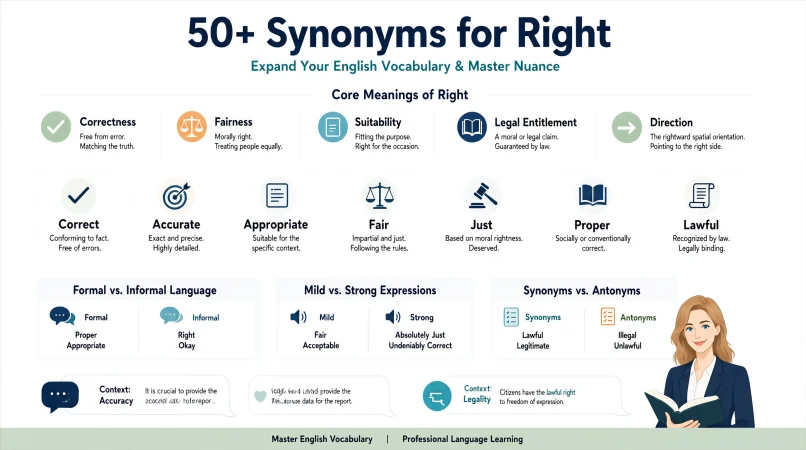
Right can mean correct, morally fair, suitable, or located on the opposite side of left. Common synonyms include correct, accurate, proper, appropriate, just, and lawful. Use formal alternatives in professional writing, conversational words in everyday speech, and precise terms when discussing facts, ethics, or directions.
Do you use the word right repeatedly in essays, emails, conversations, captions, or professional documents? This common English word has several meanings, so replacing it with the wrong synonym can change your message completely.
For example, correct means free from mistakes, appropriate means suitable for a situation, just can describe fairness, and rightward describes a direction. Each alternative serves a different purpose.
This guide explains synonyms for right with clear definitions, natural American English examples, and practical recommendations for academic writing, workplace communication, everyday conversations, and creative content. You will learn how to select the most accurate word for your intended meaning.
Meaning, Tone and Context
1. Simple Definition
The word right has several meanings depending on the sentence.
It can describe something that is correct, something that follows moral principles, something that is suitable, a legal entitlement, or a direction.
Examples:
- Your answer is right. This means it is correct.
- You made the right decision. This means the decision was suitable.
- Everyone deserves equal rights. Here, rights means entitlements or freedoms.
- Turn right at the next street. Here, right indicates direction.
Understanding the intended meaning is essential before choosing a synonym.
2. Part of Speech
Right can function as several parts of speech.
| Part of speech | Meaning | Example |
| Adjective | Correct, suitable, or morally fair | That is the right answer. |
| Noun | An entitlement, freedom, or claim | Everyone has the right to speak. |
| Adverb | Correctly or toward the right side | You guessed right. |
| Verb | To correct or repair a wrong | The organization promised to right the injustice. |
3. Tone and Connotation
Right is generally neutral or positive.
When it means correct, it communicates accuracy. When it refers to morality, it suggests fairness or ethical behavior. Also When it means suitable, it expresses a good match for a particular purpose.
However, the word can carry different meanings in political, legal, and directional contexts. The surrounding sentence determines which interpretation applies.
4. Formality Level
Right is appropriate in both formal and informal English.
In academic writing, accurate, valid, or correct may be more precise. In professional communication, appropriate, suitable, or compliant may better express the intended meaning.
Also In everyday conversation, right, correct, and okay often sound more natural than technical alternatives.
5. Common Use Cases
The word appears in many situations:
- Education, tests, and factual explanations.
- Workplace decisions and professional communication.
- Ethics, fairness, and personal values.
- Laws, freedoms, and legal entitlements.
- Directions, navigation, and location.
- Product selection and personal preferences.
- Grammar, writing, and editing.
- Agreements and everyday conversations.
6. Related Word Forms
| Word | Part of speech | Meaning | Example |
| Right | Adjective, noun, adverb, verb | Correct, fair, an entitlement, or a direction | You chose the right option. |
| Rightly | Adverb | Correctly or justifiably | She was rightly praised for her work. |
| Righteous | Adjective | Morally upright | He fought for a righteous cause. |
| Righteousness | Noun | Moral integrity or virtue | The story explores justice and righteousness. |
| Rightful | Adjective | Legally or morally entitled | She reclaimed her rightful position. |
| Rightfully | Adverb | In a justified or legitimate manner | The award was rightfully given to the winner. |
| Righten | Verb, uncommon | To make right or correct | This word is rare and is usually better replaced with correct or rectify. |
Not every related word is interchangeable with right. For instance, righteous specifically concerns morality, while rightful concerns a legitimate claim or entitlement.
When and How to Use “Right”
Use right when you want to express correctness, fairness, suitability, entitlement, or direction. Before replacing it, identify which meaning the sentence requires.
Here are seven practical examples.
- Professional: “We need the right strategy to improve customer retention.”
- Academic: “The researcher selected the correct method for analyzing the data.”
- Personal: “Choosing to spend more time with family felt right.”
- Email: “Please confirm that the attached figures are accurate.”
- Social media: “The right people make ordinary moments unforgettable.”
- Resume: “Selected appropriate tools to improve reporting accuracy.”
- Casual conversation: “You were right about the restaurant.”
The examples demonstrate that right does not always have the same replacement. Correct works for factual accuracy, appropriate describes suitability, and accurate is especially useful when discussing information or measurements.
Another Word for “Right”
The best single replacement for right is usually correct when you mean that something is free from mistakes. For other meanings, the best synonym changes.
| Situation | Best alternative | Example |
| Professional writing | Appropriate | We selected the appropriate strategy for the project. |
| Academic writing | Correct | The student applied the correct formula. |
| Casual conversation | Okay | This time works for me. |
| Emotional writing | Just | She wanted a just outcome for everyone involved. |
| Creative writing | Fitting | The quiet ending was fitting for the story. |
| Resume or workplace use | Accurate | Maintained accurate records of client transactions. |
| Social media captions | Perfect | The perfect moment can turn an ordinary day into a memory. |
| Stronger meaning | Unquestionably correct | The evidence supports an unquestionably correct conclusion. |
| Softer meaning | Suitable | This may be a suitable option for your needs. |
These alternatives apply to different meanings of right. Perfect suggests an exceptionally good match, while suitable makes a more moderate claim. Neither should automatically replace right in every sentence.
When Not to Use “Right”
The word can be too general when readers need a precise explanation.
1. When You Mean Factual Accuracy
Instead of: “The information is right.”
Write: “The information is accurate.”
Accurate is particularly useful for statistics, measurements, reports, and records.
2. When You Mean Suitability
Instead of: “This is the right tool for the job.”
Write: “This is the most appropriate tool for the job.”
Appropriate emphasizes suitability for a particular purpose or situation.
3. When You Mean Fairness
Instead of: “The decision was right.”
Write: “The decision was fair.”
Use fair when the main concern is impartial treatment, equal consideration, or reasonable judgment.
4. When You Mean a Legal Entitlement
Instead of: “Employees have the right to request their records.”
Write: “Employees have a legal entitlement to request their records,” if that entitlement is established under the applicable rules.
A legal right is not interchangeable with a general moral preference. Avoid implying a legal guarantee without checking the relevant law.
5. When You Mean a Direction
Instead of: “Go right at the corner.”
Write: “Turn right at the corner.”
In directional contexts, right is already the natural word. Alternatives such as rightward are generally less conversational.
6. When You Mean a Corrected Mistake
Instead of: “We need to make the error right.”
Write: “We need to correct the error.”
Use correct for fixing mistakes and rectify when a more formal description of correcting a problem is appropriate.
Words Commonly Confused With “Right”
The meaning of right changes considerably across contexts. These six words are especially useful to distinguish.
| Word | Difference from right | Best used for |
| Correct | Free from mistakes or errors | Answers, calculations, facts |
| Accurate | Faithfully representing facts or measurements | Data, reports, records |
| Appropriate | Suitable for a situation or purpose | Behavior, language, choices |
| Fair | Impartial or reasonable | Decisions, treatment, rules |
| Just | Morally fair or consistent with justice | Ethics, rights, social issues |
| Proper | Conforming to accepted standards or requirements | Procedures, conduct, formal instructions |
For example, an answer can be correct because it matches the facts. A report can be accurate because its details faithfully represent the evidence. A response can be appropriate because it suits the occasion.
A fair decision does not necessarily guarantee that every person receives the same outcome. Fairness often depends on the circumstances and the standards being applied.
Best Synonym by Context for “Right”
| Context | Best synonym | Why it works | Example |
| Formal writing | Appropriate | Expresses suitability clearly | The committee selected an appropriate procedure. |
| Academic writing | Correct | Clearly identifies an answer or method without errors | The student used the correct equation. |
| Professional communication | Suitable | Focuses on practical fit | We identified a suitable vendor for the project. |
| Resume | Accurate | Emphasizes reliable information | Maintained accurate inventory records. |
| Casual conversation | Okay | Communicates acceptance or agreement in informal speech | That time is okay with me. |
| Creative writing | Fitting | Suggests a meaningful match to the situation | The final scene was fitting. |
| Emotional writing | Just | Emphasizes fairness and moral concern | They hoped for a just resolution. |
| Strong factual emphasis | Definitive | Suggests a conclusive answer when evidence supports it | The test provided a definitive result. |
| Soft or moderate tone | Reasonable | Communicates a defensible or sensible choice | That seems like a reasonable compromise. |
| Social media captions | Perfect | Expresses an especially good fit | The perfect place for a quiet afternoon. |
| Legal context | Lawful | Describes something permitted by law | The court examined whether the search was lawful. |
| Data and statistics | Accurate | Emphasizes faithful representation of information | The figures are accurate. |
| Ethics and fairness | Equitable | Emphasizes fairness while accounting for relevant differences | The program aims to provide equitable access. |
| Directions | Rightward | Describes movement toward the right side | The arrow points rightward. |
| Editing and proofreading | Correct | Indicates that an error has been fixed | The editor supplied the correct spelling. |
Choose the synonym that matches the intended meaning rather than relying on a single replacement throughout the article.
Which Synonym Should You Choose?
Use these five questions to find the best alternative.
- What does right mean in the sentence? If it means correct, choose correct or accurate. If it means fair, consider fair, just, or equitable.
- How formal is the writing? Appropriate, lawful, and accurate work well in many professional contexts. Okay is more conversational.
- How strong should the statement be? Reasonable expresses a measured judgment, while definitive suggests a conclusive result.
- Does the word carry emotional meaning? Just can communicate moral concern, whereas correct usually emphasizes factual accuracy.
- Does the replacement preserve the original meaning? Read the full sentence after substituting the word. If the sentence becomes inaccurate or changes its meaning, select another alternative.
The most effective vocabulary choice is the one that tells readers exactly what you mean.
Real Life Examples of “Right” in Sentences
These examples show how alternatives can improve clarity in different situations.
| Situation | Example sentence |
| School | The student chose the correct answer after reviewing the lesson. |
| Workplace | We selected an appropriate solution for the customer’s problem. |
| Writing | The author used the proper term to explain the concept. |
| Conversation | You were correct about the meeting time. |
| Social media | The perfect people make the simplest moments memorable. |
| Resume | Maintained accurate records and verified transaction details. |
| Please confirm that the figures in the attached report are accurate. | |
| Storytelling | After years of uncertainty, she finally believed she had made a just decision. |
| Legal discussion | The attorney explained the client’s legal rights. |
| Directions | Turn right at the next intersection. |
The best replacement depends on what the example is trying to communicate. In a resume, accurate describes reliable work. In a story, just can convey moral judgment. Also In navigation, right remains the clearest choice.
25 Synonyms for “Right”
The word right has several meanings depending on the context. It can describe something that is correct, fair, suitable, legally permitted, or morally acceptable. It can also refer to direction.
The following 25 synonyms cover these different meanings, along with simple definitions, common uses, and example sentences.
Synonyms for Right Meaning Correct or Accurate
These words are useful when discussing facts, answers, information, and actions that meet accepted standards.
| Synonym | Simple Meaning | Best Used For | Example Sentence |
|---|---|---|---|
| 1. Correct | Free from mistakes | Answers and facts | Your calculation is correct. |
| 2. Accurate | Faithful to the facts | Data and measurements | The survey provides accurate results. |
| 3. Proper | Following accepted standards | Procedures and behavior | Please follow the proper application process. |
| 4. Valid | Supported by acceptable reasoning or rules | Arguments and evidence | The reviewer made a valid point. |
| 5. Sound | Based on sensible reasoning or reliable principles | Decisions and judgments | The board reached a sound conclusion. |
| 6. Rectified | Corrected or put right | Reports and formal communication | The accounting error was rectified. |
| 7. Correctly | In a correct manner | Instructions and explanations | The form was completed correctly. |
Synonyms for Right Meaning Suitable or Appropriate
These alternatives describe something that fits a particular purpose, situation, or set of circumstances.
| Synonym | Simple Meaning | Best Used For | Example Sentence |
|---|---|---|---|
| 8. Appropriate | Suitable for a situation | Professional communication | Choose appropriate language for the audience. |
| 9. Suitable | A good fit for a purpose | Choices and recommendations | This course is suitable for beginners. |
| 10. Apt | Particularly fitting or well chosen | Comments and descriptions | Her apt observation clarified the issue. |
| 11. Fitting | Appropriate to the circumstances | Creative and personal writing | The tribute was fitting for the occasion. |
| 12. Reasonable | Sensible and defensible | Everyday decisions | That is a reasonable request. |
| 13. Perfect | Exactly suited to a purpose or ideal | Casual descriptions and captions | This is the perfect spot for a picnic. |
Synonyms for Right Meaning Fair or Morally Correct
Use these words when discussing justice, ethics, fairness, personal character, or responsible behavior.
| Synonym | Simple Meaning | Best Used For | Example Sentence |
|---|---|---|---|
| 14. Fair | Impartial or reasonable | Decisions and treatment | The manager made a fair decision. |
| 15. Just | Morally fair or consistent with justice | Ethics and social issues | They demanded a just resolution. |
| 16. Equitable | Fair while considering relevant differences | Policy and resource allocation | The program promotes equitable access to education. |
| 17. Righteous | Morally upright | Ethical or literary descriptions | The character believed he was fighting a righteous cause. |
| 18. Ethical | Consistent with moral principles | Business and professional conduct | The company adopted an ethical policy. |
| 19. Upright | Honest and morally principled | Character descriptions | She was known as an upright leader. |
| 20. Deserved | Earned or merited | Recognition and rewards | The team received its deserved recognition. |
Synonyms for Right Meaning Legal or Legitimate
These expressions are especially useful in legal, professional, and formal contexts.
| Synonym | Simple Meaning | Best Used For | Example Sentence |
|---|---|---|---|
| 21. Lawful | Permitted by law | Legal discussions | The court reviewed whether the action was lawful. |
| 22. Legitimate | Valid or justified under relevant rules or circumstances | Claims and authority | She raised a legitimate concern. |
| 23. Rightful | Legally or morally entitled | Ownership and authority | The rightful owner reclaimed the property. |
Synonyms for Right Meaning Correction or Direction
These terms describe the act of correcting a problem or movement toward the right-hand side.
| Synonym | Simple Meaning | Best Used For | Example Sentence |
|---|---|---|---|
| 24. Corrective | Intended to correct an error or problem | Workplace and technical writing | The team introduced corrective measures. |
| 25. Rightward | Toward the right side | Directions and movement | The arrow points rightward. |
How to Choose the Right Synonym for “Right”
The best synonym depends on the intended meaning and the sentence in which it appears.
- For correct answers or facts: Use correct or accurate.
- For suitable choices: Choose appropriate, suitable, or apt.
- For fairness and justice: Use fair, just, or equitable.
- For legal matters: Choose lawful, legitimate, or rightful.
- For moral character: Use ethical, upright, or righteous.
- For correcting mistakes: Choose rectified or corrective.
- For direction: Use rightward.
Remember that these alternatives are not interchangeable in every context. Correctly is an adverb, rightward describes direction, and lawful specifically concerns legality. For ordinary factual statements, correct is often the simplest and most natural substitute.
Synonym Groups and Usage Differences
Professional vs. Personal Synonyms
Professional communication benefits from precise, objective vocabulary. Use accurate for information, appropriate for behavior or choices, valid for arguments, and lawful for actions permitted by law.
Personal communication allows more flexibility. Fair, just, perfect, and fitting can express personal judgments, emotional reactions, or a sense that something matches the situation.
Professional example: “The team verified the accuracy of the financial records.”
Personal example: “It felt right to spend the weekend with my family.”
The first emphasizes evidence. The second communicates a personal sense of suitability.
Formal vs. Conversational Synonyms
| Formal expression | Conversational alternative |
| Appropriate | Right for the situation |
| Accurate | Correct |
| Equitable | Fair |
| Lawful | Allowed by law |
| Rectified | Fixed |
| Reasonable | Fair enough or sensible |
Formal language is helpful in reports, essays, policies, and workplace documents. Conversational alternatives are often clearer in texts and everyday discussions.
For example, “The error has been rectified” sounds formal. “The error has been fixed” is more natural in an informal conversation.
Academic Synonyms
Academic writing benefits from words that distinguish factual accuracy, logical validity, and ethical fairness.
Correct is suitable for answers and calculations. Accurate describes faithful representation of facts. Valid describes an argument, inference, or method that meets relevant standards. Sound often emphasizes reliable reasoning.
Example: “The researchers used an appropriate method and reported accurate measurements.”
This sentence communicates two distinct qualities rather than treating them as interchangeable.
Professional and Business Synonyms
| Business purpose | Recommended word | Example |
| Verifying records | Accurate | The team maintained accurate client records. |
| Selecting a method | Appropriate | We selected an appropriate testing procedure. |
| Evaluating a proposal | Sound | The committee approved a sound business plan. |
| Checking a claim | Valid | The analyst raised a valid concern. |
| Discussing compliance | Lawful | The company reviewed whether the process was lawful. |
| Correcting an error | Rectified | The discrepancy was rectified before publication. |
| Giving feedback | Constructive | The supervisor offered constructive feedback. |
For resumes, concrete accomplishments are more persuasive than vague statements such as “always makes the right decisions.”
A stronger, evidence based description might be: “Verified transaction records and corrected discrepancies before monthly reporting.” Use this wording only if it accurately describes your work.
Creative or Literary Synonyms
Creative writing can use righteous, fitting, just, and perfect to communicate character, emotion, or narrative meaning.
Righteous often suggests strong moral conviction. Just emphasizes fairness. Fitting suggests that an action or ending suits the circumstances.
Example: “After years of conflict, the characters finally received a just ending.”
This wording gives the outcome a moral dimension that the more neutral word correct would not convey.
Slang or Modern Synonyms
There is no single slang word that replaces every meaning of right.
In casual American English, expressions such as spot on can mean exactly correct, while legit can mean genuine or credible in informal contexts. Okay can express acceptance, but it does not necessarily mean that something is morally right or factually correct.
Examples:
- “Your explanation was spot on.”
- “That seems legit.”
- “Okay, let’s meet at six.”
Avoid using informal expressions such as legit in formal research writing unless you are discussing the expression itself.
Strongest vs. Weaker Synonyms
The strength of a synonym depends on the meaning being expressed. This practical scale focuses on certainty when evaluating a factual answer.
Mild or conversational
Seems right, reasonable, suitable
Useful when expressing a tentative opinion or a moderate judgment.
Clear and neutral
Correct, proper, appropriate
Suitable for everyday facts, instructions, and decisions.
Precise or evidence focused
Accurate, valid, lawful
Appropriate when discussing evidence, reasoning, or legal standards.
Conclusive when justified
Definitive, indisputable
Use only when the evidence genuinely supports a conclusive statement.
These words do not form a universal ranking. For example, lawful describes legality rather than certainty, while indisputable emphasizes that a claim is not reasonably open to dispute.
Emotional vs. Neutral Synonyms
| Neutral expression | Additional implication |
| Correct | Factual accuracy |
| Accurate | Reliable representation of information |
| Appropriate | Suitability for the situation |
| Fair | Impartial or reasonable treatment |
| Just | Moral fairness |
| Righteous | Strong moral conviction |
| Perfect | An exceptionally good fit |
| Legitimate | Valid or justified under relevant standards |
Choose neutral words when objectivity matters. Use emotionally expressive alternatives when describing values, personal judgments, or the moral meaning of an event.
Antonyms of “Right”
The opposite of right depends on its meaning. For factual accuracy, the opposite may be incorrect. For moral fairness, it may be unjust. Also For direction, it is left.
The following 15 contrasting terms cover the main meanings of the word.
| Antonym | Meaning | Example sentence |
| 1. Wrong | Incorrect or mistaken | Your answer is wrong. |
| 2. Incorrect | Not factually correct | The report contains an incorrect figure. |
| 3. Inaccurate | Not representing the facts faithfully | The article includes inaccurate information. |
| 4. Improper | Not following accepted standards | The employee used an improper procedure. |
| 5. Inappropriate | Unsuitable for the situation | That comment was inappropriate for the meeting. |
| 6. Unfair | Not impartial or reasonable | The policy seems unfair to part time workers. |
| 7. Unjust | Contrary to justice or moral fairness | The decision was widely criticized as unjust. |
| 8. Unlawful | Contrary to law | The court found the action unlawful. |
| 9. Illegitimate | Not valid or lawfully established in the relevant context | The review questioned the legitimacy of the claim. |
| 10. Invalid | Not legally or logically acceptable under relevant standards | The argument relied on an invalid assumption. |
| 11. Unsuitable | Not appropriate for a purpose | The material is unsuitable for outdoor use. |
| 12. Unreasonable | Not sensible or justified | The deadline was unreasonable. |
| 13. Unethical | Contrary to accepted moral principles | The company rejected the unethical proposal. |
| 14. Left | The direction opposite to right | Turn left at the next intersection. |
| 15. Wrongful | Unjustified, unlawful, or morally wrong, depending on context | The court considered whether the dismissal was wrongful. |
These are contextual antonyms rather than exact opposites in every sentence. Left is the directional opposite of right, while wrong is the most general opposite when right means correct.
Comparison: “Right” vs. Similar Words
Right vs. Correct
Main difference: Right can refer to correctness, fairness, suitability, direction, or entitlement. Correct specifically emphasizes freedom from mistakes.
Which is stronger? Neither is inherently stronger.
Which is more formal? Correct is often more precise in academic and technical contexts.
Examples:
- “You made the right choice.”
- “Your answer is correct.”
Right vs. Accurate
Main difference: Accurate means faithfully representing facts, details, or measurements. Right can have a broader meaning.
Which is stronger? Accurate is more specific about precision.
Which is more formal? Accurate is especially suitable for technical reports and data analysis.
Examples:
- “You were right about the meeting.”
- “The report contains accurate measurements.”
Right vs. Appropriate
Main difference: Appropriate means suitable for a particular purpose or situation. Right can also indicate correctness or moral fairness.
Which is stronger? Neither is stronger, but appropriate is more specific about suitability.
Which is more formal? Appropriate is often preferred in professional communication.
Examples:
- “We chose the right person for the role.”
- “We selected an appropriate response to the complaint.”
Right vs. Fair
Main difference: Fair focuses on impartiality and reasonable treatment. Right can describe a decision as correct, suitable, or morally acceptable.
Which is stronger? Neither is universally stronger.
Which is more formal? Both work in formal writing. Fair is more specific when discussing equal treatment.
Examples:
- “She made the right decision.”
- “The manager treated everyone fairly.”
Right vs. Just
Main difference: Just often emphasizes moral fairness or justice. Right has broader meanings.
Which is stronger? Just may carry a stronger ethical emphasis.
Which is more formal? Both are appropriate in formal discussions of ethics and law.
Examples:
- “He believed his decision was right.”
- “He wanted a just outcome for the affected families.”
Right vs. Proper
Main difference: Proper emphasizes accepted standards, procedures, or expected behavior. Right can refer to correctness more generally.
Which is stronger? Neither is inherently stronger.
Which is more formal? Proper is common in formal instructions and procedural writing.
Examples:
- “We chose the right method.”
- “Please follow the proper procedure.”
Common Phrases and Expressions with “Right”
1. Right Away
Meaning: Immediately or without delay.
Example sentence: “I will send you the revised document right away.”
2. All Right
Meaning: Acceptable, satisfactory, or in good condition.
Example sentence: “The revised schedule looks all right to me.”
3. Right on Time
Meaning: At the exact expected time.
Example sentence: “The delivery arrived right on time.”
4. Get Something Right
Meaning: Do something correctly or understand it accurately.
Example sentence: “Practice regularly until you get the pronunciation right.”
5. Make Things Right
Meaning: Correct a mistake or resolve an unfair situation.
Example sentence: “The company offered a refund to make things right.”
6. In the Right
Meaning: Correct or justified in a disagreement or dispute.
Example sentence: “After reviewing the evidence, the mediator concluded that she was in the right.”
7. Right Under Your Nose
Meaning: In a very obvious or nearby place that you failed to notice.
Example sentence: “The missing keys were right under your nose the entire time.”
8. Right as Rain
Meaning: In good health or working properly.
Example sentence: “After a good night’s sleep, I felt right as rain.”
These expressions are useful in everyday American English. Their meanings sometimes differ from the literal meanings of the individual words, so learn them as complete phrases.
Common Mistakes to Avoid
1. Using “Right” When a More Precise Word Is Better
Instead of “The data is right,” consider “The data is accurate.”
The second sentence emphasizes the reliability of the information.
2. Confusing “Right” With “Fair”
A decision can be factually correct without being fair to everyone involved.
Use fair when you mean impartial treatment, and correct when you mean factual accuracy.
3. Using Casual Language in Formal Writing
Words such as okay or spot on may sound too conversational in a formal report.
Use appropriate, accurate, or valid when those terms express the intended meaning.
4. Choosing an Overly Dramatic Word
Indisputable suggests that a claim cannot reasonably be challenged. It is too strong for an ordinary opinion.
Use reasonable or well supported when the evidence allows some uncertainty.
5. Repeating “Right” Too Often
Repeated use can make your writing vague.
Instead of saying “the right answer, the right approach, and the right method,” consider “the correct answer, the appropriate approach, and the most effective method.”
6. Choosing the Wrong Emotional Tone
Righteous conveys moral conviction, while accurate is more objective.
Choose the word that matches your purpose rather than using a dramatic alternative simply to sound impressive.
7. Confusing Legal Rights With General Preferences
A person may feel that something is right without having a legal right to demand it.
Use legal right, entitlement, or lawful when discussing legal matters, and verify the relevant rules before making legal claims.
FAQs
1. What is the best synonym for right?
The best synonym for right is usually correct when discussing facts or answers. Use appropriate for suitability, fair for impartiality, and lawful for legal permission.
2. What is a formal synonym for right?
Appropriate, accurate, valid, and lawful are useful formal alternatives. Choose appropriate for suitability, accurate for factual precision, valid for acceptable reasoning, and lawful for legal compliance.
3. What is an informal synonym for right?
Okay can mean acceptable, while spot on means exactly correct in casual American English. Neither replaces every meaning of right, especially legal or directional meanings.
4. What is another word for right in professional writing?
Appropriate works for choices and procedures, accurate for records, and valid for arguments. Use the alternative that describes the specific quality being evaluated.
5. What is the difference between right and correct?
Right has several meanings, including correct, fair, suitable, and a direction. Correct specifically means free from mistakes or errors.
6. What is the opposite of right?
The opposite depends on context. Wrong or incorrect contrasts with factual correctness, unjust contrasts with moral fairness, and left is the opposite direction.
Conclusion
The word right can describe correctness, suitability, fairness, morality, legal entitlement, or direction. Choosing an accurate synonym depends on which meaning you want to communicate.
Use correct for answers, accurate for information, appropriate for suitability, fair or just for ethical judgments, and lawful for actions permitted by law. In casual conversations, okay and spot on can sound natural when their meanings fit.
The most useful vocabulary tip is to identify the meaning of right before replacing it. A precise word makes your writing clearer, more natural, and easier for readers to understand.